
Artists Profile
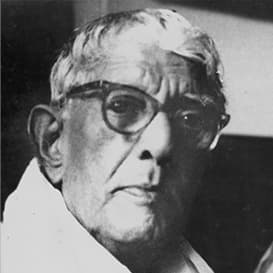
Jamini Roy
Jamini Roy was a pioneering figure of modern Indian art, best known for developing a distinctive visual language rooted in Bengali folk traditions. Born in 1887 in Beliatore, Bankura district, then part of the Bengal Presidency under British India, he trained at the Government School of Art, Kolkata, where he initially worked within a British academic-realist framework, producing landscapes and portraits in a post-Impressionist idiom.
By the mid-1920s, Roy had decisively turned away from Western naturalism, drawing instead on the visual idioms of Kalighat patachitra and rural Bengali folk art. This shift marked a radical reorientation in his practice, as he embraced flattened pictorial space, bold outlines, and earthy, primary colour palettes. He also experimented with unconventional supports such as woven mats, cloth, and wood treated with lime, often citing Byzantine mosaics as a formal inspiration for their textured, grid-like surfaces.
Roy’s subjects included Santhal communities, rural life, Hindu mythology, Christian iconography, and figures such as the mother and child and Radha, all rendered in simplified, rhythmic forms. His practice blended elements of folk, tribal, and temple traditions, particularly terracotta reliefs from sites such as Bishnupur, while maintaining a highly controlled and deliberate line.
Roy received the Viceroy’s Gold Medal in 1935, the Padma Bhushan in 1954, and was elected a fellow of the Lalit Kala Akademi in 1956. Declared a National Treasure artist in 1976, his works are now held in major public and private collections internationally.
He passed away in 1972.
By the mid-1920s, Roy had decisively turned away from Western naturalism, drawing instead on the visual idioms of Kalighat patachitra and rural Bengali folk art. This shift marked a radical reorientation in his practice, as he embraced flattened pictorial space, bold outlines, and earthy, primary colour palettes. He also experimented with unconventional supports such as woven mats, cloth, and wood treated with lime, often citing Byzantine mosaics as a formal inspiration for their textured, grid-like surfaces.
Roy’s subjects included Santhal communities, rural life, Hindu mythology, Christian iconography, and figures such as the mother and child and Radha, all rendered in simplified, rhythmic forms. His practice blended elements of folk, tribal, and temple traditions, particularly terracotta reliefs from sites such as Bishnupur, while maintaining a highly controlled and deliberate line.
Roy received the Viceroy’s Gold Medal in 1935, the Padma Bhushan in 1954, and was elected a fellow of the Lalit Kala Akademi in 1956. Declared a National Treasure artist in 1976, his works are now held in major public and private collections internationally.
He passed away in 1972.

KNOW MORE
Buy
Sell
Request an Estimate
FAQs
Seller Terms
Store Terms
SERVICES
Client Advisory
Restoration
DOWNLOAD THE APP


Copyright 2026 AstaGuru. All Rights Reserved


