
Artists Profile
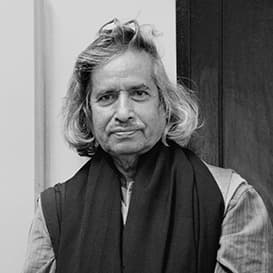
Jogen Chowdhury
Jogen Chowdhury was born in 1939 in a village near Kotalipara, in the Faridpur district of what is now Bangladesh. He entered the Government College of Art and Crafts in 1955 and graduated in 1960. Chowdhury subsequently moved to Paris, where he studied at the École des Beaux-Arts and William Hayter’s Atelier 17. He returned to India in 1967.
In 1968, Chowdhury moved to Chennai and began working as a textile designer for the Madras Handloom Board. His first book of poems was published in 1970, the same year he joined the Calcutta Painters Group. In 1987, he joined Kala Bhavana, Santiniketan, as a professor of painting.
Chowdhury’s distinctive use of colour and light, coupled with his ability to capture the essence of Indian culture, set his work apart. The sinuous lines contouring his fleshy figures and the cross-hatching used to achieve tonal variations became defining characteristics of his paintings. His works frequently depict men and women in enigmatic situations, their provocative gestures set within dark, dreamlike spaces.
Although Chowdhury often addressed weighty themes such as violence, poverty and inequality, his art also conveyed a spirit of possibility and hope. As the artist himself stated, “I want my paintings to be like sunlight in the darkness.” In 2019, Chowdhury established the Jogen Chowdhury Centre for Arts in Kolkata, where he brought together and exhibited a collection of artworks accumulated over the course of his career. Through the centre, he sought to foster greater curiosity about visual art and cultural activities. Its expansive galleries also accommodate artist residencies, creating a space for artistic exchange and engagement.
Jogen Chowdhury passed away on 25 October 2026. His legacy endures through his distinctive visual language and his significant contribution to modern Indian art.

KNOW MORE
Buy
Sell
Request an Estimate
FAQs
Seller Terms
Store Terms
SERVICES
Client Advisory
Restoration
DOWNLOAD THE APP


Copyright 2026 AstaGuru. All Rights Reserved


