
Artists Profile
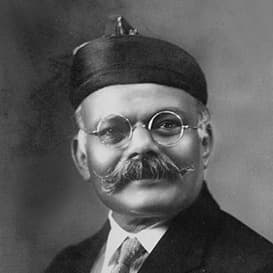
M V Dhurandhar
Mahadeo Vishwanath Dhurandhar (1867–1944) was one of the most accomplished and influential artists of late nineteenth- and early twentieth-century India. Born into the Pathare Prabhu community in Kolhapur, he received his formal training at the prestigious Sir J J School of Art, where he excelled under the guidance of the renowned principal John Griffiths. His academic rigour and exceptional draughtsmanship earned him numerous prizes and scholarships, laying the foundation for a distinguished artistic career.
Working within the European academic tradition, Dhurandhar developed a uniquely Indian visual language that bridged Western realism with indigenous themes. His oeuvre encompassed religious, mythological, historical and social subjects, alongside portraits, landscapes, and genre scenes that vividly documented contemporary Indian life. Through depictions of festivals, weddings, pilgrimages, courtrooms, and street scenes, he emerged as a keen chronicler of Maharashtrian society and the broader Bombay Presidency.
Beyond painting, Dhurandhar was a pioneering figure in applied arts. He produced illustrations for books and periodicals, designed postcards, advertisements, posters, and book covers, and contributed to the visual culture of modern India through widely circulated prints and publications. His illustrations appeared in notable works such as By-Ways of Bombay and Women of India, while his association with the Ravi Varma Press further expanded his public reach.
A respected educator and administrator, Dhurandhar spent much of his career teaching at Sir J J School of Art and mentoring a generation of artists associated with the Bombay School. In 1930, he became the first Indian to serve as Acting Director of the institution. Honoured with the title of Rao Bahadur in 1927, Dhurandhar remains celebrated for his role in shaping modern Indian art and for creating a body of work that successfully united European academic techniques with Indian subjects and sensibilities.
Working within the European academic tradition, Dhurandhar developed a uniquely Indian visual language that bridged Western realism with indigenous themes. His oeuvre encompassed religious, mythological, historical and social subjects, alongside portraits, landscapes, and genre scenes that vividly documented contemporary Indian life. Through depictions of festivals, weddings, pilgrimages, courtrooms, and street scenes, he emerged as a keen chronicler of Maharashtrian society and the broader Bombay Presidency.
Beyond painting, Dhurandhar was a pioneering figure in applied arts. He produced illustrations for books and periodicals, designed postcards, advertisements, posters, and book covers, and contributed to the visual culture of modern India through widely circulated prints and publications. His illustrations appeared in notable works such as By-Ways of Bombay and Women of India, while his association with the Ravi Varma Press further expanded his public reach.
A respected educator and administrator, Dhurandhar spent much of his career teaching at Sir J J School of Art and mentoring a generation of artists associated with the Bombay School. In 1930, he became the first Indian to serve as Acting Director of the institution. Honoured with the title of Rao Bahadur in 1927, Dhurandhar remains celebrated for his role in shaping modern Indian art and for creating a body of work that successfully united European academic techniques with Indian subjects and sensibilities.

KNOW MORE
Buy
Sell
Request an Estimate
FAQs
Seller Terms
Store Terms
SERVICES
Client Advisory
Restoration
DOWNLOAD THE APP


Copyright 2026 AstaGuru. All Rights Reserved


