
Artists Profile
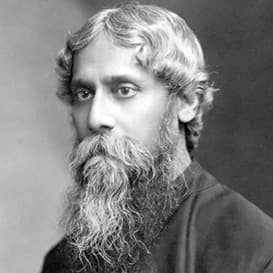
Rabindranath Tagore
Rabindranath Tagore, born in 1861, was widely celebrated as a poet and Nobel laureate and developed a remarkably original visual art practice relatively late in life, beginning to paint in his sixties. Despite having no formal academic training, he went on to produce thousands of works, emerging as one of the most distinctive modernist voices in early 20th-century art.
Tagore’s entry into painting evolved organically from his manuscripts, where he would transform erasures and doodles into imaginative forms. These spontaneous beginnings shaped a deeply intuitive approach to art-making, free from rigid conventions. His paintings are characterised by bold, simplified forms, rhythmic compositions, and a dreamlike, often introspective quality. Human faces, frequently mask-like, distorted, and emotionally charged, became a central motif, reflecting an interest in psychological depth and the subconscious. His figures, sometimes theatrical and enigmatic, reveal the influence of his experience in drama and performance.
Unlike the prevailing Bengal School led by his nephew Abanindranath Tagore, Tagore’s visual language resisted revivalist nationalism and instead aligned more closely with international modernist tendencies. His work shows affinities with artists such as Wassily Kandinsky and Paul Klee, as well as an engagement with ideas of psychoanalysis. His imagery, ranging from fantastical creatures to brooding landscapes, often appears to emerge from the subconscious, creating a sense of ambiguity and emotional tension.
Tagore held his first exhibitions in Europe, including Paris, where his work received considerable attention, though it was initially less appreciated in India. Through institutions like Visva-Bharati University and Kala Bhavana, he also helped shape modern art education in India. Today, his paintings are regarded as a vital contribution to global modernism, marking a profound departure from both his literary ideals and traditional artistic norms. He passed away in 1941.
Tagore’s entry into painting evolved organically from his manuscripts, where he would transform erasures and doodles into imaginative forms. These spontaneous beginnings shaped a deeply intuitive approach to art-making, free from rigid conventions. His paintings are characterised by bold, simplified forms, rhythmic compositions, and a dreamlike, often introspective quality. Human faces, frequently mask-like, distorted, and emotionally charged, became a central motif, reflecting an interest in psychological depth and the subconscious. His figures, sometimes theatrical and enigmatic, reveal the influence of his experience in drama and performance.
Unlike the prevailing Bengal School led by his nephew Abanindranath Tagore, Tagore’s visual language resisted revivalist nationalism and instead aligned more closely with international modernist tendencies. His work shows affinities with artists such as Wassily Kandinsky and Paul Klee, as well as an engagement with ideas of psychoanalysis. His imagery, ranging from fantastical creatures to brooding landscapes, often appears to emerge from the subconscious, creating a sense of ambiguity and emotional tension.
Tagore held his first exhibitions in Europe, including Paris, where his work received considerable attention, though it was initially less appreciated in India. Through institutions like Visva-Bharati University and Kala Bhavana, he also helped shape modern art education in India. Today, his paintings are regarded as a vital contribution to global modernism, marking a profound departure from both his literary ideals and traditional artistic norms. He passed away in 1941.

KNOW MORE
Buy
Sell
Request an Estimate
FAQs
Seller Terms
Store Terms
SERVICES
Client Advisory
Restoration
DOWNLOAD THE APP


Copyright 2026 AstaGuru. All Rights Reserved


