
Artists Profile
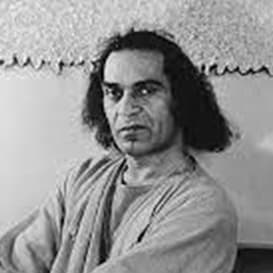
Sohan Qadri
Sohan Qadri (b. 1932) was an Indian-born artist whose practice seamlessly fused spirituality with abstraction, creating meditative works characterised by vibrant colour and rhythmic structure. Born in Chachoki village in Punjab to a prosperous farming family, Qadri’s spiritual journey began early when, at the age of seven, he encountered two mystics residing on his family’s farm—a Bengali Tantric-Vajrayan yogi, Bikham Giri, and the Sufi teacher Ahmed Ali Shah Qadri. Their teachings in meditation, music, and dance profoundly shaped his worldview and laid the foundation for a lifelong engagement with spirituality that would become central to his artistic philosophy.
After briefly seeking spiritual retreat in the Himalayas and Tibetan monasteries, Qadri returned to India and pursued formal training in art, earning his MFA from the Government College of Art in Simla. By the late 1950s he had begun developing a distinctive visual language that gradually moved away from representation toward abstraction inspired by tantric symbolism and meditative experience. In 1965 he left India and travelled widely across Europe, Africa, and North America before eventually settling in Copenhagen, where he lived and worked for much of his life.
Qadri’s work is best known for its innovative use of ink and dye on paper. While he began his career painting in oils on canvas, from the 1970s onwards he worked almost exclusively on paper, soaking, carving, and puncturing its surface before saturating it with luminous pigments. These repetitive incisions—most evident in his celebrated “dot” series—were themselves a meditative act, transforming the flat sheet into a subtly sculptural form. The resulting compositions, often described as a synthesis of Tantric imagery and modernist minimalism, led F. N. Souza to refer to him as the “Tantric yogi artist.”
Over the course of his career, Qadri exhibited extensively in India and internationally, with more than a hundred solo and group exhibitions across Europe, North America, and Asia. His works are held in numerous important collections, including the Peabody Essex Museum, Massachusetts; the Rubin Museum of Art, New York; the National Gallery of Modern Art, New Delhi; the Los Angeles County Museum of Art; and the Royal Ontario Museum, Toronto. Qadri passed away in Toronto in 2011, leaving behind a body of work that continues to resonate for its serene fusion of spiritual practice and modern abstraction.
After briefly seeking spiritual retreat in the Himalayas and Tibetan monasteries, Qadri returned to India and pursued formal training in art, earning his MFA from the Government College of Art in Simla. By the late 1950s he had begun developing a distinctive visual language that gradually moved away from representation toward abstraction inspired by tantric symbolism and meditative experience. In 1965 he left India and travelled widely across Europe, Africa, and North America before eventually settling in Copenhagen, where he lived and worked for much of his life.
Qadri’s work is best known for its innovative use of ink and dye on paper. While he began his career painting in oils on canvas, from the 1970s onwards he worked almost exclusively on paper, soaking, carving, and puncturing its surface before saturating it with luminous pigments. These repetitive incisions—most evident in his celebrated “dot” series—were themselves a meditative act, transforming the flat sheet into a subtly sculptural form. The resulting compositions, often described as a synthesis of Tantric imagery and modernist minimalism, led F. N. Souza to refer to him as the “Tantric yogi artist.”
Over the course of his career, Qadri exhibited extensively in India and internationally, with more than a hundred solo and group exhibitions across Europe, North America, and Asia. His works are held in numerous important collections, including the Peabody Essex Museum, Massachusetts; the Rubin Museum of Art, New York; the National Gallery of Modern Art, New Delhi; the Los Angeles County Museum of Art; and the Royal Ontario Museum, Toronto. Qadri passed away in Toronto in 2011, leaving behind a body of work that continues to resonate for its serene fusion of spiritual practice and modern abstraction.

KNOW MORE
Buy
Sell
Request an Estimate
FAQs
Seller Terms
Store Terms
SERVICES
Client Advisory
Restoration
DOWNLOAD THE APP


Copyright 2026 AstaGuru. All Rights Reserved


