yashwant deshmukh - profile, history, paintings & art style
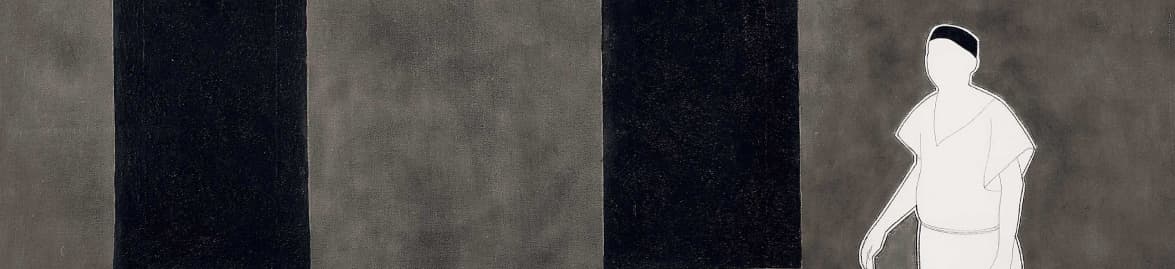
Yashwant Deshmukh is a distinguished contemporary Indian artist celebrated for his contemplative and minimalist approach to art. Born in 1963 in Akola, Maharashtra, Deshmukh has carved a niche for himself in the Indian art scene through his exploration of space, form, and the metaphysical aspects of everyday objects. His works, often rendered in acrylic and graphite on canvas, are known for their subtle interplay of textures, muted colours, and profound symbolism.
Early Life and Education
Deshmukh's artistic journey began in Akola, where he was born and raised. His early fascination with art led him to pursue formal training at the Sir J.J. School of Art in Mumbai, one of India’s most prestigious art institutions. He graduated with a Bachelor of Fine Arts (BFA) degree in 1988. This academic foundation laid the groundwork for his exploration of complex themes such as space, stillness, and the metaphysical dimensions of the mundane.
Artistic Themes and Inspirations
Yashwant Deshmukh draws inspiration from everyday objects and phenomena that surround him—flowers, pots, mirrors, windows, shadows, and even intangible elements like breezes. These seemingly ordinary items serve as conduits for his exploration of space and form. For Deshmukh, painting is not merely a visual exercise but a meditative process that seeks to capture the unseen spaces within and around us.
In his own words: “Painting is to give shape to the space within us; the unseen space one feels through intuition only. My paintings are iconic representations of a self-contained universe”. This philosophical approach imbues his works with a sense of stillness and introspection.
Art Style
Deshmukh’s art style is characterised by minimalism and an emphasis on spatial relationships. He primarily works with acrylic on canvas but also incorporates graphite and pencil into some of his pieces. His colour palette is intentionally subdued, dominated by greys and muted tones. This choice reflects his desire to depict stillness and the absence of movement.
He avoids "fresh" or vibrant colours, as he aims to evoke a sense of timelessness and quietude in his works. The negative spaces in his paintings often play as significant a role as the forms themselves, creating a delicate balance between presence and absence.
Deshmukh’s compositions are meticulously arranged to highlight the metaphysical qualities of objects. Everyday items such as buckets or tea cups are transformed into profound symbols that challenge viewers to perceive their surroundings differently.
Notable Works
Over the years, Yashwant Deshmukh has produced an impressive body of work that includes both paintings and installations. Some of his notable creations include:
"Still Life with Wooden Branch": A painting that explores the interplay between organic forms and negative space.
"Moon at Third Step": A work combining acrylic and graphite on canvas to delve into themes of perception and intuition.
"Contours of Continuum": A solo exhibition presented at Art Alive Gallery in Delhi (2024) that showcased Deshmukh’s mastery over form and space. In this series, everyday objects dissolve into mystical representations, provoking reflections on memory and existence.
His works have been featured in prominent exhibitions such as Monologue (2012) at Tao Art Gallery in Mumbai and Contours of Continuum (2024), further cementing his reputation as one of India’s leading contemporary artists.
Exhibitions and Recognition
Yashwant Deshmukh’s art has been showcased extensively both in solo exhibitions and group shows across India. Some key exhibitions include:
Solo Shows:
. Monologue (2012) at Tao Art Gallery.
. Contours of Continuum (2024) at Art Alive Gallery in Delhi.
. Group Shows:
. Synergy (2012), Tao Art Gallery.
Deshmukh has also received numerous accolades for his contributions to art. Between 1985–1988, he was honoured with awards such as the Kumari Ratan Wadke Award, Shirgaonkar Award, Mayo Award, Maharashtra State Art Award, and Handicapped Welfare Federation Award.
Techniques
Deshmukh employs a unique combination of acrylic paint mixed with marble dust to create textured surfaces that add depth to his canvases. His use of pencil or graphite introduces fine details that contrast with the larger expanses of muted colour.
The artist’s compositions often feature geometric arrangements or abstracted forms that resonate with viewers on an intuitive level. By focusing on spatial relationships rather than overt narratives, Deshmukh invites audiences to engage deeply with his works.
Legacy
Yashwant Deshmukh continues to live and work in Mumbai, where he remains active in exploring new dimensions within his artistic practice. His ability to transform mundane objects into profound artistic statements has made him a significant figure in contemporary Indian art. Through his minimalist yet evocative style, Yashwant Deshmukh challenges conventional perceptions of space, form, and stillness. His works serve as meditative explorations into the essence of existence, offering viewers a chance to pause and reflect amidst life’s chaos. In conclusion, Yashwant Deshmukh’s art stands as a testament to the power of simplicity and introspection. By bridging the tangible with the intangible, he has created a legacy that resonates deeply within India’s modern art landscape.