ardha nareshwar paintings by famous artists
.jpg&w=3840&q=75)
The figure of Ardha Nareshwar (also known as Ardhanarishvara), a composite androgynous form of Lord Shiva and Goddess Parvati embodies the spiritual concept of unity in duality. Half male and half female, this deity is a symbolic representation of balance, cosmic harmony and the inseparable nature of masculine and feminine energies in the universe. Over the decades, this motif has inspired many modern Indian artists, who have each interpreted Ardha Nareshwar through their unique aesthetic and philosophical lens.
To grasp the depth behind these celebrated Ardha Nareshwar paintings, we must first revisit the mythological narrative and symbolic layers that define this iconic fusion of Shiva and Parvati.
Who is Ardha Nareshwar?
Ardha Nareshwar is a revered and unique form of the Hindu deity Shiva combined with his consort Parvati, depicted as one body split equally into male and female halves. The name comes from Sanskrit words ardha meaning "half" nari meaning "woman" and ishvara meaning "lord" thus translating to "the Lord who is half woman". It represents the cosmic balance, the origin of creation, and the harmonious coexistence of opposites such as active/passive, male/female, and spiritual/material. Historically,
Ardha Nareshwar Meaning
The term Ardha Nareshwar, Ardhanarishvara or Ardhanareeshwara means "the Lord who is half woman". This composite form of the Hindu deities Shiva and Parvati merges the masculine and feminine principles into a single figure, typically depicted split vertically one half representing Shiva (Purusha, the passive male aspect) and the other Parvati (Prakriti, the active female aspect). Ardhanarishvara symbolizes the inseparable unity and balance of these cosmic forces, illustrating that both are essential and interdependent dimensions of the divine.
Ardha Nareshwar Historical Background
Ardha Nareshwar iconography dates back to the Kushan period (circa 1st century CE), with the form evolving and reaching artistic maturity during the Gupta era (4th to 6th centuries CE). This deity features prominently in various Hindu scriptures, including the Shiva Purana, Linga Purana, Vayu Purana, and others. These texts recount the origin of Ardhanarishvara in the context of cosmic creation for instance, when Brahma was unable to create women, Shiva manifested as Ardhanarishvara to demonstrate the fundamental unity of male and female forces, thereby enabling creation to continue. Temples dedicated to Ardhanarishvara exist across India, honoring this form as a symbol of creative energy and cosmic balance.
Ardha Nareshwar Significance & Symbolism
Unity of Opposites: Ardhanarishvara represents the perfect synthesis of dualities. Shiva symbolizes asceticism, detachment, and transcendental consciousness, while Parvati embodies fertility, compassion, and worldly engagement. Together, they portray the holistic nature of existence.
Cosmic Creation: The union of Shiva and Parvati in Ardhanarishvara is emblematic of the creative power generated through the dynamic interplay of opposites akin to the metaphysical merging of Linga (masculine principle) and Yoni (feminine principle), which births the cosmos.
Transcendence of Gender: Ardhanarishvara conveys that the ultimate reality transcends conventional gender distinctions. By embodying both male and female aspects, the deity challenges rigid gender constructs and emphasizes spiritual androgyny, balance, and inclusivity.
Harmony Between the Spiritual and Material: This form harmonizes ascetic renunciation (Shiva) with active participation in worldly life (Parvati), teaching that spiritual enlightenment and material existence are not opposing paths, but rather complementary elements of human experience.
Non-Dualism and Totality: Ardhanarishvara embodies the Advaitic (non-dualistic) philosophy of unity in diversity. The fusion of contrasting energies gentle and fierce, passive and active reflects the completeness of the divine, encouraging a vision of wholeness beyond division.
With this foundation in mind, we can now examine how some of India’s most renowned artists have interpreted Ardha Nareshwar each infusing the divine duality with their own creative vision, technique and philosophical outlook. Let us journey through the works of four celebrated artists who have given this ancient icon a renewed visual life on canvas. Among the most compelling and recognized interpretations are the works of Nandalal Bose, Anjolie Ela Menon, M.F. Husain and Shampa Sircar Das. Each artist has reimagined the divine form with a distinct voice, blending mythology with contemporary themes, form and style. Let's explore the details of these 4 famous Ardha Nareshwar paintings by celebrated Indian artists.
1. Ardhanarishvara by Nandalal Bose
One of the pioneering figures of modern Indian art and a key member of the Bengal School, Nandalal Bose approached mythological subjects with a deep spiritual sensibility. His “Ardhanarishvara” painting exemplifies his signature blend of Indian traditional styles and modernist aesthetics.
In Bose’s version, the figure of Ardha Nareshwar is serene and graceful, painted with a subdued palette and elegant line work. The gender duality is rendered delicately with Shiva’s ascetic symbolism on one side and Parvati’s feminine poise on the other. Rather than dramatic contrast, Bose emphasizes oneness, using symmetry and compositional balance to reflect spiritual harmony. His work often carried nationalist undertones, and in this painting, the divine union subtly symbolizes social unity and equilibrium.
• Style and Composition: Nandalal Bose's Ardhanarishvara painting is characterized by its delicate lines, soft colors, and intricate details. The artwork beautifully captures the fusion of Shiva and Parvati, with one half of the figure adorned with masculine attributes and the other half with feminine grace.
• Symbolism: Bose's painting emphasizes the harmony and balance between the masculine and feminine energies. The use of traditional Indian motifs and patterns adds a layer of cultural richness to the artwork.
• Legacy: Nandalal Bose's Ardhanarishvara is not just a visual treat but also a spiritual experience. His ability to convey complex philosophical concepts through simple yet profound imagery has made this painting a timeless masterpiece.
2. Ardhanarishvara by M.F. Husain
A maverick of modern Indian art, M.F. Husain approached mythology with a bold, energetic, and abstract sensibility. His Ardhanarishvara is not a calm deity but a powerful symbol of dynamic balance. M F Husain’s version bursts with movement, broad brushstrokes, intense colors, and fragmented forms come together to create a deity that feels alive and in flux.
Rather than portraying Ardha Nareshwar in perfect symmetry, Husain often used disjointed composition to explore the creative tension between masculine and feminine. Shiva’s side may be angular and fiery, while Parvati’s might flow with curves and softness. This asymmetry reflects the artist’s belief in duality as a creative force rather than a static balance. For Husain, the form was not just divine; it was political, cultural, and deeply personal.
• Style and Composition: Husain's Ardhanarishvara is characterized by its dynamic composition, bold lines, and vibrant colors. The artwork captures the essence of the divine union with a sense of energy and movement.
• Symbolism: Husain's painting emphasizes the balance and harmony between the masculine and feminine energies. The use of traditional Indian motifs and modern artistic techniques adds a layer of cultural richness to the artwork.
• Legacy: M.F. Husain's Ardhanarishvara is a powerful and evocative representation of the divine union. His ability to convey complex philosophical concepts through bold and innovative imagery has made this painting a timeless masterpiece.
3. Ardhanarishvara by Shampa Sircar Das
Contemporary artist Shampa Sircar Das brings a meditative and devotional quality to her Ardhanarishvara works. Known for her spiritual and metaphysical themes, Das paints the divine union with intricate detail, often using motifs like lotuses, third eyes, and sacred geometry to frame her figures.
Her Ardhanarishvara is often depicted in vibrant hues with gold accents, evoking both divinity and transcendence. She emphasizes inner unity, a central theme in her art inviting viewers to see beyond gender, body, and form. In her portrayal, Ardha Nareshwar becomes not just a deity but a symbol of inner wholeness and spiritual awakening.
Das’s attention to texture and sacred symbols often imbues her paintings with a mandala-like quality, guiding the viewer toward contemplation. Her works are frequently showcased in galleries dedicated to spiritual and mythological themes, and they resonate deeply with seekers of visual serenity and philosophical depth.
• Style and Composition: Das's Ardhanarishvara is marked by its delicate lines, intricate details, and soft colors. The figure is depicted with a sense of grace and elegance, capturing the essence of the divine union.
• Symbolism: Das's painting explores the duality and unity of the masculine and feminine principles. The use of traditional Indian motifs and patterns adds a layer of cultural richness to the artwork.
• Legacy: Shampa Sircar Das's Ardhanarishvara is a celebration of the divine feminine and masculine energies. Her unique style and contemporary approach have made this painting a significant contribution to modern Indian art.
4. Ardha Nareshwar by Anjolie Ela Menon
Anjolie Ela Menon, known for her haunting, introspective portraits and Byzantine-inspired textures, brings a deeply contemplative mood to her Ardha Nareshwar interpretation. Her painting is less about literal mythological narrative and more about emotional duality and spiritual introspection.
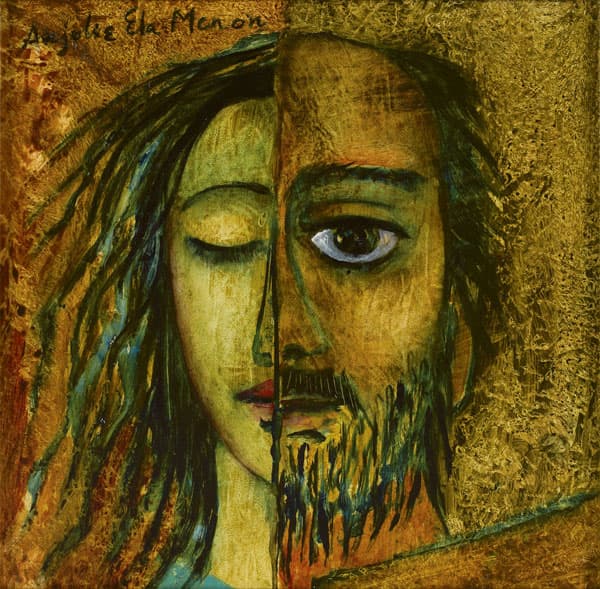 Using her characteristic muted tones, textured backgrounds, and stylized human figures, Menon's Ardha Nareshwar captures a melancholic beauty. The androgynous figure appears timeless, an ethereal fusion of opposites. In Menon's work, the divine duality transcends gender, speaking to the shared soul within all beings. Her use of mixed media and layered symbolism adds psychological depth, suggesting the eternal dance between polarities: light and shadow, strength and gentleness, creation and destruction.
• Style and Composition: Menon's Ardhanarishvara is marked by bold colors, strong lines, and a dynamic composition. The figure is depicted with a sense of movement and energy, capturing the essence of the divine union.
• Symbolism: Menon's painting explores the duality and unity of the masculine and feminine principles. The use of bright colors and intricate details highlights the complexity and richness of this divine concept.
• Legacy: Anjolie Ela Menon's Ardhanarishvara is a celebration of the divine feminine and masculine energies. Her unique style and contemporary approach have made this painting a significant contribution to modern Indian art.
The depiction of Ardha Nareshwara is found in various traditional and classical Indian art forms across regions and mediums. Here are the main types of paintings in which Ardha Nareshwar is commonly portrayed:
1) Ardha Nareshwar in Madhubani Painting (Mithila Art)
Ardha Nareshwara Madhubani painting is a traditional Indian folk art that represents the composite form of the Hindu deities Shiva and Parvati, symbolizing the unity of masculine and feminine energies. Created in the Madhubani (or Mithila) painting style, this artwork is deeply rooted in the cultural and spiritual heritage of the Mithila region of Bihar, India. Ardhnarishwar in Madhubani art is a representation of one of the 64 manifestations of Shiva, highlighting profound philosophical themes about duality, creation, and interconnectedness prevalent in Hindu culture.
Some renowned Madhubani artists known for depicting mythological themes like Ardhanarishvara include:
Sita Devi – One of the pioneering Madhubani artists, awarded the Padma Shri.
Baua Devi – A well-known artist who also received the Padma Shri for her work.
Ganga Devi – Famous for innovating within the Madhubani tradition.
Mamata Devi – A contemporary artist known for her bold depictions of deities including Ardhanarishvara.
Remant K Mishra and Krishna Kumar Jha - Created compelling Ardhnarishwar Madhubani paintings, using traditional materials and techniques, often framed for display
2) Ardha Nareshwar??????? in Pattachitra Paintings
Ardha Nareshwara in Pattachitra painting is a powerful representation of the divine synthesis of masculine and feminine energies through the union of Lord Shiva and Goddess Parvati. Pattachitra, a traditional scroll painting style from Odisha and West Bengal, is known for its mythological themes, ornamental detailing, and narrative storytelling. The Ardha Nareshwar figure is often depicted with precise symmetry—half male, half female—portrayed in flowing garments and adorned with divine attributes like the trident and lotus. This theme, rooted in Shaivite philosophy, is expressed with stylistic finesse in Pattachitra, where every element is symbolic—right from color choices to border patterns.
Renowned Pattachitra Artists Known for Depicting Ardha Nareshwar:
Although Pattachitra is a collective tradition, several master artists have gained recognition for preserving and promoting themes likeArdha Nareshwar:
Ananta Maharana – A senior Pattachitra artist from Raghurajpur known for his detailed depictions of mythological figures.
Durgadhar Maharana – Known for reviving traditional themes with classical precision, including Ardha Nareshwar.
Jayadev Maharana – A contemporary artist from Odisha who often integrates Shaiva themes into his work.
Swarna Chitrakar – From the Bengal Patachitra tradition, known for narrative scrolls including gender-fluid depictions like Ardha Nareshwar.
Krishna Chandra Sahu – Recognized for large-format Pattachitra works on divine subjects such as Ardha Nareshwar and Dashavatara.
Ardha Nareshwar Pattachitra Painting Features:
Medium: Traditionally painted on treated cloth (patta), dried palm leaves, or temple walls.
Materials: Natural pigments derived from stone, seashells, minerals, and plants; gum and resin used as binders.
Techniques:
Strong black outlines drawn with fine brushes
Detailed floral and geometrical borders
Flat, vibrant colors with minimal shading
Elaborate ornamentation and stylized anatomy
Visual Style:
Shiva’s half features include matted locks, trident, tiger skin
Parvati’s half shows ornate jewelry, flowing sari, lotus
Symmetrical posture and divine aura unify the composition
Ardha Nareshwar Pattachitra Painting – Cultural & Spiritual Significance:
Philosophical Symbolism: Ardha Nareshwar represents the balance of cosmic opposites, Purusha (consciousness) and Prakriti (nature), male and female, destruction and creation.
Spiritual Balance: The form highlights the interdependence of genders and energies in Hindu cosmology.
Ritual and Decorative Role: Displayed in homes and temples for spiritual protection and harmony
Cultural Identity: Reflects the depth of Shaivism in Odisha’s devotional practices and art history.
3) Ardha Nareshwar in Pattachitra Painting
Ardha Nareshwara in Pattachitra is a revered subject in this ancient scroll painting tradition of Odisha and West Bengal. Pattachitra, meaning "cloth painting," is known for its intricate detailing, mythological themes, and strong linework. The Ardha Nareshwar form represents the harmonious balance of Shiva and Parvati, depicted with distinct iconographic elements that highlight their divine duality. The painting typically follows the Pattachitra convention of bold outlines, stylized figures, and decorative floral or geometric borders.
Renowned Pattachitra artists such as Ananta Maharana and others from Raghurajpur village have illustrated Ardha Nareshwar with precision and devotion.
Ardha Nareshwar Pattachitra Painting Features:
Medium: Cloth (treated with tamarind seed glue), dried palm leaves, or walls
Materials: Natural pigments derived from minerals, stones, and shells
Techniques: Detailed brushwork, mythological storytelling, strong contour lines
Themes: Focus on divine stories, especially from Shaivism and Vaishnavism
Cultural & Spiritual Significance:
Symbolizes the fusion of Purusha (consciousness) and Prakriti (nature)
Used in religious festivals and temple rituals
Enhances sacred spaces, promoting spiritual reflection
4) Ardha Nareshwar in Tanjore Painting
Ardha Nareshwara in Tanjore painting is rendered with grandeur, embodying the spiritual opulence of South Indian temple art. Tanjore paintings, which originated in Tamil Nadu, are known for their rich gold foil work, jewel-like embellishments, and divine subjects. In this style, Ardha Nareshwar is portrayed as a regal, divine being—half Lord Shiva, half Goddess Parvati—often adorned with fine jewelry and seated or standing in a majestic pose.
Artists from families preserving Tanjore painting traditions continue to create exquisite Ardha Nareshwar depictions for collectors and temples.
Ardha Nareshwar Tanjore Painting Features:
Medium: Wood panels (jackfruit or teak)
Materials: 22k gold leaf, gesso, semi-precious stones, and vibrant paints
Techniques: Layered relief work, embossing, and intricate hand painting
Themes: Predominantly religious and devotional
Cultural & Spiritual Significance:
Often displayed in puja rooms and temples
Represents divine completeness and cosmic unity
Associated with blessings of harmony, fertility, and spiritual balance
5) Ardha Nareshwar in Kalamkari Painting
Ardha Nareshwara in Kalamkari reflects the hand-painted or block-printed storytelling tradition of Andhra Pradesh and Telangana. Kalamkari, meaning "pen work," uses natural dyes and intricate brush techniques to narrate mythological stories. Ardha Nareshwar is depicted with flowing garments, stylized features, and ornate backgrounds, often accompanied by motifs such as lotuses, cows, and temple arches.
Artisans from Srikalahasti (hand-painted) and Machilipatnam (block-printed) schools include Ardha Nareshwar in broader epics like the Shiva Purana or Ramayana.
Ardha Nareshwar Kalamkari Painting Features:
Medium: Cotton or silk fabric
Materials: Natural dyes (derived from roots, flowers, iron rust, jaggery, etc.)
Techniques: Freehand drawing with bamboo pens, wax-resist dyeing, block printing
Themes: Mythological narratives, temple legends, spiritual symbolism
Cultural & Spiritual Significance:
Used in temple draperies, religious backdrops, and sacred storytelling
Emphasizes divine unity and harmony between masculine and feminine energies
Encourages reflection on spiritual balance
6) Ardha Nareshwar in Miniature Painting
Ardha Nareshwar in Miniature painting appears in various schools of Indian miniature art, including Rajput, Mughal, Pahari, and Deccan. These paintings are noted for their small scale, fine detailing, and lyrical beauty. Ardhanarishwar is depicted with grace and poise, reflecting the subtle balance between male and female divinity. Often shown with attendants, celestial beings, or in temple settings, these depictions are framed with decorative floral and geometric borders.
Ardha Nareshwar Miniature Painting Features:
Medium: Paper or parchment
Materials: Natural pigments, gold leaf, and fine brushes made from squirrel hair
Techniques: Layered color washes, precision brushwork, miniature detailing
Themes: Spiritual, romantic, and courtly depictions of divine forms
Cultural & Spiritual Significance:
Served as devotional objects for royal patrons and spiritual seekers
Symbolized divine love, cosmic balance, and artistic sophistication
Collectible pieces reflecting the aesthetic richness of India's artistic past
7) Ardha Nareshwar in Wall Murals and Temple Paintings
Ardha Nareshwar is a prominent theme in temple murals and wall paintings across India, especially in states like Tamil Nadu, Kerala, Odisha, and Himachal Pradesh. These large-scale depictions adorn inner sanctums, ceilings, and temple walls, representing Ardha Nareshwar as a cosmic figure in the divine realm. Often painted with mineral pigments and natural colors, these murals are embedded with symbolic meaning and ritual importance.
Famous examples include murals in Chidambaram, Meenakshi Temple (Madurai), and Mattancherry Palace (Kerala).
Ardha Nareshwar Mural Features:
Medium: Lime-plastered temple walls or ceilings
Materials: Natural colors (vegetable and mineral-based), lime, charcoal
Techniques: Fresco secco (dry plaster painting), bold and flowing lines
Themes: Devotional, cosmic balance, celestial scenes
Cultural & Spiritual Significance:
Considered sacred and integral to temple architecture
Meant for divine vision (darshan) during worship
Represents the theological depth of Shaiva-Shakta philosophy
8) Ardha Nareshwar in Contemporary Indian Art
In Contemporary Indian Art, Ardha Nareshwars is reinterpreted by modern artists to explore themes like gender identity, duality, and spiritual harmony. Artists use mediums such as acrylics, digital art, mixed media, and installations to present Ardha Nareshwar in bold, abstract, or symbolic ways. These artworks often blend traditional iconography with modern aesthetics, making the divine form relevant to current cultural and philosophical dialogues.
Notable modern artists like Anjolie Ela Menon, Seema Kohli, and others have explored Ardha Nareshwar as a symbol of transcendence and gender fluidity.
Contemporary Ardha Nareshwar Painting Features:
Medium: Canvas, installations, digital platforms, murals
Materials: Acrylics, oil paints, digital tools, mixed media
Techniques: Abstract, surreal, symbolic, narrative
Themes: Gender unity, philosophical dualism, modern identity
Cultural & Spiritual Significance:
Reflects ongoing reinterpretation of ancient myths in modern contexts
Raises questions about identity, balance, and divinity in contemporary society
Bridges tradition with innovation in visual storytelling
Conclusion
The enduring allure of Ardha Nareshwar lies in its capacity to transcend religious storytelling and speak to universal truths. Through the hands of Nandalal Bose, Anjolie Ela Menon, M.F. Husain, and Shampa Sircar Das, this divine form has been transformed from sacred sculpture into powerful, interpretative modern art. Each artist, rooted in their unique context, finds in Ardha Nareshwar a mirror of identity, balance, and transcendence. Whether through minimal lines, rich texture, dynamic abstraction, or sacred symbolism, their works remind us that divinity exists not just in gods, but in the union of opposites within ourselves.