arpana caur - profile, history, paintings & art style
.jpg&w=3840&q=75)
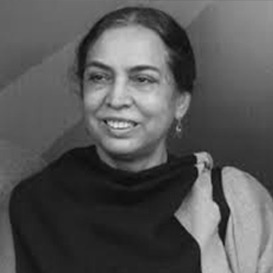 Arpana Caur (born January 4, 1954) is a renowned Indian contemporary painter & graphic artist known for her deeply spiritual, feminist & socially conscious artworks. Born to literary legend Ajeet Cour, she transformed her mother’s radical feminism and Punjabi storytelling traditions into a visual language of elongated figures, floating clocks and haunting scissors; each stroke a meditation on time, trauma and transcendence. From the quiet anguish of The Widow to the cosmic dance of Guru Nanak’s Journey, Arpana Caur’s artwork invites us not just to see, but to witness: the resilience of women, the scars of partition and the sacredness of the everyday. As both artist and activist, she proves that a brush can be as mighty as a pen and far more luminous.
Early Life
Arpana Caur was born in 1954 in Delhi, India, to a Sikh family that fled West Punjab during the partition of British India in 1947. Her early exposure to art, music, and literature was profound; she learned the sitar, penned poetry, and created her first oil painting, "Mother & Daughter," at the age of nine, inspired by Amrita Sher-Gil.
Later Life
As Arpana matured as an artist, her work grew increasingly introspective and layered. She continued to explore the intersections of the personal and the political, addressing issues like female infanticide, partition, environmental degradation, and spiritual seeking. Over the years, she evolved from figurative narratives to more abstract and symbolic representations, often drawing inspiration from Sikhism, Sufism, and Indian folk traditions.
Arpana Caur now continues to live and work in Delhi, remaining deeply engaged with both artistic and social causes. She leads the Academy of Fine Arts & Literature, which hosts the South Asian Literature Festival, fostering connections among authors from the subcontinent. In memory of her younger sister, she supports a leprosy home in Ghaziabad that also offers vocational training for young girls. Caur has also been an environmental advocate, notably opposing the felling of trees in New Delhi's Siri Forest area during the 2010 Commonwealth Games preparations.
Family
Arpana Caur is the daughter of Ajeet Caur (born as Rajinder Kaur), a renowned Punjabi writer and Padma Shri awardee who founded the Academy of Fine Arts and Literature in Delhi. The influence of her mother’s literary achievements and social consciousness is evident in Arpana’s art and activism. The mother-daughter duo has worked together to promote arts and culture through the Arpana Fine Arts Gallery and Academy in Delhi.
Education
Contrary to the typical trajectory of Indian artists, Arpana Caur did not receive formal training in fine arts. She completed her Master’s in Literature from Delhi University in 1975. Although largely self-taught as a painter, she received training in etching at Garhi Studios in New Delhi in 1982 and briefly studied at Central St. Martin’s College of Art, London, before returning to India.
Artistic Philosophy
Arpana Caur's art delves into themes of life, death, violence, environmental concerns and women's issues. Her paintings often depict women's conditions in modern India, addressing issues such as violence, the environment, and gender equality. She portrays women not as passive figures but as sturdy, resilient individuals, often set against urban backdrops. Her work emphasizes the latent power of women to renew and regenerate, challenging traditional representations.
Famous Quote
"I like my painting not to be a picture but to be a world"
Painting Style
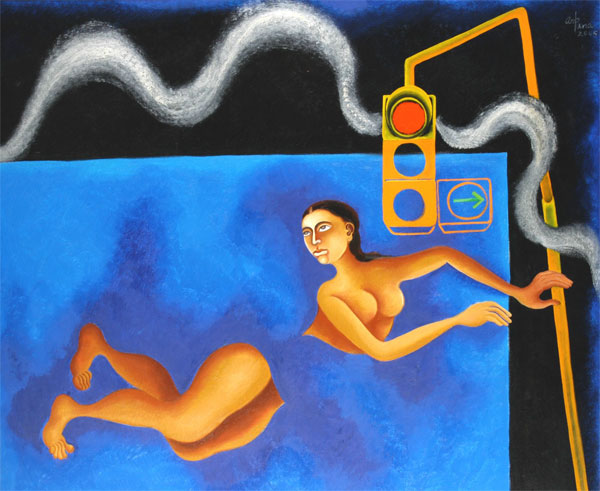
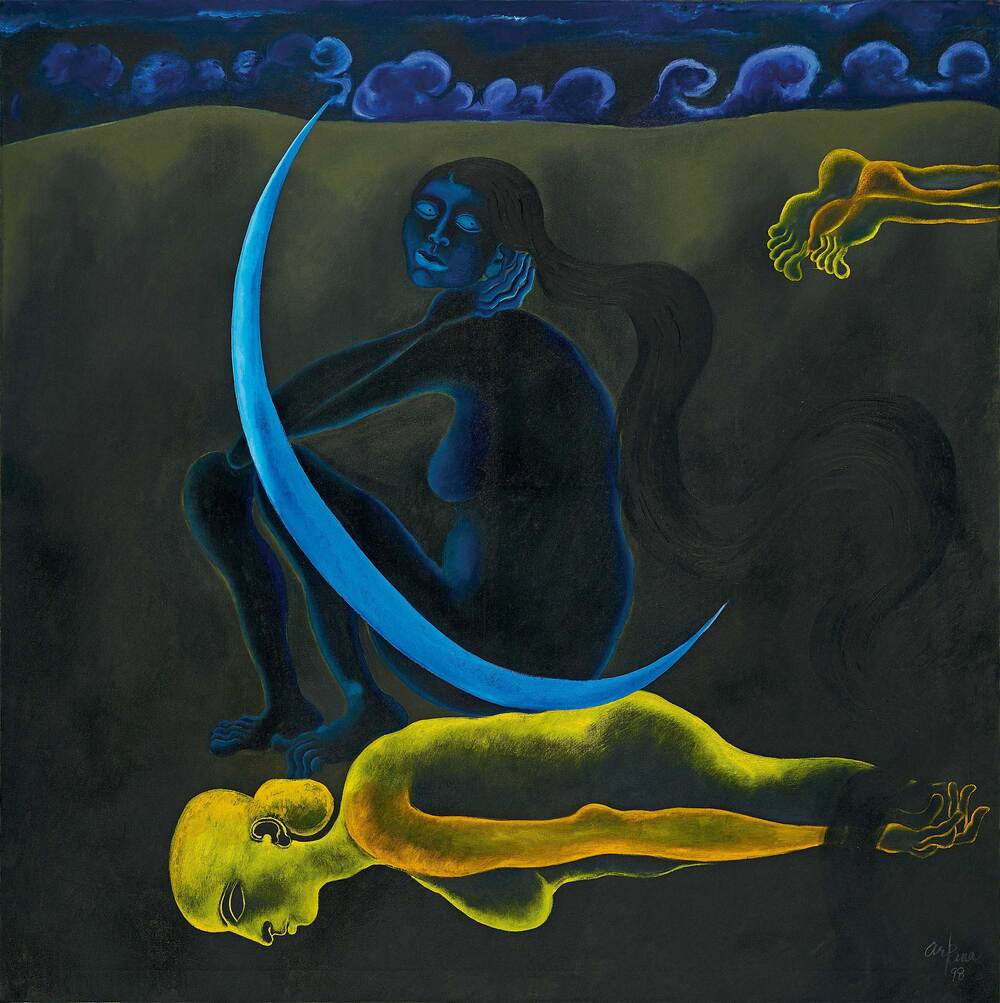
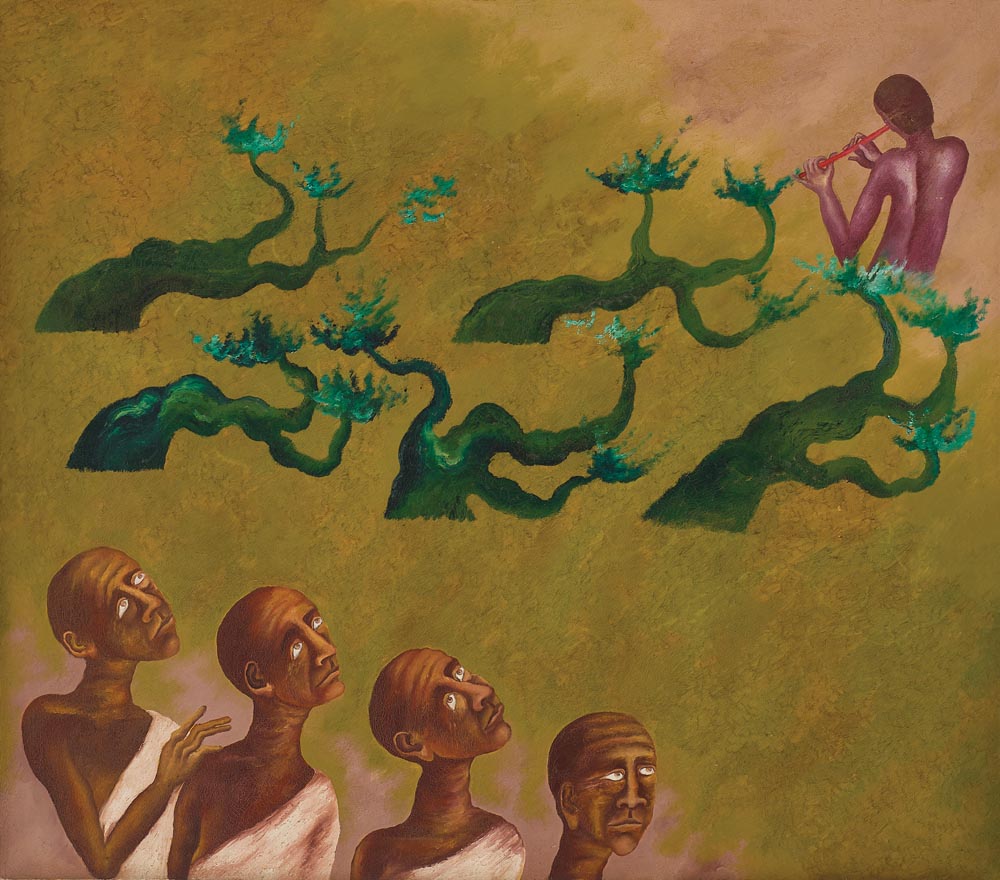
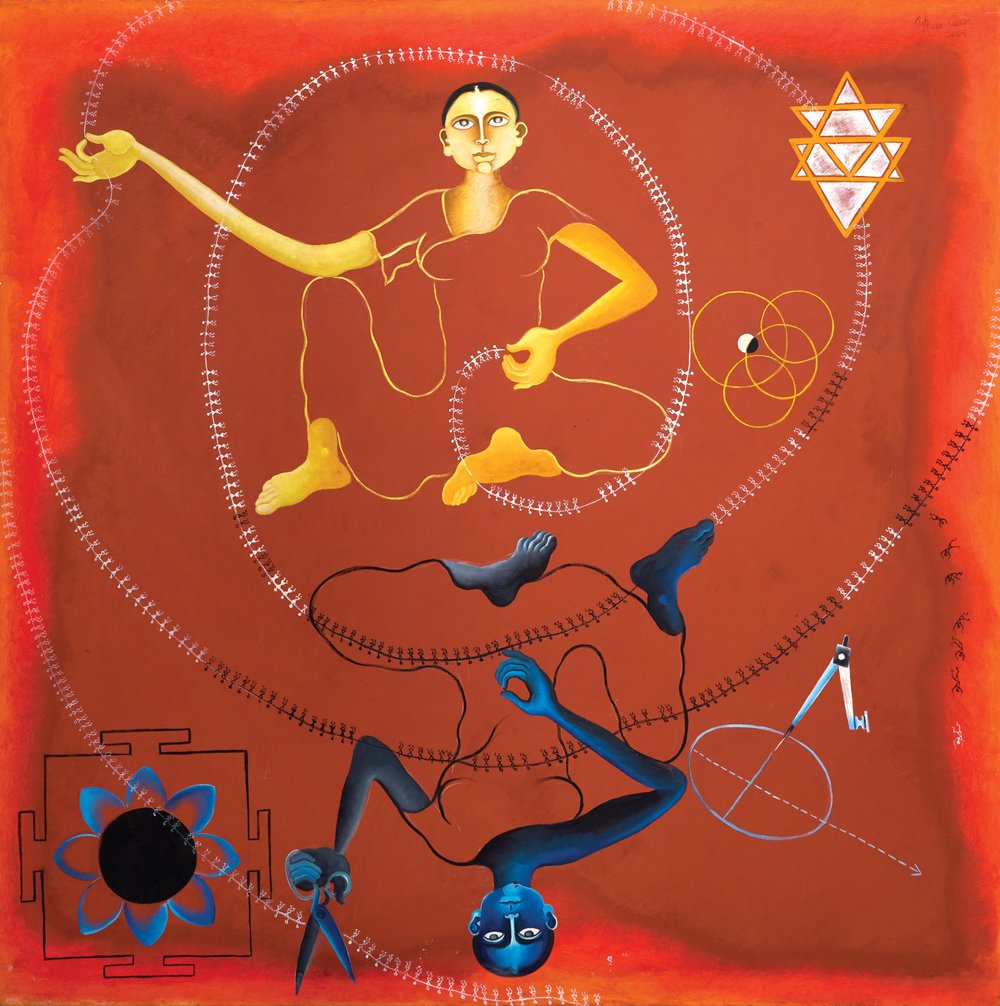
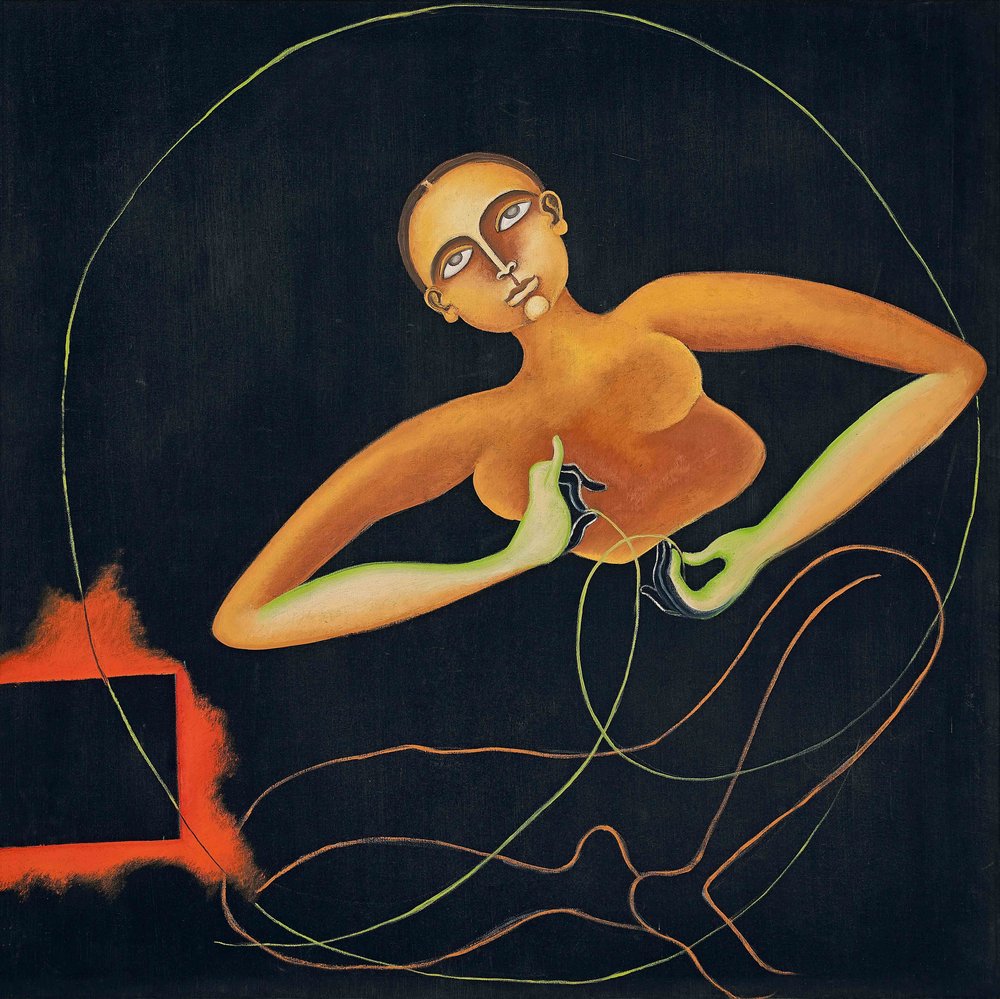
Arpana Caur's distinctive painting style combines elements from multiple traditions, including Gond, Madhubani, Pahari miniatures, Mughal art and contemporary global influences often arranging pictorial space in unique, layered compositions. Her compositions often feature flattened perspectives, bold outlines and vibrant color fields that create a sense of timelessness. Human figures in her works appear elongated with simplified features, reminiscent of folk traditions yet bearing the psychological complexity of modern individuals.
Recurring motifs in her paintings include scissors (symbolizing division and violence) which have earned her the pet name "kainchi", flowing water (representing time and purification), floating figures (suggesting spiritual transcendence) and urban architecture juxtaposed against natural elements.
Famous Paintings
Some of Arpana Caur's most notable paintings include:
• Water Weaver - This 58 x 69 inches Oil on canvas painting depicts a woman weaving streams of water, symbolizing the interconnection between human creativity and nature. The imagery reflects themes of feminine strength and the cyclical nature of life.
• Immersion, Emergence - Part of Arpana Caur's Guru Nanak series, this 160 x 293 cm Oil on canvas painting portrays spiritual transformation, illustrating the journey from worldly immersion to spiritual emergence. The composition uses layered imagery to convey the depth of spiritual awakening.
• In Vrindaban - This Oil on canvas painting captures the essence of Vrindaban, a town associated with Lord Krishna. Caur's depiction blends mythological references with contemporary themes, highlighting the timelessness of spiritual narratives.
• Crafts Maps of India - A series of maps illustrating India's diverse craft traditions. Each map highlights regional crafts, celebrating the country's rich artisanal heritage.
• The Embroiderer - Depicts a woman embroidering, symbolizing the intricate work and creativity of women. The 167 x 137 cm Oil on canvas painting challenges traditional domestic roles, presenting embroidery as a powerful act of creation. ?
• Nanak: Journeys - Part of the Guru Nanak series, this 151 x 120.5 cm Oil on canvas painting reflects the spiritual travels of Guru Nanak, emphasizing themes of enlightenment and universal connection.
Awards
Throughout her distinguished career, Arpana Caur has received numerous accolades recognizing her contributions to art, including:
• Gold Medal at the 6th India Triennale by Lalit Kala Akademi (1986)
• T.K. Padmanabhan Award, Kerala Government (2007)
• B. C. Sanyal Award (2017)
• Sikh Art and Film Foundation, New York: The Lifetime Achievement Award (2010)
• Lifetime Achievement Award for Vocational Excellence by Rotary Club of Delhi (2011)
• AIFACS Award
Exhibitions
Since her first solo exhibition in 1975 at Shridharani Gallery, New Delhi, Caur’s work has been exhibited globally, including in London, Berlin, Amsterdam, Singapore, New York, Stockholm, and Copenhagen. Some notable exhibitions include:
2009: Mural on Tiles for the outer wall of SAARC Secretariat, Kathmandu
2007: Indigo Blue Gallery, Singapore
1995: Commissioned by Hiroshima Museum of Modern Art for its 50th anniversary
1987: VI Triennale Gold Medal for Painting (International exhibition)
Arpana Caur’s murals can also be seen in public spaces across India, including the Varanasi and Bangalore railway stations, as well as at the Delhi Vidhan Sabha.
Legacy Beyond Art
In addition to being an artist, Arpana Caur is deeply committed to social causes:
• Education Initiatives: She runs a free school for slum children and women alongside her mother.
• Environmental Advocacy: She supports tree plantation drives and rural restoration projects.
• Support for Widows: Part of her earnings aids widows resettled after the 1984 riots.
• Heritage Preservation: She actively contributes to protecting monuments and cultural heritage sites.
Arpana Caur’s philanthropic activities are sustained entirely through earnings from her paintings without external grants—a testament to her dedication to giving back to society.
Contribution to Indian Art
As one of India's prominent female artists emerging in the 1970s and 80s, Arpana Caur helped pave the way for greater recognition of women in the field. Her unflinching engagement with political violence, particularly the 1984 anti-Sikh riots, established an important precedent for addressing communal tensions through art. Additionally, her environmental works have contributed to ecological consciousness within India's artistic discourse.
Conclusion
Arpana Caur’s journey from a self-taught artist in Delhi to an internationally acclaimed painter is a testament to her profound empathy, intellectual depth, and steadfast dedication to both artistic expression and social consciousness. Her evocative canvases, imbued with themes of pain, resilience, and the timeless search for meaning, have firmly established her as one of India’s most significant living artists. As she continues to create with passion and purpose, Caur's enduring influence and place in the canon of contemporary art remain indisputable.