arpita singh - pioneer of narrative figuration in indian art

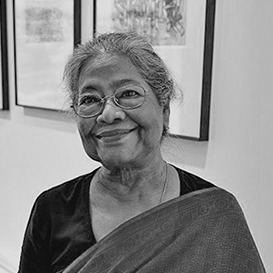 Arpita Singh is celebrated as the first female artist in India to vividly represent the essence of home & domestic life in her paintings. Often regarded as one of the finest artists since Amrita Sher-Gil, Arpita Singh has crafted a distinct pictorial language that captures the complexities of middle-class existence, particularly the lives of women. Her works delicately explore their daily routines, aspirations, and struggles, weaving subtle yet profound narratives of resilience and identity. Through her evocative use of symbolism, color, and texture, Singh has elevated the portrayal of everyday life into a universal commentary on societal and gender dynamics.
A recipient of numerous awards and honors, Arpita Singh’s art is an intricate commentary on society, culture, and personal experiences, making her a prominent figure in both national and international art circles. Arpita Singh’s art not only captivates but also provokes thought, often addressing themes such as womanhood, societal struggles, and human emotions. Her canvas paintings often feature bold colors, dynamic compositions, and symbolic motifs, which have made her works highly sought after in art auctions. As one of the pioneers of contemporary art in India, Singh’s influence extends far beyond the canvas. Her contributions to the evolution of modern art in India continue to inspire emerging artists and art collectors alike.
Early Life & Background
Arpita Singh, born in 1937 in Baranagar, West Bengal, spent her early childhood in a quaint, semi-rural town on the outskirts of Kolkata before her family relocated to Delhi. This significant shift from the serene landscapes of Bengal to the bustling energy of Delhi profoundly shaped her artistic sensibilities, exposing her to two distinct cultural and urban environments. As a child, Singh demonstrated remarkable resourcefulness, often creating art on newspapers and industrial catalogues due to limited access to traditional materials. This early blending of text and imagery would later emerge as a hallmark of her mature works. Despite these challenges, Singh’s unwavering passion for painting fueled her creative journey, laying the foundation for her evolution into one of India’s most celebrated contemporary artists.
Later Life
As Arpita Singh moved into her later years, her oil paintings evolved, becoming more introspective and complex. Her work began to reflect a deeper engagement with the world around her, often delving into themes of personal identity, loss, and emotional complexity. Singh’s later works feature a more layered and textured approach, often incorporating both abstract elements and figuration to convey the complexity of the human experience. Her prints have also gained significant recognition, extending her reach to a broader audience while retaining the essence of her original paintings.
Arpita Singh’s later years saw her participating in numerous exhibitions worldwide, where her works were displayed in prestigious galleries and museums. She became a recognized name in international art circles, with her works collected by art institutions, private collectors, and museums. Even as she aged, Singh’s creativity remained robust, with her style evolving while remaining distinctly her own.
Family
Arpita Singh's family played a pivotal role in shaping her artistic narrative, which often reflects themes of violence, displacement, and memory. Born into a family that faced significant upheaval, Singh's childhood was marked by profound loss and the tumult of India's Partition. After her father's death, she moved with her mother and brother to the Bengali Market area of central Delhi in 1946, where they settled in a government apartment. From her balcony, she witnessed the violence and chaos of independence and Partition at just six years old—a traumatic experience that would leave an indelible mark on her work.
In 1962, Arpita Singh married fellow artist Paramjit Singh, and together they had a daughter, Anjum Singh, who would also become an artist. Tragically, Anjum passed away in 2020 after a long battle with cancer. Today, Arpita continues to live and work in New Delhi alongside Paramjit, with their shared dedication to the arts fostering a thriving artistic community in the city. Despite the personal tragedies and challenges she has faced, Arpita Singh's family remains a cornerstone of her creative journey, deeply influencing both her life and work.
Education
Arpita Singh's educational journey in the arts began at the Delhi Polytechnic (now the College of Art), where she studied from 1954 to 1959 and earned a Diploma in Fine Arts. During her time there, she was mentored by distinguished artists such as Dinkar Kaushik, Biren De, Jaya Appasamy, BC Sanyal, and Sailoz Mookherjea, whose guidance profoundly influenced her artistic growth. After graduating, Arpita joined the Weavers' Service Centre under the Ministry of Textiles in New Delhi, where she delved into traditional embroidery techniques like kantha embroidery, a Bengali craft. This exposure to textile art, particularly the intricate patterns and mythological themes of pattachitra scrolls, had a lasting impact on her style.
In the 1980s, Arpita began incorporating elements of traditional Kantha embroidery into her paintings, drawing inspiration from the repetitive patterns, symmetry, and ornate borders she had encountered in her textile studies. This approach transformed her works, saturating the canvas with detailed forms and figures set within intricate, ornamental frames. Arpita Singh's education and early experiences with textile art helped define her unique style, merging the worlds of traditional craft and contemporary painting into a distinctive visual language that continues to captivate audiences today.
Artistic Journey & Development
Arpita Singh’s artistic journey began in the mid-20th century when she was part of the modernist movement in Indian art. Her initial works were influenced by her studies and training in both traditional and contemporary styles. However, it was her exploration of personal and societal themes that set her apart. In the 1970s, Singh's work began to take on a more unique, emotional, and symbolic quality, often using vibrant colors and intricate details to communicate powerful narratives about human life.
Over the years, Singh’s work evolved to incorporate more complex elements, including the exploration of feminist themes, identity, and cultural history. Her oil paintings of this period often displayed a unique blend of abstraction and figuration, with a focus on human figures and the use of vivid, contrasting colors. The evolution of Singh’s style marks a significant shift from the purely traditional forms of Indian painting to a more modern, abstract language that is now widely recognized and celebrated.
Philosophy
Arpita Singh’s philosophy of art revolves around the belief that painting should be an emotional and intellectual journey. For her, art is not merely about aesthetics but also about making a statement—one that often reflects the complexities of identity, society, and emotion. She has often spoken about how her art is a means of communicating the deeper layers of human existence, capturing fleeting moments and complex narratives. This philosophical outlook is reflected in the layers of meaning embedded within her works.
Her artistic philosophy is deeply personal, with Singh often viewing painting as a form of self-exploration. She uses her work to grapple with themes of memory, personal history, and social change, making her creations resonate with universal human experiences.
Themes
Singh’s oeuvre encompasses a wide range of themes, including womanhood, gender identity, memory, and nostalgia. Her female figures embody strength, vulnerability, and complexity, reflecting the essence of Indian womanhood.
Memory is another poignant theme. Many of her paintings evoke nostalgia, exploring the intersection of personal and collective memories. Singh often employs symbolic elements to convey fertility, life, and the intricacies of memory, creating rich visual experiences that resonate emotionally.
Painting Style & Techniques
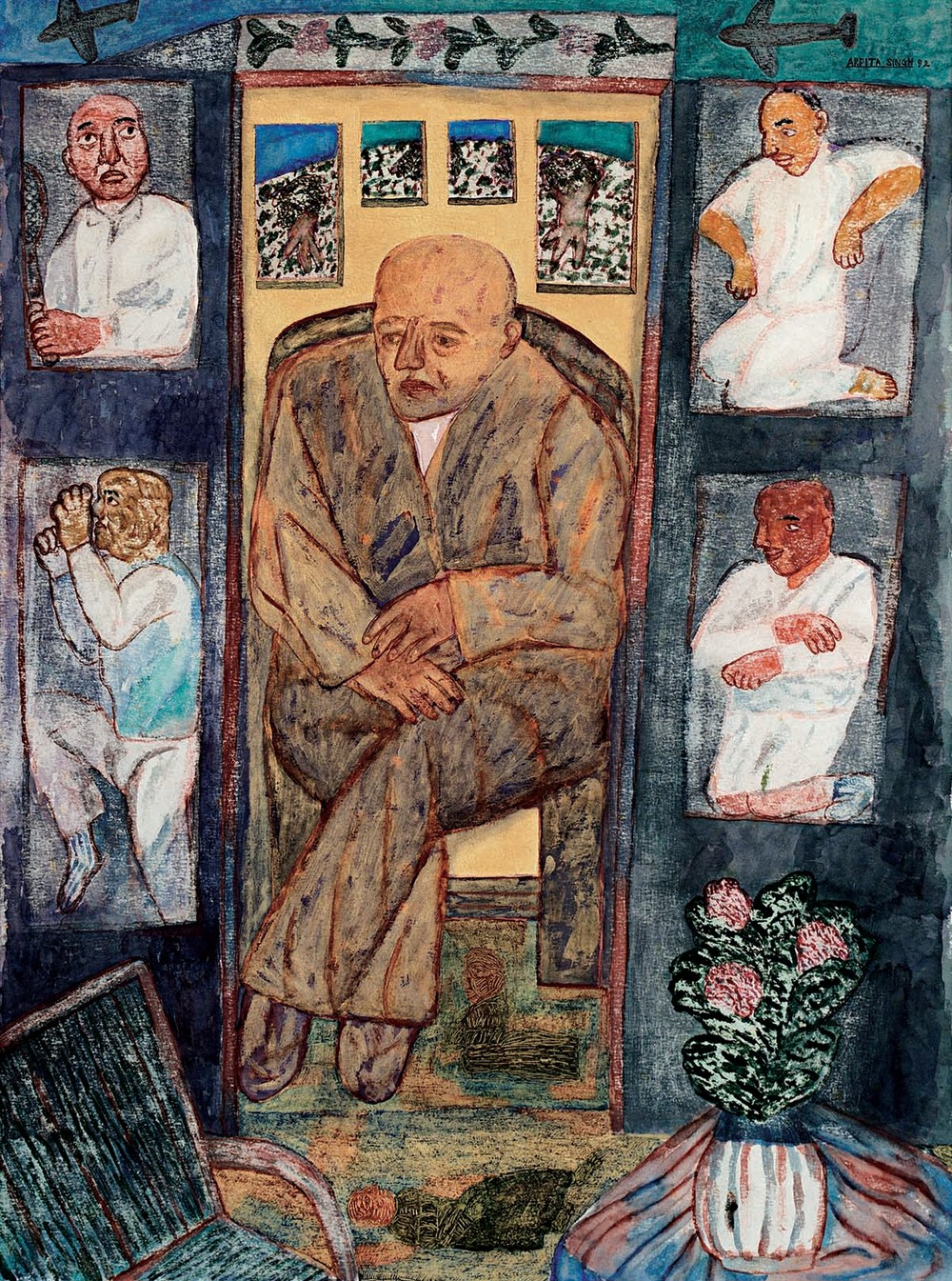
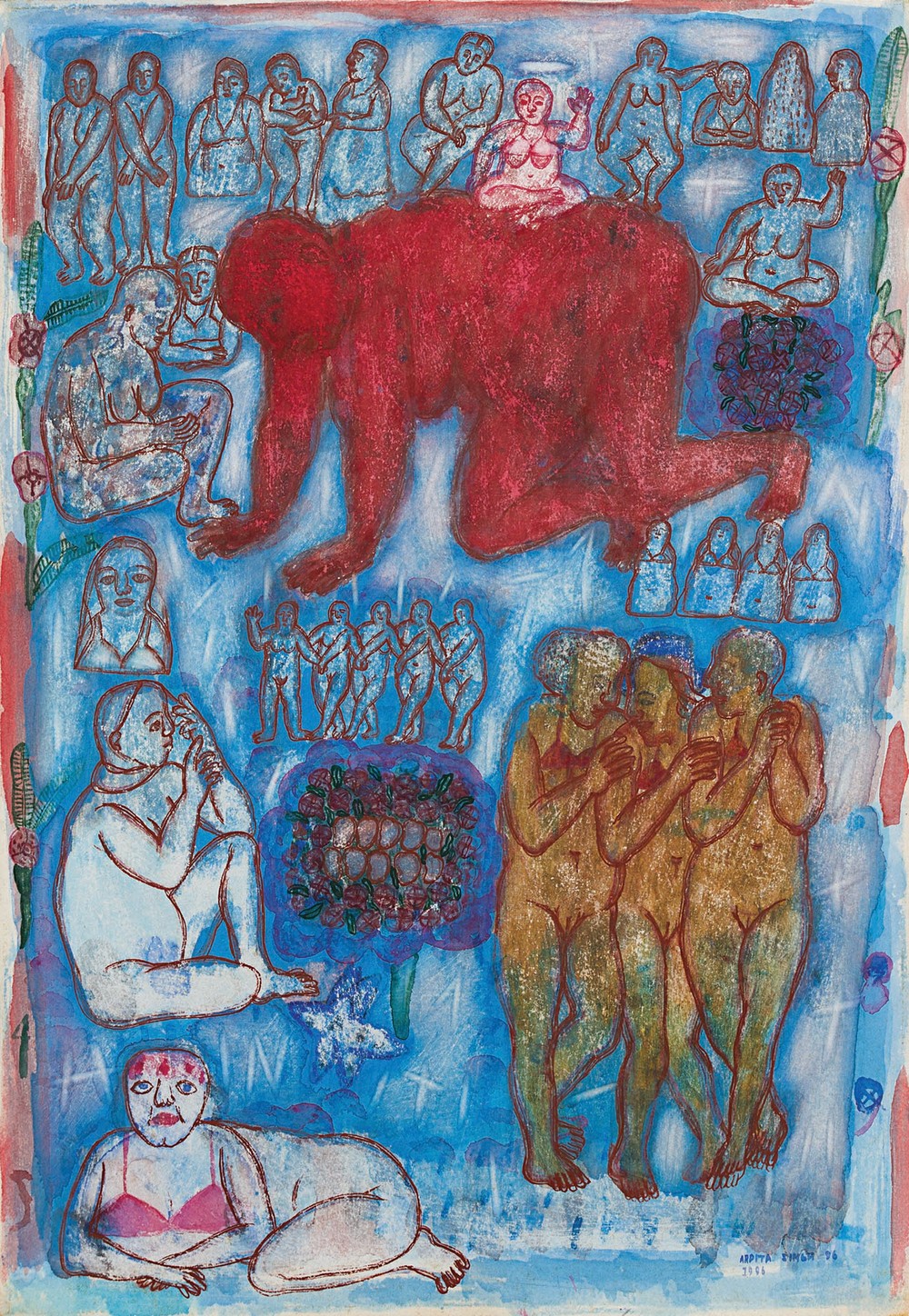
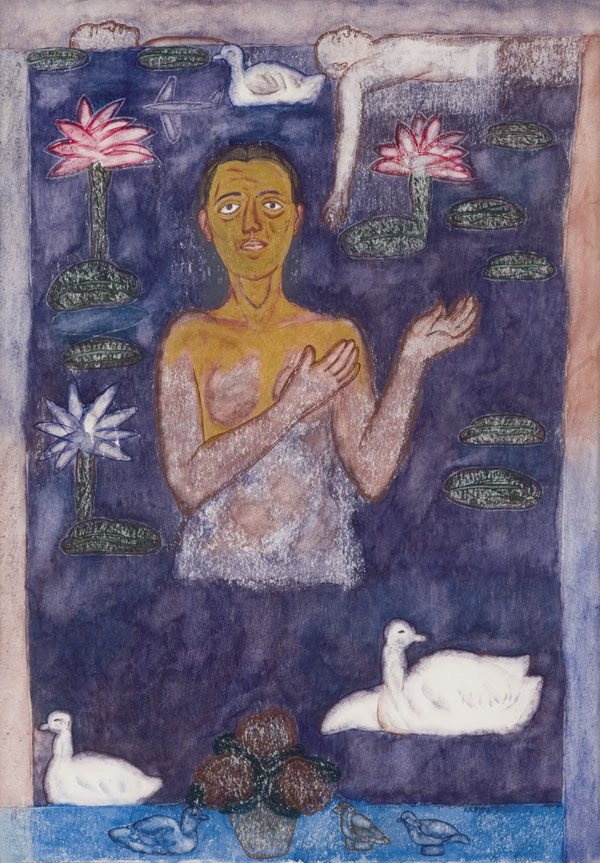
Arpita Singh’s painting style evolved significantly over the decades, reflecting her deep engagement with personal experiences, societal issues, and cultural heritage. Her early works, primarily watercolors and ink drawings, were characterized by their monochromatic simplicity and direct representation. However, by the 1980s, her style underwent a transformative shift, embracing bold colors and densely packed compositions. Drawing inspiration from Indian folk traditions, particularly her Bengali roots, Singh’s palette became vibrant with hues of pink, blue, and green. Her works from this period often featured women engaged in everyday routines, surrounded by objects imbued with symbolic meanings, bridging the personal and the universal.
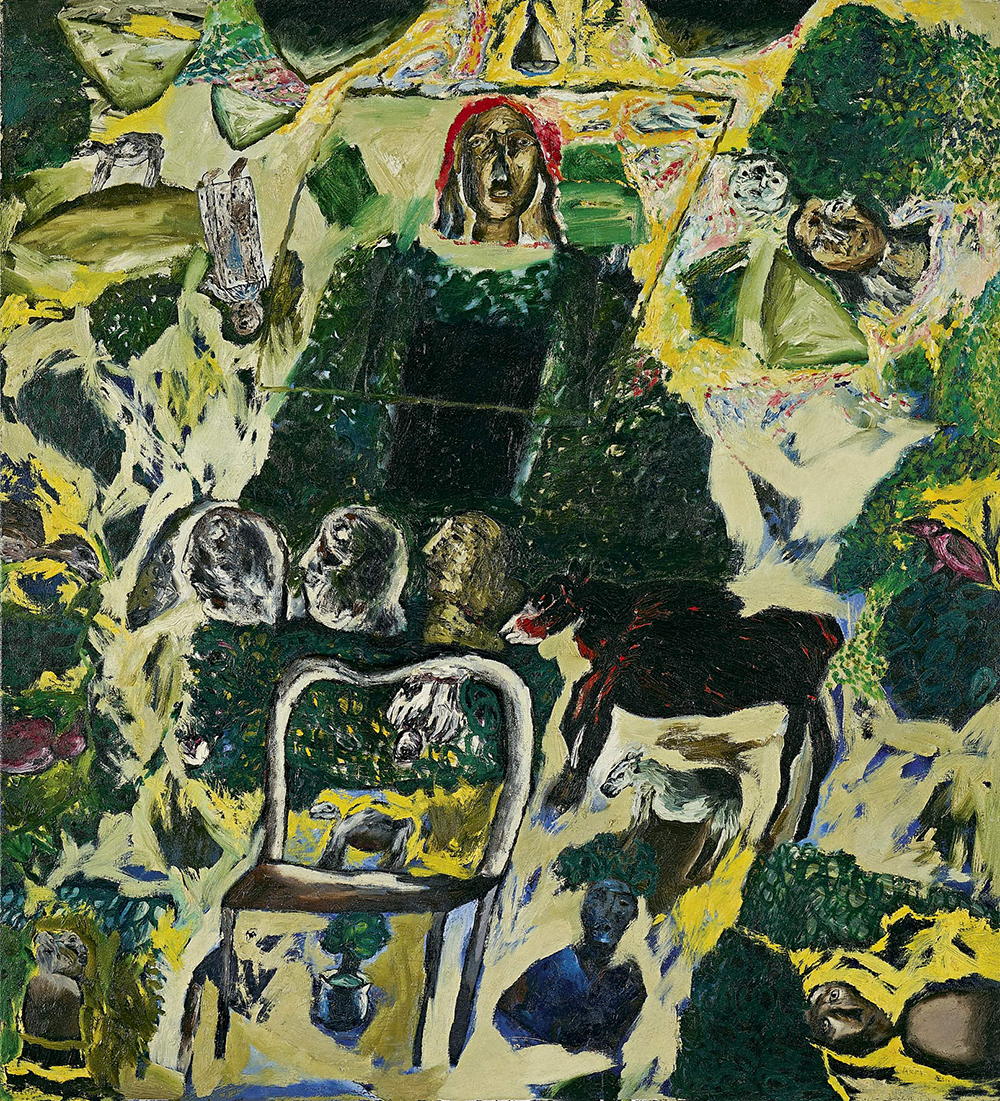
In the 1990s, Singh transitioned to oil on canvas, further expanding the thematic depth of her art. Her exploration of femininity and domesticity took on a more political tone, reflecting societal and historical turbulence. Paintings from this period frequently allude to events such as the assassination of Prime Minister Indira Gandhi, the anti-Sikh riots of 1984, and even international conflicts like the Gulf War. Through these narratives, Singh’s art expressed a profound sense of unease, often depicting women in contexts of violence and displacement, capturing the fragility of human existence amidst turmoil.
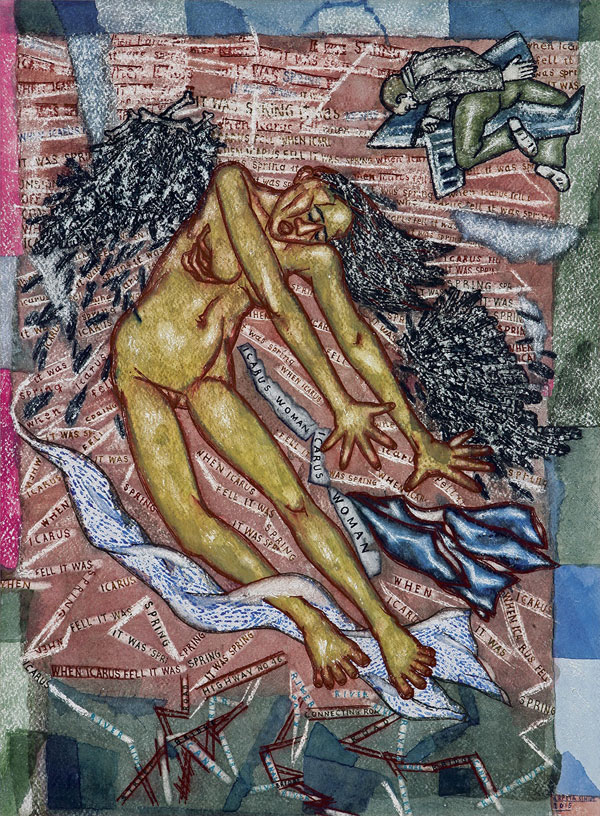
Overall, Arpita Singh’s works are a remarkable fusion of the ordinary and the symbolic, blending elements of domestic life with broader commentaries on war, displacement, and societal injustices. Teapots, flowers, and animals coexist with complex human emotions, creating layered compositions that are both intimate and universal. Her ability to infuse the mundane with profound meaning has solidified her as one of India’s most influential contemporary artists.
Famous Paintings
Some of Arpita Singh’s most famous paintings include her iconic works such as "Ritu," "Mother and Child," and "The Red Dress." These paintings explore themes of femininity, family, and the inner world of human emotions. "Ritu," for instance, is a poignant exploration of the female form, depicted with bold strokes of color and intricate patterns that give the painting an almost dreamlike quality.
Another celebrated work, "Mother and Child," is an emotional representation of maternal love, with delicate figures and rich colors conveying deep affection and tenderness. Singh's exploration of the relationships between individuals, particularly women, is a recurring theme in her most admired paintings.
Controversial Paintings
While Singh’s work has been widely appreciated, some of her paintings have stirred controversy, particularly for their depiction of female figures and their symbolic undertones. Her piece "The Bride," for example, has sparked debates for its portrayal of a woman’s role in society and marriage. The intense emotional expression and the symbolic use of color and figures challenge conventional narratives about womanhood, making it a subject of both admiration and critique.
These controversial paintings reveal Singh's boldness as an artist willing to push boundaries and explore uncomfortable yet important themes. Her willingness to tackle sensitive social issues has solidified her place as one of the leading voices in contemporary Indian art.
Characteristics Features of Her Paintings
Arpita Singh’s paintings are instantly recognizable due to their characteristic features. One of the most notable aspects of her work is her use of bright, bold colors, which are often used to evoke emotion and to convey a sense of urgency or intensity. Another hallmark is her intricate compositions, where multiple figures and elements are interwoven into complex narratives, creating a layered effect that invites the viewer to explore the work in detail.
The symbolic use of motifs such as flowers, birds, and figures also stands out in her art. These symbols often carry deeper meanings, reflecting her interest in both personal and collective histories. Singh’s compositions are rarely static; instead, they are filled with movement, energy, and emotion, giving the impression that her original paintings are alive with expression and meaning.
Emergence of Narrative Figuration
Arpita Singh's work exemplifies narrative figuration, intertwining story and visual art. She explores complex themes through human experience, inviting viewers to engage intimately with the narratives behind each figure. The richness of life is interwoven in her paintings, where multiple figures convey diverse stories, enhancing viewer engagement.
Unlike the abstract art movements that characterised the last century, Singh's use of figuration makes her subjects immediate and relevant. Her figures often possess a dreamy quality, incorporating surreal elements that blur the lines between reality and imagination, allowing her to address contemporary issues while drawing on traditional Indian artistic practices.
Quotes
Arpita Singh’s work speaks for itself, but her words also offer insight into her artistic process. She once said, “Art is a way of saying things that are too difficult to speak about.” This quote encapsulates her belief that art can serve as a powerful medium for exploring complex emotions and societal issues. Another memorable quote from Singh emphasizes the importance of personal expression: “I paint what I feel. It is not always a deliberate decision, but it comes from a place deep within me.”
Accomplishments - Awards Won
Over the years, Arpita Singh has garnered numerous accolades and awards for her contribution to the world of art. She has received prestigious recognitions such as the Padma Shri, one of India’s highest civilian honors, which was awarded to her for her exceptional contribution to Indian art. Singh has also been honored with awards from institutions like the Sahitya Kala Akademi and the National Academy of Art for her innovative and impactful work.
Her original paintings have been exhibited in numerous solo and group shows across the globe, further cementing her status as a major figure in contemporary art. The continued recognition of her work through awards and exhibitions highlights her enduring influence on the art world.
Hurun India Art List 2024
Arpita Singh's inclusion in the Hurun India Art List 2024 is a remarkable recognition of her enduring legacy and influence in contemporary Indian art. Ranked third in the prestigious list, Singh continues to hold the title of the “most successful woman artist,” a position she has retained since the list's inception in 2019. The ranking is based on the sales and auction performance of the top 50 living Indian artists, and Singh's sustained presence in the list underscores her importance in the global art market. Her notable painting, Watching (2004), significantly contributed to her overall sales, cementing her reputation as a leading figure in modern Indian art.
The Hurun India Art List celebrates the profound contributions of artists like Singh, whose works resonate with themes of femininity, societal conflict, and domestic life, expressed through vibrant and symbolic compositions. Singh’s consistent inclusion highlights her relevance in the ever-evolving art world, inspiring new generations of artists and collectors alike. Her recognition not only reflects her individual achievements but also represents the growing prominence of Indian art on a global platform, showcasing its cultural and market significance.
Contributions and Impact on Indian Art
Arpita Singh’s contributions to Indian art have been both profound and transformative. She has played a significant role in the evolution of contemporary Indian painting, bridging the gap between traditional Indian art forms and modern techniques. Through her innovative approach, Singh has redefined the boundaries of Indian art, making it more accessible to international audiences.
Her prints and oil paintings have inspired countless young artists, and her emphasis on personal expression has reshaped how contemporary art is perceived in India. Singh's work has also brought attention to the role of women in art, both as subjects and creators, making her a pivotal figure in the feminist art movement in India.
Conclusion
Arpita Singh's beautiful paintings have left an indelible mark on the landscape of Indian contemporary art. With her original paintings, canvas paintings, and oil paintings, she has created a body of work that not only speaks to the viewer's emotions but also challenges conventional narratives. Singh's art, now highly valued in art auctions and sought after by collectors, continues to rise in painting prices, making her works highly desirable. As one of India’s foremost contemporary artists, Singh’s legacy will undoubtedly endure, influencing generations to come through her evocative, dynamic creations.
In conclusion, we’ve only scratched the surface of the incredible legacy of Arpita Singh. To truly appreciate the depth and beauty of her paintings, explore here collection here and immerse yourself in the stories her each brushstroke tells.