art of krishen khanna - a fauvist lens on modern india
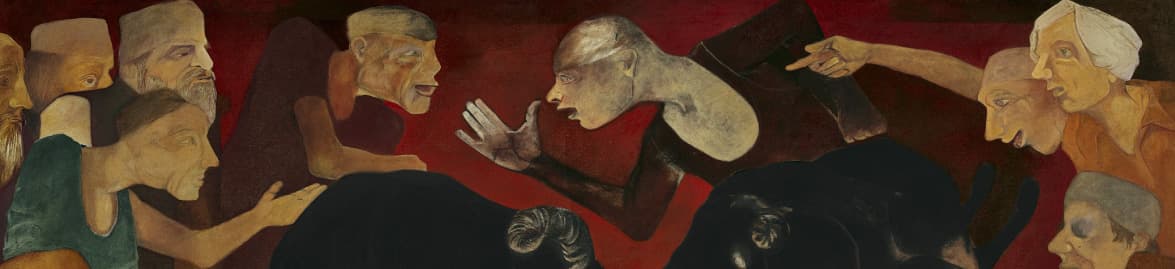
Amongst the kaleidoscope of modern Indian art, there lies a figure who personifies a blend of emotional intensity, strong colour palettes, and socially charged commentary. Often described as one of the leading exponents of Indian modernism, Khanna's style is grounded in expressive, free-flowing brushwork, a movement that emphasises the emotional power of colour over representational accuracy. However, Khanna's work was more than just a colour party; it was an in-depth reflection of post-independence India, reflecting the intricate dynamics of its social life and the plight of its citizenry, and the ever-changing configuration of its national identity. Under a Fauvist prism, Krishen Khanna throws open for view an effective visual conversation between inner and outer worlds, bringing out the viewer to empathise with the emotional and political turmoil of the modern Indian mind.
Early Life & Evolution Of The Artist
Krishen Khanna was born in Lahore (in Pakistan today) in 1925. Early life was very much associated with the partition that moulded his worldview on most levels. He had formal training in art from the prestigious Government College of Art, Lahore, and then from London. The early exposure to the movements of Western art, particularly European modernism, provided him with the technical skills to try his hand at all the different styles. However, it was the influence of Fauvism in London that made an indelible mark on his career as an artist. The bold colours of Fauvist works, particularly those by Henri Matisse and André Derain, and the raw, expressive power of it all, connected with Khanna at an emotional level, providing him with an avenue to channel his emotions onto the canvas.
Khanna's stylistic development was a synthesis of Western influences and his own history. While the Fauvist influence is evident in his vivid use of colours and simplified forms, Khanna's art was always informed by his surroundings in post-independence India. His approach to art, like Fauvism itself, is about trying to capture the emotional heart of what he's after—the energy of city life, the tension of change through history, or even quiet suffering in a society moving very quickly.
Fauvism: A View on Modern India
Emerging in early 20th-century France, Fauvism defined itself by bold, non-naturalistic colours and loose brushwork. The movement abandoned the techniques of perspective and realism of traditional painting, instead emphasising the use of colour to communicate the inner state of the artist. For Krishen Khanna, this was a perfect medium to reflect the intensity and emotional turbulence of a newly independent India.
Khanna used a Fauvist style in the treatment of colour. Rather than aiming for realistic portrayals, he used colour to describe mood, social realities, and inner emotions. His work was rich with contrasting colours—reds, yellows, oranges, and deep blues—that often clashed against one another. The use of colour, therefore, was not just an aesthetic appeal but reflected the turmoil and vitality of a society in transition.
The human figure was the focus of most of Khanna's works. His renderings of men and women, whether they were labourers, soldiers, or ordinary citizens, were always done in strong, emotive strokes that did not just depict physicality but also the psychological depth of their experiences. Figures were often monumental, symbolic of the struggles and resilience of common people in India. Khanna's brushwork was loose and expressive, marked by tendencies of Fauvism, but also singularly personal. His figures and faces seemed to grow out of a highly charged, almost nightmarish landscape—both a familiar and strange, actual and figurative world.
Social Commentary & Political Engagement
Khanna's work engaged a lot with the social and political issues of his time. Khanna lived to witness India's fight for independence and all its post-independence troubles in establishing a new national identity. His work would depict themes of alienation, social injustice, and the disillusionment following India's independence. He was more into social commentary through art than just personal reflection during his time in mid-20th-century India.
In most of his works, Khanna depicts workers and soldiers against the background of their hard lives. The vibrant colours made these figures all the more emotional, giving rise to a sense of empathy with the struggle of these workers and soldiers. These were not, however, merely passive subjects; they were presented with dignity and strength, as if showing strength over adversity. Khanna's work spoke to the complex intersection of personal experience and collective history, a theme that ran throughout his career.
In his examination of religious and cultural symbolism, Khanna often commented on the values of society and the alienation of people within it. This was a powerful tool for social critique because he could combine old iconography with modern sensibilities. His work reflected the complex dynamics of contemporary life; tension between tradition and modernity in the issues of faith, identity, and socio-political transformation in post-independence India.
Legacy & Influence
Krishen Khanna's contribution to Indian modernism is bridging the gap between European art movements like Fauvism and the social realities of post-independence India. His approach towards colour, form, and subject matter helped redefine modern Indian art, breaking out of colonial aesthetics, and forging a distinct artistic voice that resonated with the country's evolving identity. Khanna transformed Fauvism into a tool of social and emotional exploration with his typical, raw, human quality of portraiture in modern India.
Khanna's art has continued to inspire later generations of artists both in India and abroad. His colour, form, and subject matter helped redefine modern Indian art and went beyond the limitations of colonial aesthetics to forge a unique voice that spoke to India's evolving identity. Through the injection of Fauvism's expressive language with the socio-political consciousness of his time, Krishen Khanna remains an important figure in the story of Indian modernism.
Conclusion
Krishen Khanna's art is a manifestation of post-independence India's emotional and social currents. Through a Fauvist lens, he depicted not only the vibrancy of modern life but also the pain, struggle, and hope that marked India's transformation. His work, characterised by bold colour and expressive brushwork, captured the complexities of the human experience, rendering a poignant and nuanced view of India's passage through the 20th century. In his art, Khanna remains a strong witness to the spirit of modern India, one that is constantly in flux, yet always rich in its emotional depth and cultural resonance.