


artist jehangir sabavala - profile, life history, paintings & facts
.jpg&w=3840&q=75)
Jehangir Sabavala (23 August 1922 – 2 September 2011) was one of India's most distinguished modernist painters. Belonging to the first generation of post-colonial Indian artists, he spent more than six decades forging a unique creative path that stood at a tangent to mainstream contemporary Indian movements. Known for his aristocratic bearing, quiet disposition and rigorous academic discipline, Sabavala successfully bridged European technical precision with the ethereal, vast landscapes of the Indian subcontinent.
Early Life
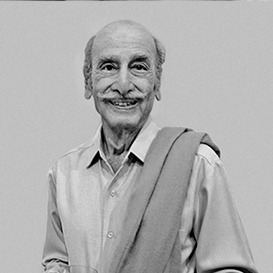 Born on August 23, 1922, in Bombay (now Mumbai), Jehangir Sabavala grew up in an extraordinarily affluent and intellectually charged Parsi Zoroastrian family. His childhood was split between the sprawling, neoclassical spaces of the Readymoney House in Bombay and extensive travels. As a quiet and imaginative child, he often created a world of private fantasy to navigate his large surroundings. In the early 1930s, his mother shepherded him and his sibling on a grand tour across Europe, exposing his formative senses to fine museums, galleries, opera, and ballet.
Later Life
Jehangir Sabavala lived out his later years in Mumbai, maintaining a tireless, disciplined dedication to his craft until the very end of his life. Even as the art market around him evolved into a high-stakes commercial environment, he kept an inner focus, rejecting group doctrines to explore human experience through an independent creative lens.
Death
Jehangir Sabavala passed away at the age of 89 in 2011 at Breach Candy Hospital in Mumbai due to complications from lung cancer. He was cremated at Chandanwadi in Marine Lines, Mumbai leaving behind a rich legacy as one of India’s most distinguished modernist painters. Following his death, his wife, Shirin Sabavala, established the Jehangir Sabavala Foundation to preserve and promote his artistic contributions. Under her leadership, the foundation worked tirelessly to uphold his legacy, culminating in the creation of a dedicated gallery at the Chhatrapati Shivaji Maharaj Vastu Sangrahalaya. This space now houses six of his late canvases, ensuring that his art continues to inspire future generations.
Education
Jehangir Sabavala received a highly prestigious education, both in India and abroad, which provided him with an unparalleled foundation in classical and modern European techniques:
• Schooling: Cathedral and John Connon School, Mumbai.
• Undergraduate Studies: Elphinstone College, Mumbai.
• Sir J. J. School of Art, Mumbai: Received his diploma in Fine Arts in 1944.
• The Heatherley School of Art, London: Studied classical drawing and painting (1945–1947).
• Académie André Lhote, Paris: Immersed himself in the intellectual mechanics of Cubism under the tutelage of André Lhote (1948–1951).
• Académie Julian, Paris: Continued his training from 1953 to 1954.
• Académie de la Grande Chaumière, Paris: Concluded his European formal education in 1957.
Family
Jehangir Sabavala was born into the aristocratic Cowasji Jehangir Readymoney family in Bombay (now Mumbai), India. His father, Ardeshir Pestonji Sabavala, was a barrister who later became the Mayor of Bombay, actively participating in the city’s political landscape. His mother Meherbai Jehangir, an activist and social worker, came from the prominent Cowasjee Jehangir family. She made significant contributions to society by establishing the Swabal Stores, the first Parsi cooperative, and founding a school for the blind. In the 1930s, due to his brother's declining health, the family moved to Switzerland when Jehangir was around nine years old, marking a pivotal shift in his early life.
During his student years in Europe, Jehangir met Shireen Dastur, who would later become his wife. The couple traveled extensively across Europe and immersed themselves in the bohemian artist community in Paris, where they married in 1948. Shireen Sabavala played a crucial role in Jehangir’s artistic journey, not only supporting his work but also titling nearly all of his paintings. She had a particular fondness for his early works and the "Pilgrim" series, reflecting her deep connection to his art. Their partnership was both personal and professional, marked by mutual respect and collaboration.
Jehangir and Shireen had a daughter, Afreed Sabavala, who continued to be a part of the family’s rich legacy. His wife Shireen Sabavala passed away in 2017 at the age of 92, leaving behind cherished memories of her contributions to Jehangir’s life and art. The Sabavala family’s legacy is intertwined with their contributions to art, politics, and social work, making them a prominent part of India’s cultural and historical fabric.
Artistic Philosophy
• Pilgrimage of Art: Jehangir Sabavala described his artistic odyssey as a pilgrimage, the constant search for lyricism and serenity amidst complexity. He spoke of light and its influence over form, which led to an ideal, finer artistic idiom above ordinary genres.
• Nature and Divinity: His works often reflect a deep connection to nature, mirroring the German Romanticism movement's desire to comprehend the natural world through art. He sought to capture the beauty and tranquillity of landscapes, infusing his paintings with emotional and spiritual resonance.
Painting Style
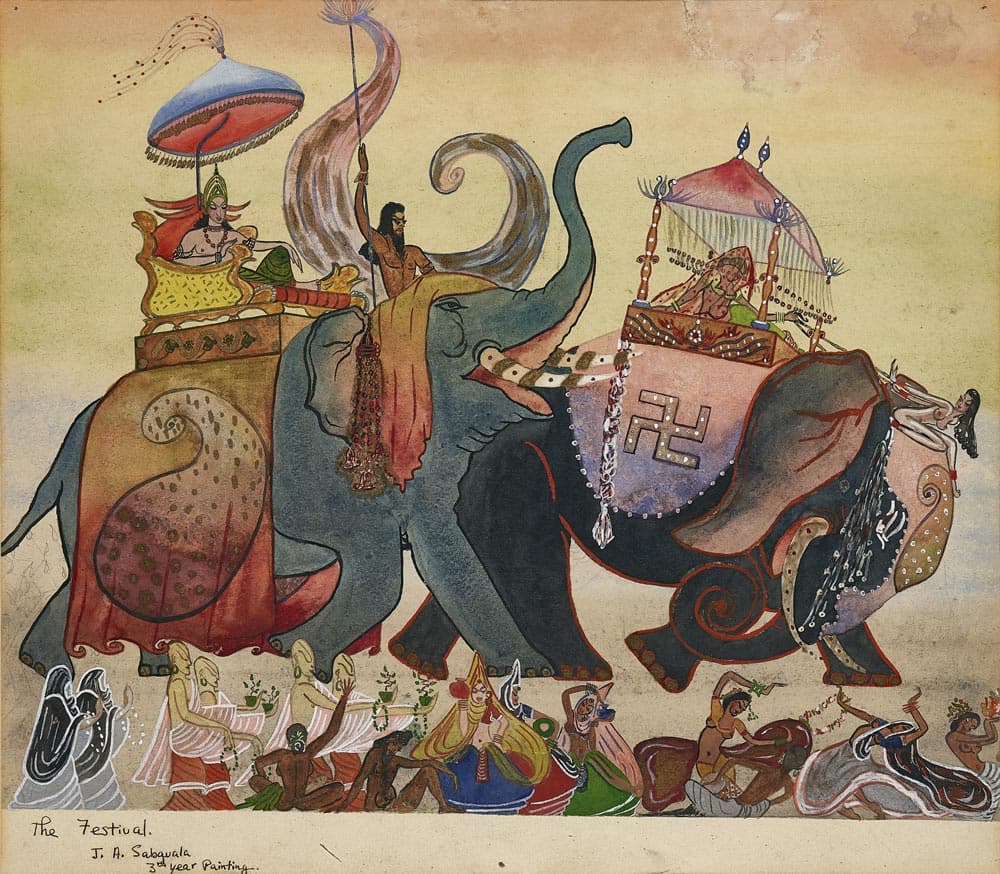 Jehangir Sabavala’s painting style can be broadly classified as Neo-Cubism infused with impressionist elements. Unlike his contemporaries in the Progressive Artists' Group who favored bold, expressive, and native folk-inspired strokes, Sabavala’s work was characterized by a meticulous, mathematical ordering of space. He broke down the world into a series of intersecting, geometric, receding planes. Over his career, his style evolved through three distinct phases:
• Early Period (1940s–1950s): Dominated by sharp Cubist scaffolding, disciplined lines, still-lifes, and rigid forms learned in Paris.
• Mid-Career (1960s–1970s): A softening of hard geometric lines into gentler, hazy, overlapping wedges. His palette shifted from vibrant tones to subdued, somber, and monochromatic hues.
• Mature Period (1980s–2000s): Visionary, luminous landscapes where form almost entirely dissolved into a poetic interplay of light, shadow, and deep spiritual introspection.
Characteristic Features of His Paintings
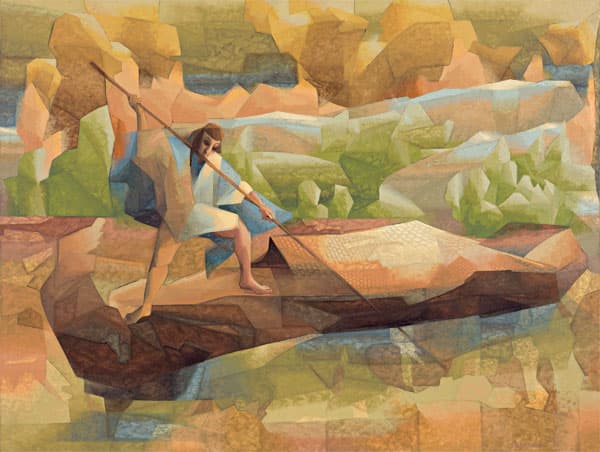 Several qualities distinguish Jehangir Sabavala’s art:
• Luminous Light – Soft, glowing illumination creates a dreamlike atmosphere.
• Geometric Structure – Influences of Cubism appear through carefully constructed forms.
• Muted Colours – Delicate blues, greys, ochres, and earth tones dominate his palette.
• Contemplative Mood – His paintings often convey stillness and introspection.
• Solitary Figures – Many works feature isolated human figures journeying through vast landscapes.
• Spiritual Undertones – His art frequently explores themes of transcendence, memory, and belonging.
Famous Paintings
Jehangir Sabavala created numerous celebrated paintings throughout his career, known for their serene landscapes, seascapes, and introspective themes. Some of his famous artworks include:
• Trapped Lakes: A contemplative landscape capturing the stillness and confinement of water bodies.
• The Source: A poetic depiction of origins, rendered with Sabavala’s characteristic luminosity.
• Impending Storm: A dramatic portrayal of nature’s turbulence with a harmonious geometric structure.
• The Casuarina Line - I: A serene natural scene featuring casuarina trees, emphasizing solitude and symmetry.
• The Quiet Boats: A peaceful seascape reflecting stillness and introspection through boats at rest.
• Stag-Antlered Trees: An abstract representation of trees resembling antlers, blending surrealism and nature.
• Flight III: A dynamic exploration of movement and liberation, using fragmented planes.
• Purdah - I: A symbolic work exploring themes of concealment and veiling.
• Down To A Sunless Sea: A somber and mysterious seascape evoking depth and introspection.
• Vespers I: A twilight scene radiating calm and meditative beauty, part of a series.
• Cobweb Cloud: A delicate depiction of fragility and transience, intertwining cobwebs and clouds.
• Under Sail: A dynamic seascape capturing the energy and motion of a boat under sail.
• The Guiding Light - II: A symbolic painting emphasizing direction and illumination.
• Pilgrimage - II: A reflective work on spiritual journeys and solitude, part of the Pilgrim series.
• The Wandering Shades - II: A mysterious composition exploring movement and ephemeral forms.
• Mirror Image: A reflective and symmetrical piece delving into duality and abstraction.
• The Bombay Dockyard: A structured urban scene capturing the industrial energy of the dockyard.
• The Predator: A bold and dynamic work symbolizing power and survival.
• The Disciples: A spiritual and introspective painting emphasizing connection and journey.
• The Embarkation: A narrative seascape portraying the beginning of a journey or voyage.
Where to View Jehangir Sabavala's Paintings
If you want to experience the vibrant colors and fluid forms of Jehangir Sabavala's canvases in person, they are preserved in major public institutions and premier private galleries:
• National Gallery of Modern Art - The National Gallery of Modern Art in Mumbai has exhibited works by major Indian modernists and has historically featured Sabavala's paintings in exhibitions and collections.
• Jehangir Art Gallery - One of India's most prestigious exhibition venues, closely linked to the Sabavala family legacy and Mumbai's art scene. It regularly hosts modern and contemporary art exhibitions.
• Private and Corporate Collections - Sabavala's works are held in numerous private collections in India, Europe, and North America, as well as major corporate art collections.
• Museum and Retrospective Exhibitions - Retrospectives and curated exhibitions periodically showcase his work in major Indian cultural institutions and galleries. Auction previews at AstaGuru provide opportunities to view significant works before sale.
Jehangir Sabavala Painting Price
The price of an original Jehangir Sabavala piece spans across a wide spectrum depending entirely on the medium and period:
• Major/Mature Oils on Canvas: ₹1 Crore to ₹3 Crore+ ($120,000 to $360,000+).
• Mid-Size/Early Oils: ₹50 Lakh to ₹1.5 Crore ($60,000 to $180,000).
• Works on Paper (Watercolour/Gouache/Charcoal): ₹2 Lakh to ₹20 Lakh ($2,400 to $24,000).
• Limited Edition Serigraphs (Prints): ₹50,000 to ₹5 Lakh ($600 to $6,000), depending heavily on the edition size and whether they are hand-signed by the artist.
Price Trend for Jehangir Sabavala Paintings in the Last 5 Years (2020–2025)
The last five years have marked a period of aggressive, breakout growth for Jehangir Sabavala. Long regarded as an "underpriced modernist" compared to peers like V.S. Gaitonde or S.H. Raza, his market values have rapidly caught up to his stellar critical reputation.
In 2020, Jehangir Sabavala's market demonstrated strong baseline resilience at the turn of the decade. The standout moment came in September when his 1961 painting, The Peasants, sold for $966,000 at an auction, signaling a robust appetite for his mid-career figurative works despite broader global economic uncertainties.
In 2021, the artist’s momentum accelerated dramatically by crushing the million-dollar barrier. His 1965 masterwork, The Embarkation, fetched an impressive $1,590,000 at a New York, establishing a monumental world record for the artist and highlighting a major shift in interest toward his mature, light-filled compositions.
Between 2022 and 2024, Sabavala’s market entered a phase of highly consistent, year-on-year growth. Various mid-size oil canvases routinely commanded values between $400,000 and $750,000 at major auctions, effectively driving up his average realized prices by roughly 75% in this short window as private collectors aggressively competed for limited supply.
In 2025, Sabavala officially solidified his elite-tier status alongside India's premier modern masters. This market peak culminated in March at a New York auction, where his iconic 1963 oil painting, The Journey of the Magi, shattered all prior estimates to sell for an astonishing $2,734,000, resetting his personal auction record by over 71%.
Key Drivers Behind the Price Surge
• Scarcity of Museum-Quality Works - Jehangir Sabavala passed away in 2011, meaning no new works will enter the market. His finest mature-period paintings are tightly held by collectors and institutions, creating limited supply. As demand rises while supply remains fixed, prices tend to appreciate.
• Market Craving for His Metaphysical Mid-Career Period - The true catalyst for Jehangir Sabavala's record-breaking valuation lies in his output from the 1960s, a watershed decade where bold, angular definition gave way to a softer, more meditative lyricism. Canvases from this era, populated by spectral monks, drifting pilgrims, and transcendent landscapes, represent the artist's peak philosophical awakening. Consequently, seminal works like The Embarkation and The Journey of the Magi command fierce bidding wars and astronomical premiums.
• Growing Global Interest in Indian Art - The broader Indian art market has experienced a significant re-rating. International auction houses, museums, and collectors are paying greater attention to South Asian modern art. Record-breaking sales of Indian masters have increased confidence in the sector, attracting both collectors and investors.
What Determines the Market Value of a Jehangir Sabavala Painting?
Art collectors and valuation experts look at several critical pillars when pricing a Jehangir Sabavala canvas:
• The Chronological Phase: Sabavala went through three major phases. His Mature Phase (1960s onwards) is by far the most valuable. This was when he broke away from rigid European Cubism and introduced his signature translucent, atmospheric light.
• Scarcity (Low Lifetime Output): Unlike some of his contemporaries who painted thousands of works, Sabavala was a meticulous perfectionist. He painted slowly and deliberately, resulting in a relatively small lifetime catalog. High demand chasing a fixed, low supply naturally drives values up.
• Provenance and Exhibition History: Works that were personally exhibited by Sabavala during historic shows (like his landmark exhibitions at the Commonwealth Institute in London or Mumbai's Jehangir Art Gallery) command a heavy premium.
• Subject Matter: His vast, contemplative, and slightly melancholic landscapes, seascapes, and deeply philosophical figures (pilgrims, wanderers, mystics) are significantly more sought-after than his earliest academic still-lifes.
Where Can I Buy Jehangir Sabavala Paintings?
The most practical way to acquire a painting by Jehangir Sabavala is through a reputable online auction house such as AstaGuru. His works most frequently come to market through established auction platforms, which offer a structured buying process, detailed catalogue information, and robust procedures for verifying provenance and authenticity. AstaGuru also maintains both historical and current auction catalogues featuring Jehangir Sabavala’s paintings, allowing collectors to track available lots and monitor market activity.
AstaGuru has established itself as a key platform for acquiring authenticated works by the artist. In 2024, the auction house achieved a landmark sale when Untitled (Oil on Canvas, 1998, 30 × 60 in.) was sold in the Historic Masterpieces auction (13–15 December 2024) for over ₹15 crore, setting a new auction record for a Jehangir Sabavala artwork. This notable result reflects both the exceptional quality of works offered through the platform and the strong demand among collectors for Sabavala’s paintings.
Collectors can also find a range of authenticated Jehangir Sabavala oil-on-canvas works through AstaGuru’s auctions. Notable examples include Conspirators, The Hooded Day, and The City IV, with works often appearing in catalogues at estimated values ranging between ₹5.38 lakh and ₹7.69 lakh. For buyers seeking authenticity, provenance, and access to high-quality works, established auction houses remain one of the most reliable avenues for acquiring a Jehangir Sabavala painting.
Jehangir Sabavala Auction Records
1.Untitled (Sale Price) — ₹ 15,81,95,955
• Auction: Historic Masterpieces, 14–16 Dec 2024
• Estimate: ₹ 2,50,00,000 – ₹ 3,50,00,000
2. Conspirators (Sale Price) — ₹ 12,14,74,274
• Auction: (no date provided in list)
• Estimate: ₹ 4,00,00,000 – ₹ 6,00,00,000
3. Untitled (Sale Price) — ₹ 9,36,61,442
• Auction: Modern Indian Art, 27–28 Dec 2021
• Estimate: ₹ 3,50,00,000 – ₹ 4,00,00,000
4. Portofino (Sale Price) — ₹ 63,52,181
• Auction: Modern Indian Art, 8–9 Sep 2021
• Estimate: ₹ 10,00,000 – ₹ 15,00,000
5. The Hooded Day (Sale Price) — ₹ 5,51,03,400
• Auction: Masters Legacy, 29–30 Apr 2022
• Estimate: ₹ 3,50,00,000 – ₹ 4,50,00,000
6. The Sky Like A Furnace Burning (Sale Price) — ₹ 4,49,75,700
• Auction: Iconic Masters, 27–28 Oct 2023
• Estimate: ₹ 3,50,00,000 – ₹ 4,50,00,000
7. Under The Shadow Of ... II (Sale Price) — ₹ 3,63,43,636
• Auction: Modern Indian Art, 19–20 Dec 2020
• Estimate: ₹ 1,75,00,000 – ₹ 2,00,00,000
8. The City IV (Sale Price) — ₹ 3,30,43,754
• Auction: Modern Indian Art, 26–27 Mar 2018
• Estimate: ₹ 2,00,00,000 – ₹ 3,00,00,000
9. Cobra Lilies (Sale Price) — ₹ 2,53,53,830
• Auction: Modern Treasures, 25–26 Sep 2022
• Estimate: ₹ 80,00,000 – ₹ 1,00,00,000
10. Treeline II (Sale Price) — ₹ 2,51,60,979
• Auction: Modern Indian Art, 21–22 Dec 2018
• Estimate: ₹ 2,00,00,000 – ₹ 3,00,00,000
Accomplishments
• Monographs: Three major celebratory monographs on his life and works have been published by premier houses, including Tata-McGraw-Hill and the Lalit Kala Akademi.
• Cinematic Tribute: His art inspired the acclaimed 30-minute documentary film titled Colours of Absence (1994), directed by Arun Khopkar.
• Institutional Collections: His paintings are proudly held in world-class permanent institutions, including the National Gallery of Modern Art (New Delhi and Mumbai), the National Gallery of South Australia (Adelaide), Air India, and the Burmah Shell Collection (London).
Exhibitions
Over his long career, Jehangir Sabavala held more than 30 solo exhibitions across the globe:
• 1951: His debut solo exhibition, held in a hired room at the Taj Mahal Hotel, Mumbai.
• 1998 & 2000: Notable solo and group showcases at the Jehangir Art Gallery and Guild Art Gallery, Mumbai.
• 2002: Occasions of Light: Recent Paintings, Aicon Gallery, New York.
• 2005–2006: Jehangir Sabavala: A Retrospective, a grand touring exhibition organized by Sakshi Gallery at the National Gallery of Modern Art in Mumbai and New Delhi.
• 2008–2009: Ricorso, a major international solo exhibition presented at Sakshi Gallery (Mumbai) and Aicon Gallery (New York).
Awards
Jehangir Sabavala was highly honored by the Indian government and national institutions for his tremendous contribution to modern art:
• 1977: Awarded the Padma Shri, one of India's highest civilian honors, by the Government of India.
• 1994: The film on his life, Colours of Absence, won the National Film Award for Best Arts/Cultural Film.
• 2001: Received the All India Fine Arts and Crafts Society’s Kala Ratna award.
• 2007: Conferred the prestigious Lalit Kala Ratna (Fellowship of the Lalit Kala Akademi) by the President of India.
Legacy & Impact
Jehangir Sabavala left behind a legacy of absolute artistic integrity. By proving that an Indian artist could adopt a foreign grammar (Cubism) and transform it into a deeply personalized, meditative regional expression, he broadened the horizon of Indian Modernism. He taught subsequent generations of painters that technical precision, tireless preliminary sketching, and slow, deliberate hard work are just as vital to artistic genius as raw, unfiltered emotion.
Conclusion
Jehangir Sabavala remains an elegant pillar of Indian art history. He walked a lifelong tightrope between abstraction and representation, transforming cold geometry into visual poetry. His canvases do not simply depict landscapes; they offer quiet, expansive sanctuaries for contemplation, ensuring his enduring status as a visionary modernist whose paintings will continue to inspire generations to come.
Lesser-Known Facts
Before fully committing to painting, Jehangir Sabavala briefly explored theatre and stage performance.
• He maintained detailed scrapbooks and archives documenting his artistic journey.
• A documentary on his life, Colours of Absence, won a National Award in 1994.
• He deliberately remained independent of major artistic groups and movements.
• His paintings often feature recurring motifs of travellers, pilgrims, and exiles.
• He was known for his meticulous working habits and disciplined studio practice.
• His final artworks and personal archives were donated to the Chhatrapati Shivaji Maharaj Vastu Sangrahalaya (CSMVS) in Mumbai.
• Despite international recognition, he preferred a quiet and private lifestyle away from public attention.
• His work frequently explored the relationship between memory, landscape, and identity.
Several of his paintings have fetched record prices at major international auctions.
FAQ
Q. What Colors Did Jehangir Sabavala Often Use?
Jehangir Sabavala was celebrated for his deliberate and highly disciplined handling of color, often keeping meticulous "color notes" similar to how a musician writes musical notation.
• The Muted Palette: He primarily preferred a soft, quiet, and muted color palette rather than bright or aggressive tones.
• Signature Hues: His works heavily featured subtle tonal shifts of greys, dusty blues, deep earth tones like sienna, and quiet ochre-yellows.
• Luminous Layering: He used these soft colors in meticulous, clean layers over geometric shapes, creating a translucent, misty quality where light seemed to rise from within the canvas rather than reflecting off the surface.
Q. Where Did Jehangir Sabavala Study Art?
Sabavala received an extensive and elite art education, spanning both premier institutions in India and several prestigious studios across Europe:
• Sir J. J. School of Art (Mumbai, India): He completed his initial foundational training here, graduating with a diploma in Fine Arts in 1944.
• The Heatherley School of Fine Art (London, UK): Studied here from 1945 to 1947.
• Académie André Lhote (Paris, France): Studied from 1948 to 1951 under the cubist master André Lhote, which heavily anchored his signature geometric style.
• Académie Julian (Paris, France): Studied from 1953 to 1954.
• Académie de la Grande Chaumière (Paris, France): Completed further studies here in 1957.
Q. Who is the founder of Jehangir Art Gallery?
The Jehangir Art Gallery, located in Mumbai's Kala Ghoda district, was established in 1952 through the generosity of Sir Cowasji Jehangir. The distinguished Parsi philanthropist financed the gallery's construction and dedicated it to the memory of his late son, Jehangir. The project was realized with the encouragement and support of Indian modernist painter K. K. Hebbar & Indian nuclear theoretical physicist Homi J. Bhabha who advocated for the creation of the gallery.
Q. What Are The Top 5 Famous Paintings Of Jehangir Sabavala?
While Jehangir Sabavala’s career spanned over six decades, these five paintings are widely considered among his most iconic, critically acclaimed, and historically significant masterpieces:
• The Journey of the Magi – A stunning, mature-period masterpiece utilizing receding planes and gentle tonal shifts, which set an auction record when it fetched over $2.7 million at an auction.
• The Embarkation – An incredibly famous, large-scale work representing his thematic fascination with exiles, pilgrims, and transient figures. It sold for $1.59 million at an auction.
• The Radiant Spheres (1963) – A pivotal mid-career canvas marking his transition into reduced silhouettes, misty horizons, and a softer palette.
• The Seers II – A brilliant representation of his signature style where human figures are stylized into geometric, monk-like forms wrapped in complete solitude.
• Down to a Sunless Sea (1962) – A hauntingly beautiful, deeply poetic landscape heavily inspired by Samuel Taylor Coleridge’s famous poem Kubla Khan, showcasing his seamless blending of Cubism and Impressionism.




