artist k.g. subramanyans mural works: bridging tradition & modernity
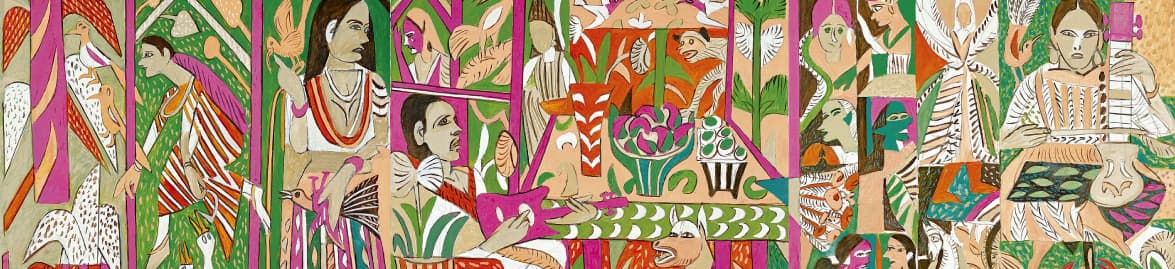
K G Subramanyan, a towering figure in Indian contemporary art, was renowned for his unique approach to visual art that bridged the gap between traditional Indian practices and modernist innovation. One of his most important contributions to the world of art was his exploration and transformation of mural painting. Subramanyan’s mural works played a crucial role in reshaping the way murals were perceived in India, combining ancient techniques with modern sensibilities, creating a dynamic fusion that captured the cultural and aesthetic richness of both tradition and contemporary thought.
Born in 1924 in Kerala, Subramanyan’s early education and training in art were shaped by his exposure to both the classical and modernist traditions. While he studied at the Government College of Fine Arts in Chennai and later in Baroda, it was the deep connection to his roots in traditional Indian art that would form the cornerstone of his artistic practice. This connection was particularly evident in his approach to mural art, where he drew inspiration from the ancient traditions of Indian temple painting and frescoes, but interpreted them in ways that reflected the changing world of post-Independence India.
A Deep Reverence For Indian Tradition
Subramanyan’s mural works were deeply informed by the rich history of Indian art, particularly the mural traditions found in the temples of Kerala, Tamil Nadu, and other parts of India. These murals, often featuring mythological and religious themes, had long been an important part of the cultural and spiritual fabric of the country. The bright, vibrant colours and intricate detailing of these traditional murals were key elements in Subramanyan’s own artistic vocabulary.
However, while Subramanyan embraced these traditional forms, he was also deeply aware of the need to reinterpret them in a modern context. The sacred and the spiritual were always central themes in his work, but he recognised that the social and political climate of post-Independence India demanded new forms of artistic expression. Subramanyan’s murals therefore became a site of negotiation between the old and the new, between tradition and modernity.
Bridging The Gap Between Tradition & Modernity
Subramanyan's mural works are best understood as a dialogue between traditional Indian practices and the evolving ideas of modern art. He saw the potential of merging the visual elements of ancient Indian murals with the principles of modern art, which were based on abstraction, experimentation, and individual expression. This fusion resulted in murals that were not only a continuation of India’s artistic heritage but also a reflection of the country’s complex and changing identity in the post-colonial era.
His approach to muralism was revolutionary. While he respected the formal elements of traditional murals—such as the use of mythological and folk motifs, as well as the characteristic flatness of the surfaces—he introduced a contemporary sensibility to the compositions. This included the use of bold, graphic lines, simplified forms, and a playful approach to perspective and space. Through these techniques, Subramanyan created a distinct style that resonated with both the ancient and the modern.
Materiality & Technique
Subramanyan was also a pioneer in the way he used materials and techniques in his murals. In traditional murals, natural pigments were used alongside lime plaster or clay, creating a tactile, textured surface that was integral to the aesthetic experience. Subramanyan, however, was open to experimentation with a variety of materials, ranging from synthetic paints to different kinds of textures. His exploration of new materials allowed him to bring a fresh, contemporary approach to an age-old medium.
In some of his major mural works, he employed both traditional techniques of fresco and tempera painting, but often combined them with newer methods such as synthetic pigments and mixed media, blurring the lines between conventional mural painting and modern mural art. By doing so, Subramanyan was able to achieve a level of dynamism and vibrancy in his murals that was unlike the traditional works, but still retained the depth and spiritual resonance that defined classical Indian mural painting.
Narrative & Symbolism
At the heart of Subramanyan’s mural works is his ability to weave complex narratives using familiar symbols and motifs from Indian mythology, history, and daily life. While traditional Indian murals often depicted religious or mythological stories, Subramanyan’s murals expanded the narrative scope to encompass broader themes, including social issues, cultural transformation, and the tension between rural and urban life in post-Independence India.
His use of symbols was both deeply rooted in Indian iconography and yet open to modern interpretations. For example, in his murals, gods and mythological creatures from Indian tradition coexisted with images of contemporary figures and urban landscapes, reflecting the changes in Indian society. Subramanyan often employed metaphorical representations, where figures and objects could stand for multiple meanings, allowing viewers to engage with the work on both an intellectual and emotional level.
His murals were not simply aesthetic objects; they were deeply intellectual works that engaged with questions of identity, culture, and tradition in a rapidly changing world. This blending of the sacred and the secular, the traditional and the modern, made his work particularly significant in the context of post-Independence India.
Influence On Indian Muralism & Art Education
Subramanyan’s murals had a profound influence on the landscape of Indian art, particularly muralism. As an educator, he was instrumental in shaping the next generation of Indian artists, especially through his long association with the Faculty of Fine Arts at the Maharaja Sayajirao University in Baroda. His commitment to teaching and his focus on both traditional and modern methods of artistic expression inspired countless students, many of whom went on to become influential artists in their own right.
His involvement in mural projects across India also brought attention to the revival and modernisation of mural art in India. Whether it was in temples, public spaces, or academic institutions, Subramanyan’s murals transformed the way murals were viewed—not just as religious or cultural artefacts but as dynamic works of contemporary art. His influence has continued to shape the practice of muralism in India, making it a significant medium for artistic expression in both urban and rural settings.
Legacy & Recognition
K.G. Subramanyan’s murals stand as a testament to his extraordinary vision as an artist. By transforming the traditional mural form into a vehicle for modern artistic expression, he has left a lasting legacy in the world of Indian art. His works are not merely decorative; they are narratives of cultural evolution, spiritual reflection, and intellectual engagement with the issues of his time.
Subramanyan's recognition as one of India’s most important modern artists was well deserved, and his murals remain an essential part of the visual language of contemporary Indian art. His work continues to inspire artists and art lovers alike, and his legacy as a master of both traditional and modern muralism will continue to influence the direction of Indian art for generations to come.
In conclusion, K G Subramanyan mural works represent the perfect synthesis of tradition and modernity, a balance between the past and the present, and a reflection of the social, cultural, and spiritual fabric of India. Through his innovative and intellectual approach to muralism, he not only revived an ancient art form but also gave it new life in a rapidly changing world, ensuring that it remains a powerful medium of artistic expression today.