between folk & feminist themes: the unique style of madhvi parekh
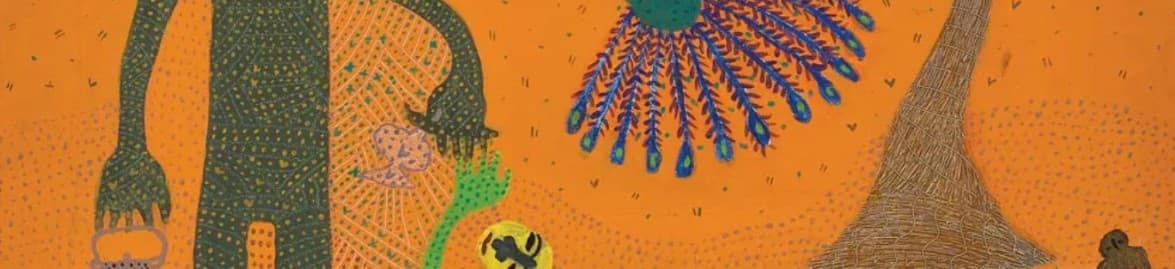
Madhvi Parekh (b. 1942) is a celebrated Indian contemporary artist known for her unique blend of folk art motifs, childhood memories, women’s crafts, and mythological themes with a modern, surrealist style. Her work strikingly transforms traditional vernacular art into vibrant, imaginative compositions that speak to personal and cultural narratives.
Early Life
• She was born in 1942 in the village of Sanjaya (sometimes spelled “Sanjay”), near Ahmedabad, Gujarat.
• Her father was a Gandhian school teacher and also served as postmaster; the environment was one imbued with education, rural crafts, and values of equality.
• From childhood she was exposed to village life, folk stories, traditional rituals, Rangoli (floor designs), temple ceremonies, nature, animals etc., which later became recurring motifs in her art.
Later Life
• At age 15, she married Manu Parekh, a fellow artist. She moved with him first to Ahmedabad, then Mumbai, then to Kolkata (briefly), and finally settled in New Delhi.
• Though she had no formal art education, over time she began painting (first in the 1960s), gradually broadening her medium and developing a distinctive style.
• Her later works continue to reflect her rural past but also respond to urban life, travels, and larger mythic, religious, and symbolic themes. She has engaged with large scale works, reverse painting on glass/acrylic, and explorations in serigraph, etc.
Family
• Husband: Manu Parekh, himself a well-known painter.
• Children: She has a daughter i.e Manisha Parekh, who is also an artist.
• Siblings: She grew up with sisters and brothers; the family setting and her father’s egalitarian attitude influenced her early years.
Education
Despite not receiving formal training in fine arts, Madhvi Parekh is largely self-taught. A key catalyst was her husband gifting her Paul Klee's Pedagogical Sketchbook, which deeply influenced her style and approach to color and form.
Painting Style
Her paintings meld simple geometric shapes, dots, and lines, often inspired by folk embroidery motifs like kantha, rangoli, and other craft traditions. Her style blends surrealism with folk narratives, infusing personal memories, myths, and fantasy into vivid, fluid compositions.
Famous Paintings
Here are some of her well-known works, with details:
The Last Supper - Created in 2011. Reverse painting on acrylic sheet. It’s one of her large-scale works. It is a reinterpretation of Da Vinci’s The Last Supper but through her own visual vocabulary.
Sea God (1971) - Oil on canvas. Features mythic creature, a three-legged figure with surrounding mythological / floating creatures, in blues and greens.
World of Kali (1971) - Oil and oil pastel. Full-body depiction of Goddess Kali in her powerful form.
Kaliadaman (1993) - Depicts the tale of Krishna taming the serpent Kaliya.
Playing With Animals (1989) - Oil on canvas. A large painting capturing human-animal interactions in her stylized, whimsical way.
Characteristic Features of Her Paintings
• Flatness: Surfaces tend to avoid deep perspective; figures, motifs are often stylised, placed without concern for realistic depth.
• Decorative motifs: use of border-like elements, repeating patterns, embroidery/lace-like or textile-like textures.
• Narrative / Memory: Scenes often drawn from rural childhood memories; myth and ritual; village animals, deities, festivals etc. Memory is central.
• Hybrid Figures: Animals, humans, deities sometimes merged; imaginary beings; anthropomorphic forms.
• Rhythm & Repetition: Rhythmic use of line, dot, geometric shape; repeating elements to create decorative effect.
• Colour: Bold, vivid colours; contrast; often saturated tones.
• Technique/Medium variety: From traditional folk materials/methods to modern ones; reverse painting; serigraphs etc.
Exhibitions
Some of her important solo and group exhibitions:
• The Curious Seeker, (Delhi, Mumbai, New York), 2017-2019 – a major retrospective.
• The Last Supper, Seagull Foundation for the Arts, Kolkata & New Delhi, 2011.
• Living Walls, Art Alive Gallery (2013)
• Fair and Furious: Feminine Fables, Jebiwool Art Museum, Seoul (2004)
• Through the Looking Glass, paintings by Nalini Malani, Madhvi Parekh, Nilima Sheikh, Arpita Singh (1987-1989) multiple cities in India.
• International group shows: in London, Amsterdam, New York, Australia, Kuwait etc.
Awards & Achievements
• National Award from Lalit Kala Akademi, New Delhi (1979)
• Senior Fellowship from Government of India (for the Arts)
• Fund for Artists Colonies / Residency Fellowship at Fine Arts Work Center, Provincetown, USA
• Whirlpool Women’s Achievement Award in the World of Fine Art (2003)
• French Government Scholarship for Fine Arts to study in Paris (1970-72)
• More recently, she was conferred the Kailash Lalit Kala Award by Chitrakutdham Trust in Gujarat.
Contribution in Indian Art
Madhvi Parekh enriched Indian contemporary art by marrying folk visual language with modernist aesthetics, expanding the narrative capacity of Indian art and inspiring a fusion of personal and collective memory in art.
Enduring Legacy & Impact
Her pioneering efforts paved the way for multiple generations of artists to explore indigenous crafts and narratives within a global contemporary art framework. Her influence is acknowledged for blending feminist themes subtly through her autobiographical and socially conscious works.
Conclusion
Madhvi Parekh is a singular figure in Indian art. Without formal training, she has managed to build a body of work over nearly six decades that is deeply rooted in her rural past, yet constantly evolving in technique, scale, theme and form. Her paintings are joyous, imaginative, richly patterned, yet also profound in their sense of memory, myth, and narrative. She occupies an important position between folk tradition and modern art, and has significantly contributed to expanding what Indian contemporary art can look like especially by women artists drawing on the everyday and the mythic.
Lesser-Known Facts
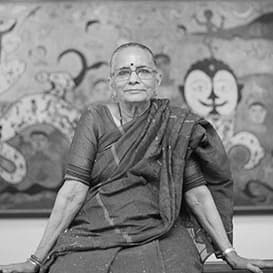 • She began painting in earnest while pregnant with her first daughter, Manisha.
• Her style is often being influenced by a single book: Pedagogical Sketchbook by Paul Klee, gifted to her by her husband, which introduced her to geometrical shapes etc.
• Reverse painting on glass/acrylic (painting in reverse order) is a technique she learned from fellow artist Nalini Malani.
• Even as she becomes older, she continues to sketch consistently, including in sketchbooks that span decades, to capture everyday observations, rain, travel, memories.
• She does not consider herself a “folk artist,” even though her work draws heavily from folk forms, she prefers to see her work as its own language.
• Her works are now increasingly becoming part of fashion / craft collaborations; for instance, having been involved in recent shows or backgrounds for haute couture exhibitions etc.