


bharti khers exploration of identity, gender, and societal norms
Fast Facts:
Date of Birth: October 23, 1969.
Place of Birth: London, England.
Nationality: Indian.
Profession: Indian Contemporary Artist (Painting, Sculpture).
Education: Middlesex Polytechnic, London.
Themes: Identity, Gender, Cultural Heritage.
Spouse: Subodh Gupta (Artist).
Biography:
Born in 1969 in London, England, Bharti Kher is a British-Indian contemporary artist known for her innovative and thought-provoking mixed media works. Kher's early life was marked by a rich cultural heritage, with her mother hailing from a traditional Indian family and her father being a British artist. This unique blend of cultures would later influence her artistic practice, as she sought to explore the complexities of identity, belonging, and cultural fusion.
Artistic Journey:
Kher's artistic journey began with a degree in Fine Art from the Chelsea College of Art and Design in London. However, it was her fascination with anthropology that led her to explore the intersection of art and culture. Her work often incorporates elements of Indian folk art, embroidery, and textile traditions, which she combines with modern materials and techniques to create intricate, layered pieces.
Famous Paintings:
Among Bharti Kher's notable series are The Hunter and the Prophet, An Absence of Assignable Cause, Impossible Triangle, Solarum Series, A Letter to My Love and Seeing Some Things Better. Another significant series, "The Skin Speaks a Language Not Its Own," uses the symbolism of a dying elephant to address the impacts of popular culture, mass media, and consumerism on Indian culture. The series employs the image of the elephant, a traditional symbol of strength and wisdom in Indian culture, to contemplate the destructive effects of these modern influences on cultural heritage. In these works, Bharti Kher explores how the grandeur of traditional symbols, such as the elephant, are being eroded by contemporary forces. The use of elaborate textures and layers in these pieces mirrors the complexities and often the erosion of cultural identity under the pressures of modernity. Through this powerful imagery, Kher critiques the commodification of culture and its consequences on traditional values and practices.
The Skin Series:
One of Kher's most iconic series, "The Skin," features intricate, hand-painted elephant sculptures adorned with vibrant, swirling patterns. These works are a metaphor for the artist's own journey of self-discovery, as she navigates the complexities of her British-Indian identity. The elephants, often seen as symbols of wisdom and strength, serve as a canvas for Kher's exploration of cultural heritage and personal identity.
The Elephant Capital Series:
In her "Elephant Capital" series, Kher critiques the legacy of colonialism and imperialism. The works feature elephants with intricate, ornate patterns, which are juxtaposed with industrial materials like steel and concrete. This contrast highlights the tension between cultural heritage and economic power, underscoring the artist's concern with the impact of colonialism on indigenous cultures.
The Family Series:
Kher's "The Family" series is a celebration of cultural diversity and the complexities of family relationships. The works feature intricate, hand-painted wooden sculptures of family members, adorned with traditional Indian patterns and motifs. This series is a testament to the artist's own experiences as a British-Indian woman, navigating the complexities of cultural identity and belonging.
Painting Style:
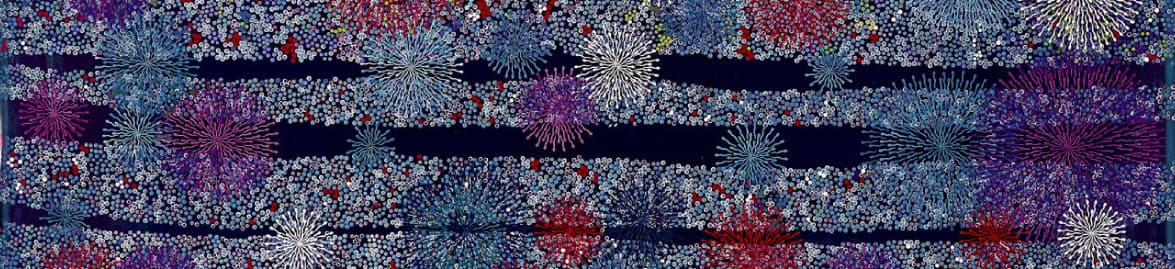
The strength of Kher's painting lies in eclecticism and depth. Most of her works mix traditional motifs with contemporary uses for bindis and other materials in very textured, often multidimensional surfaces. It is characterised by minute detail, intricate patterns, inviting close inspection by the viewer. The use of bindis and elements of Hindu mythology is characterised by minute detail, intricate patterns, inviting close inspection by the viewer. She approaches subjectivity and universality, taking on timeless issues like identity, gender, and cultural heritage.
What imparts to Bharti Kher's paintings their distinctive character is her ability to ennoble or transform ordinary materials into profound symbolism. In her work, bindi art do not merely serve as ornamentation. They possess multiple layers of meaning. Her paintings often sport intricate patterns that convey a depth and sense of richness, inviting viewers to explore the multiple layers of significance in her work.
Classifications Of Her Paintings:
The paintings of Bharti Kher can be broadly divided into thematic categories, including:
1. Identity and Gender: The works that fall under this category would be those where the bindi becomes a representational device for suggesting contemporary ideas of identity and gender. The most famous work by this artist, "The Skin Speaks a Language Not Its Own" (2006), is an extraordinary example. The works in this category show that one essential topic in Kher's oeuvre is her use of self as a subject to discuss personal and cultural identity and question how these features intersect and affect each other.
2. Societal Norms: Works that challenge norms and expectations in society, often incorporating playful elements of popular Indian culture in unconventional ways. Kher's art challenges the given conventions of society and encourages a revisit into the accepted norms and practices.
3. Mixed Media: Works that incorporate a combination of materials and techniques, which attain a variety of surfaces, ultimately creating complex textures that address themes both classic and contemporary. Kher's mixed media works are often characterised by the use of resin, metal, and fabric, combined and integrated with her hallmark use of bindis, to derive unique and engaging works of art.
4. Abstract and Conceptual: This includes works that deal with abstract forms and conceptual ideas of a philosophical nature, along with broader cultural questions. Abstract ideas are investigated, and deeper intellectual motives are treated by these works.
Awards and Collaborations:
Kher's work has been recognized with numerous awards and exhibitions worldwide. Her solo exhibitions have been held at the Museum of Modern Art (MoMA) in New York, the Tate Modern in London, and the British Museum in London. She has also been featured in group exhibitions at the Venice Biennale and the Turner Prize.
Conclusion:
Bharti Kher's art practice is a testament to the power of art in navigating the complexities of identity, culture, and belonging. Through her mixed media works, she has created a unique narrative that celebrates cultural diversity and critiques the legacy of colonialism. As a British-Indian artist, Kher's work serves as a bridge between cultures, traditions and personal experiences, offering a glimpse into the complexities of the human experience.
Curious to see Bharti Kher's original paintings? Visit here for a curated collection of her original pieces.




