bhil, the art of painting with dots & storytelling
.jpg&w=3840&q=75)
In the heart of Madhya Pradesh, Gujarat, Rajasthan and Maharashtra, Bhil art is a celebratory expression of the Bhil tribe, the second-largest tribal community in India. Known for its explosion of colors and rhythmic patterns, Bhil art serves as a bridge between the spiritual world of ancestors and the daily realities of rural life.
What is Bhil Art?
Bhil art is a distinct form of storytelling characterized by the use of multi-colored dots to create images. Historically, these paintings were not meant for decoration but were ritualistic offerings to the gods. Every painting is a collection of thousands of dots that map out the artist's environment, folklore, and internal world.
Origin and History
The Bhils are believed to be among India's oldest indigenous inhabitants, with references to them appearing in ancient texts including the Mahabharata and Ramayana. The word "Bhil" is thought to derive from "bil," meaning bow, reflecting their traditional identity as forest-dwelling archers and hunters. For millennia, the Bhil people have inhabited the mountainous regions spanning Rajasthan, Gujarat, Madhya Pradesh, Maharashtra, and parts of Tripura.
Bhil art's origins are deeply rooted in ritualistic and ceremonial practices. Traditionally, the art was created on the walls of houses, particularly during important occasions such as marriages, harvests, and religious festivals. Women primarily practiced this art form, using natural pigments and simple tools to create elaborate murals that would invoke blessings, ward off evil, and celebrate life's milestones.
Types
While Bhil art is often grouped under one umbrella, it can be categorized into:
• Pithora Paintings: Large-scale ritualistic wall murals traditionally painted by men (the Likhindras).
• Contemporary Bhil Art: Modern interpretations on paper and canvas, popularized by women like Bhuri Bai, focusing on narrative storytelling.
Symbolism
Symbolism in Bhil art runs deep, with every element carrying layered meanings that connect the material and spiritual worlds. Understanding this symbolic language is key to appreciating the art's cultural significance.
• Animals are among the most prevalent symbols. Horses represent power, mobility, and the divine (as Pithora rides a horse). Tigers symbolize strength and protection. Birds, particularly peacocks, represent beauty, rain, and fertility. Fish signify abundance and the life-giving properties of water. Snakes are associated with fertility, danger, and the earth's energy. These animals are not merely observed from nature but imbued with spiritual significance drawn from Bhil mythology.
• Trees and Plants symbolize life, growth, and the connection between earth and sky. Certain trees are considered sacred and believed to house spirits or deities. The representation of trees often includes their roots, trunk, branches, leaves, and fruits simultaneously showing the whole life cycle in a single image.
• Human Figures typically represent community, family, and the daily activities that sustain life. Women carrying water, men hunting or farming, children playing; these scenes celebrate the ordinary as sacred. The figures are rarely individualized; instead, they represent archetypal roles within the community.
• Geometric Patterns such as dots, spirals, zigzags, and concentric circles carry cosmic significance. Dots might represent seeds, stars, or rain. Spirals suggest growth, evolution, and the cyclical nature of time. Zigzag lines often symbolize water, lightning, or the serpent's movement.
• Colors have symbolic associations: red might represent blood, life force, or the earth; yellow could signify ripening grain or the sun; white often represents purity or spirituality; black provides contrast but also represents the fertile soil or the night sky.
Painting Techniques
The most defining technique is the Pointillist style. Artists start with a solid silhouette of a figure; be it a bird, a human, or a tree and then meticulously fill the interior with patterns of dots. These dots are often arranged in rows or concentric circles to create a sense of movement or "vibration" on the surface.
Method of Making
The traditional method of creating Bhil art, particularly Pithora paintings, follows a ritualistic process that is as important as the final artwork.
• Surface Preparation begins with preparing the wall. The surface is cleaned and often coated with a mixture of cow dung and mud to create a smooth, slightly textured base. For contemporary works on paper or canvas, the surface might be primed with gesso or left natural.
• Sketching involves lightly outlining the main elements of the composition. Traditionally, this was done freehand, with designs passed down through generations or improvised based on established conventions. Contemporary artists might sketch more elaborate compositions, though many still work intuitively.
• Outlining comes next, where the main forms are defined with bold lines, typically in black or dark brown. This creates the framework that will be filled with patterns.
• Pattern Filling is the most time-intensive stage. Working section by section, the artist fills each form with chosen patterns. This requires deciding which patterns to use where, maintaining consistent spacing and rhythm, and ensuring that different pattern areas work harmoniously together.
• Color Application might happen simultaneously with pattern creation or as a subsequent step, depending on the artist's technique and materials. Colors are applied in layers, building up depth and vibrancy.
• Detailing and Finishing includes adding final touches, strengthening outlines, and ensuring visual balance across the entire composition. For ritual paintings, this stage might also involve ceremonial marking or blessing of the completed work.
Materials Used
Traditional Bhil art relied entirely on locally sourced, natural materials, reflecting the community's intimate knowledge of their environment.
• Natural Pigments were prepared from various sources: red and orange from red ochre or iron oxide; yellow from turmeric or yellow ochre; white from chalk or rice paste; black from charcoal or soot; green from leaves or copper compounds; blue from indigo or certain minerals. These pigments were ground into fine powder and mixed with binders.
• Binders included gum from trees, rice paste, or milk, which helped the pigments adhere to surfaces and created the desired consistency for application.
• Brushes and Tools were fashioned from natural materials: twigs with chewed ends, bamboo sticks, feathers, or grass bundles. Different tools created different marks; fine points for detailed work, broader tools for filling larger areas.
• Painting Surfaces traditionally included mud walls prepared with dung and clay mixtures. The slightly absorbent, textured surface was ideal for natural pigments.
Themes & Motifs
Bhil art draws from a rich well of themes that reflect the community's worldview, environment, and cultural practices.
• Mythology and Religion dominate traditional Bhil art. Pithora, the primary deity, appears frequently, usually mounted on a horse and surrounded by symbolic elements. Other deities, spirits, and supernatural beings populate the Bhil cosmos, each with specific attributes and stories.
• Nature and Wildlife feature prominently, reflecting the Bhil people's forest-dwelling heritage. Animals are not simply decorative but carry specific meanings and stories. The interdependence of humans and nature is a constant theme, with hunting scenes, agricultural activities, and forest settings frequently depicted.
• Daily Life celebrates the ordinary activities that sustain the community: women fetching water, men plowing fields, children playing, communal gatherings, and festivals. These scenes document social practices and gender roles while elevating everyday labor to artistic subject matter.
• Festivals and Celebrations including weddings, harvest festivals, and religious ceremonies provide rich visual material. These scenes burst with activity, color, and joy, capturing the communal spirit that defines Bhil culture.
• Village Scenes offer panoramic views of community life, with multiple activities happening simultaneously. Houses, trees, animals, people, and spirits might all share the same composition, creating a holistic representation of the Bhil world.
Distinctive Features
Several features make Bhil art instantly recognizable and distinguish it from other Indian folk art traditions.
• Pattern-Filled Forms represent the most distinctive characteristic. Rather than using solid colors, every shape is filled with intricate patterns of dots, lines, or other marks. This creates a unique visual texture that gives the art remarkable depth and energy.
• Flat Picture Plane means all elements exist on the same visual level without Western-style perspective. This isn't a limitation but an aesthetic choice that allows equal importance to all elements.
• Vibrant Color Palette featuring earthy tones accented with bright hues creates visual impact. The color choices often have symbolic rather than naturalistic motivations.
• Busy Compositions where multiple elements coexist without hierarchical organization reflect a worldview that sees interconnection rather than separation between life forms and activities.
• Rhythmic Quality emerges from the repetitive marks that fill forms. The art has an almost musical quality, with visual rhythms creating movement and energy.
• Stylization over Realism means animals, humans, and plants are rendered according to cultural conventions rather than optical observation. This stylization allows immediate identification while maintaining symbolic flexibility.
• Border and Frame Elements often include decorative borders or framing devices that contain the main composition, creating a sense of completeness and enclosure.
Significance
Bhil art holds profound significance on multiple levels; cultural, spiritual, social, and economic.
• Cultural Preservation: In an era of rapid modernization and cultural homogenization, Bhil art serves as a vital link to ancestral knowledge and traditions. The art encodes mythology, environmental wisdom, social practices, and philosophical concepts that might otherwise be lost.
• Spiritual Expression: For the Bhil community, particularly in traditional contexts, art-making is a spiritual practice. Pithora paintings aren't merely decorations but sacred objects that mediate between human and divine realms, invoking blessings and protection.
• Identity and Pride: The recognition and appreciation of Bhil art has fostered cultural pride within the community. Young people see their traditions valued and respected, countering the marginalization tribal communities have historically faced.
• Economic Opportunity: For artists like Bhuri Bai and others, art has provided economic independence and social mobility while allowing them to stay connected to their cultural roots. The art market for Bhil paintings has created sustainable livelihoods for numerous artists and their families.
• Educational Value: Bhil art serves as a teaching tool, conveying cultural knowledge and values across generations. Children learn myths, moral lessons, and community history through visual narratives.
• Aesthetic Contribution: Beyond its cultural context, Bhil art represents a significant aesthetic achievement. Its distinctive visual language expands our understanding of artistic possibility and challenges hierarchies that privilege certain art traditions over others.
Famous Artists
Several artists have been instrumental in bringing Bhil art from village walls to international recognition.
• Bhuri Bai (born 1960) is perhaps the most celebrated Bhil artist. Born in Pitol village, Madhya Pradesh, she worked as a laborer before being introduced to painting on paper and canvas at Bharat Bhavan in Bhopal. Her works depicting village life, animals, and nature have been exhibited internationally. She has received numerous awards including recognition from the Government of Madhya Pradesh. Her success paved the way for other Bhil artists, particularly women.
• Lado Bai (born 1972) is another prominent female artist whose works focus on traditional themes rendered with exceptional skill. Her paintings often feature elaborate village scenes, festivals, and mythological subjects. She has been instrumental in training younger artists and maintaining traditional techniques.
• Kalu Ram Shyam has gained recognition for his bold compositions and experimental approach to color. While rooted in tradition, his works show individual creativity in subject selection and treatment.
• Durgabai Vyam, though primarily known for Gond art, has also worked with Bhil techniques, demonstrating the cross-pollination between tribal art traditions.
• Roshni Vyam represents the younger generation of artists who are adapting traditional techniques to contemporary themes while maintaining cultural authenticity.
These artists have not only achieved individual success but have become cultural ambassadors, representing their community and traditions on national and international platforms.
Famous Paintings
Several Bhil paintings have achieved iconic status, becoming reference points for understanding the tradition.
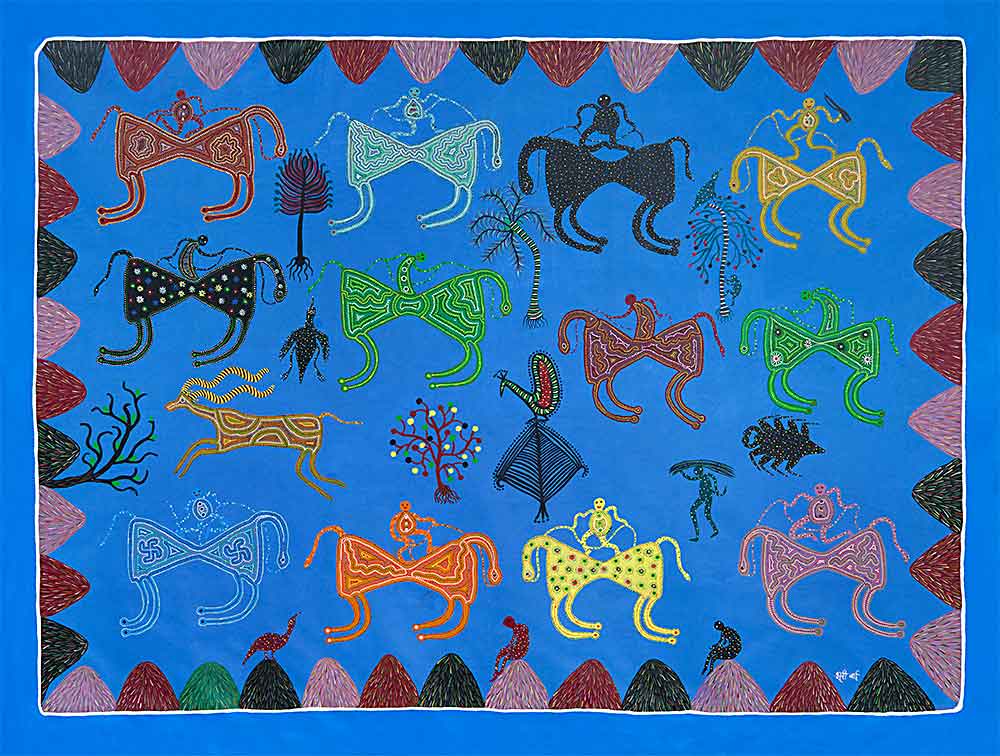 • "My Village" by Bhuri Bai is perhaps the most recognized Bhil painting. This large-scale work depicts a comprehensive village scene with houses, trees, animals, people engaged in daily activities, and surrounding nature. Every element is filled with intricate dot work, creating a mesmerizing tapestry of community life. The painting captures both the specificity of Bhil culture and universal themes of home and belonging.
• "Tree of Life" compositions by various artists explore the sacred significance of trees in Bhil cosmology. These paintings show trees as cosmic entities, filled with birds, spirits, and symbolic patterns that represent the tree's role as a bridge between earth and heaven.
• "Pithora on Horseback" in its many iterations represents the most traditional and sacred subject in Bhil art. These paintings show the deity surrounded by attendants, animals, and symbols of prosperity, following iconographic conventions passed down through generations.
• "Hunting Scenes" by various artists reflect the Bhil community's historical relationship with the forest. These dynamic compositions show men with bows pursuing animals through dense vegetation, capturing both the practical aspects of subsistence and the spiritual dimensions of hunting.
• "Festival Celebrations" paintings capture the joy and communal spirit of tribal festivals, with elaborately dressed figures, musicians, dancers, and celebrants filling the composition with movement and color.
Modern Revival and Global Reach
The revival and transformation of Bhil art from a localized traditional practice to a globally recognized art form represents one of Indian folk art's great success stories.
• Institutional Support has been crucial. Bharat Bhavan in Bhopal, under J. Swaminathan's vision, provided the initial platform. Subsequently, organizations like the Indira Gandhi National Centre for the Arts, various state art academies, and NGOs have supported Bhil artists through training, materials, exhibition opportunities, and market access.
• Exhibition Opportunities have expanded dramatically. Bhil art has been featured in major museums and galleries worldwide, including exhibitions in Europe, America, and Asia. These exposures have created international markets and critical appreciation.
• Publications including art books, catalogs, and collaborative projects have documented and celebrated Bhil art, making it accessible to broader audiences and ensuring its preservation in archival form.
• Digital Platforms have opened new avenues for visibility and sales. Artists and galleries use social media and online marketplaces to reach collectors globally, bypassing traditional gatekeepers.
• Collaborative Projects with contemporary artists, designers, and brands have introduced Bhil aesthetics to new contexts from fashion and home décor to public murals and digital media.
• Academic Interest has grown, with scholars studying Bhil art from anthropological, aesthetic, and cultural perspectives, legitimizing it as a subject worthy of serious academic inquiry.
• Government Recognition through awards, grants, and cultural programs has validated Bhil art's importance to India's cultural heritage.
This modern revival hasn't diluted the tradition but rather has allowed it to evolve while maintaining its core identity. Contemporary Bhil artists balance innovation with tradition, creating works that speak to both their community and global audiences.
Challenges
Despite its success, Bhil art and its practitioners face significant challenges that threaten the tradition's sustainability and authenticity.
• Economic Precarity remains a reality for many artists. While a few have achieved financial success, many struggle with inconsistent income, lack of fair pricing, and exploitation by middlemen who take large commissions while artists receive minimal compensation.
• Loss of Traditional Knowledge occurs as younger generations move to cities for education and employment. The intricate symbolic systems, mythological narratives, and technical skills risk being lost if not adequately transmitted to new generations.
• Cultural Dilution threatens as commercial pressures encourage artists to create what sells rather than what has cultural meaning. There's tension between market demands and cultural authenticity, with some artists pressured to oversimplify or alter their work to appeal to buyers' tastes.
• Material Changes while enabling portability and preservation, have also changed the art's nature. The shift from natural pigments to acrylics, from wall surfaces to canvas, from communal creation to individual production, transforms not just the technical process but potentially the art's spiritual and cultural dimensions.
• Intellectual Property Issues arise as Bhil designs appear on commercial products without proper attribution or compensation to the community. Protecting traditional knowledge and ensuring artists benefit from their cultural heritage remains challenging.
• Environmental Pressures as forests shrink and traditional lifestyles become unsustainable, the connection to nature that informs Bhil art weakens. Artists increasingly depict a world they remember rather than one they live in.
• Gender Dynamics persist despite prominent female artists. Women still face barriers to recognition and economic independence, and the art world's tendency to focus on a few celebrated names can overshadow the work of numerous skilled but less visible artists.
• Educational Gaps mean many talented artists lack business skills, knowledge of copyright and contracts, or access to direct market channels, leaving them vulnerable to exploitation.
• Authenticity Debates emerge around what constitutes "real" Bhil art, with some purists criticizing contemporary innovations while others argue traditions must evolve to survive.
Addressing these challenges requires multifaceted approaches: fair trade practices, community-based art education, intellectual property protections, documentation projects, and support systems that empower artists economically while respecting cultural integrity. The goal must be ensuring Bhil art thrives as a living tradition; honoring its past while embracing its future, serving the community that created it while enriching the broader world that has come to appreciate its beauty and significance.