bimal das gupta: a visionary of seascapes and abstraction

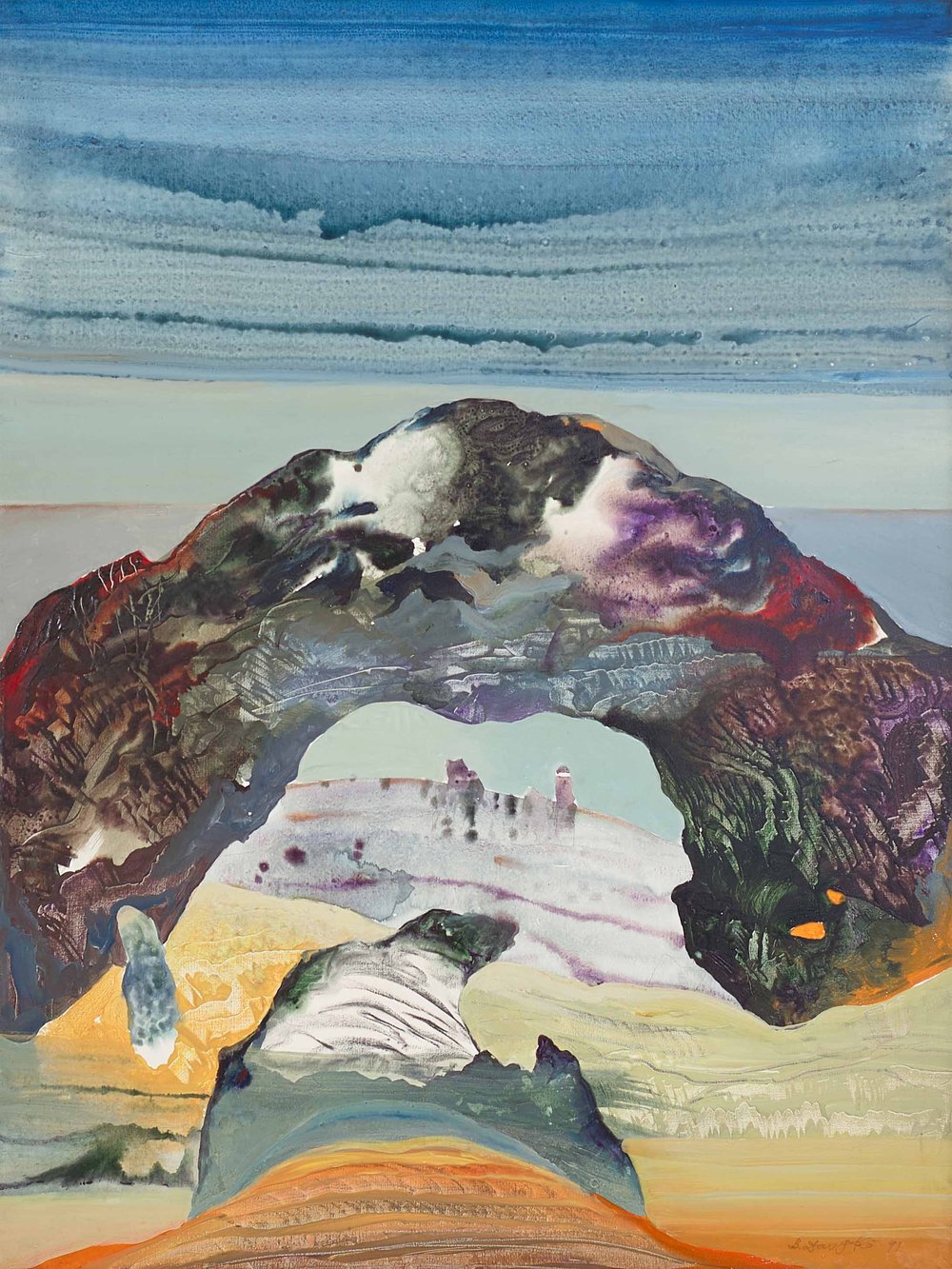
AstaGuru’s upcoming ‘Dimension Defined’ Auction will feature an evocative work by Bimal Das Gupta, a celebrated artist known for his lyrical interpretations of nature and architecture. This particular painting, believed to depict the Santorini lighthouse framed by a natural arch, exemplifies Das Gupta’s mastery in capturing the harmony between man-made structures and their natural surroundings.
The Mastery of Composition and Texture
The interplay of rugged textures and smooth surfaces, juxtaposed against the tranquil hues of the sea and sky, evokes a sense of timeless serenity. Das Gupta’s composition employs warm, earthy tones that infuse the scene with a golden glow, enhancing the depth and dimensionality of the landscape. The natural arch, rendered with tactile detail, frames the lighthouse—an enduring symbol of guidance and resilience amidst the vast, open sea. His skilled manipulation of mediums brings out the contrast between the arch’s ruggedness and the lighthouse’s delicate yet sturdy presence, reinforcing the work’s meditative quality.
The Seascape: A Deep Fascination with Nature
This painting is a testament to Das Gupta’s deep fascination with seascapes, a theme that resonated throughout his career. Having travelled extensively across Europe by sea, he absorbed the interplay of light, water, and architecture, later translating these impressions onto canvas. His ability to merge observation with memory allows this work to transcend realism, offering instead a poetic interpretation of Santorini’s enduring beauty.
The Artistic Journey of Bimal Das Gupta
Born in Bengal in 1917, Bimal Das Gupta was raised by his uncle in Delhi. His early aspirations to become an artist faced resistance from his uncle’s family, but with his father’s support, he enrolled at the College of Arts and Crafts in Calcutta in 1937. However, his studies were disrupted by World War II, leading him to work as a clerk in a war office, where his artistic talents were found to be expressed in “Victory” magazine as an assistant director of artwork. Following the war, Das Gupta worked at the Dhoomimal Art Gallery in New Delhi and for various advertising agencies before transitioning to teaching at the College of Art, New Delhi. His career took a significant turn when he received a scholarship to study and travel in Europe for six months, an experience that introduced him to gouache and oil painting techniques.
The Evolution of Bimal Das Gupta’s Artistic Style
Nature remained the cornerstone of Das Gupta’s artistic practice. While initially recognised for his landscapes, his European travels exposed him to Cubism, which briefly influenced his work. Later, he explored neo-tantrism and pure abstraction, particularly through watercolours and acrylics. His fascination with the ocean led to surreal and abstract depictions of underwater life, imbued with movement and fluidity.
Legacy and Recognition
Das Gupta’s works were widely exhibited both in India and internationally. He was commissioned to create murals for the India pavilions at trade fairs in Moscow and Tokyo, further solidifying his reputation. In 1972, he was honoured by the Sahitya Kala Parishad, New Delhi, and in 1989, he was made a fellow of the Lalit Kala Akademi. He passed away in 1995, leaving behind a rich legacy of artistic exploration.
The Santorini-Inspired Painting: A Poetic Homage
The Santorini-inspired painting in AstaGuru’s auction is a reflection of Das Gupta’s lifelong pursuit of capturing the essence of nature through form and colour. This work stands not just as a visual representation of a picturesque landscape but as a poetic homage to the sea’s eternal allure and the structures that stand resilient within it.