c raja raja varma - the artist and scholar
C. Raja Raja Varma (1860-1905) has long been something of an enigma. Take his name, for example. It isn’t entirely clear what the “C” stands for: some say it represents Kilimanoor, the ancestral seat of his family, spelt in the colonial fashion—like Cawnpore for Kanpur. Others, more convincingly, argue that it marks a domestic nickname: Cherunni. Even his formal name can cause confusion. People sometimes believe the first “Raja” is a title, as in Raja Ravi Varma, and that his given name was simply “Raja Varma”. But the fact is that the two words are meant to be pronounced together: Rajaraja, like with the famous eleventh century Chola emperor.
Born twelve years junior to his better-known sibling, Raja Raja could have led a very different life. When he was a boy, Ravi Varma brought him to Trivandrum so he could be schooled in English, studying alongside the princes of Travancore. And as Raja Raja’s diaries as well as a travelogue from the mid-1890s shows, he certainly picked up the language. But it was also clear to Ravi Varma that his younger brother had a talent for painting. He encouraged it, and as early as 1878—with Raja Raja just out of his teens—he took the latter along for his first major royal commission in the state of Pudukkottai.
 From there, as the old cliché goes, there was “no looking back”—until his untimely and tragic demise in 1905, Raja Raja was his brother’s constant companion. For many years, it is true, he served as something of an assistant to Ravi Varma. As he notes in his diary, the latter’s success was a product of their joint work; it was “we” who travelled around India; “we” who painted assorted maharajahs; “we” who struggled to find models. Newspaper mentions too often speak of the “the brothers” (plural), rather than just Ravi Varma. But by the 1890s, after nearly two decades of apprenticeship, the younger sibling was coming into his own.
Ravi Varma recognised this: many of his later works bear Raja Raja’s signature too. Similarly, while a portrait of Dewan Shungrasoobyer is acknowledged as a Ravi Varma, in his diary Raja Raja notes that he was the one who actually began work on this. Ravi Varma made transfers of money and property to his brother, and was devastated when Cherunni died suddenly. Of course, Raja Raja had long been painting independently too. As a newspaper observed, though the brothers “invariably move[d] and work[ed] together”, they also submitted separate works during competitions. And if Ravi Varma was “an idealist in the strictest sense”, his brother, we read, favoured a “strong realistic feeling”.
This comes across in the themes they preferred. In 1894, Ravi Varma exhibited his Indian Lady Of The Puranic Age while his brother opted for a more contemporary Indian Lady Of The Nineteenth Century. Though they remain uncatalogued, press reports list many of Raja Raja’s works from this period. In Honour Of Baby’s Birthday was “one of the best” at a 1901 show, alongside Roadside Restaurant and Early To The Fair. In 1904, Raja Raja exhibited Triplicane Temple and Siesta, the second praised as the “best figure-painting” on display. Rajaraja’s Lohgad was also described by a European as “the most successful attempt in pure landscape we have ever seen by a Native”.
Raja Raja was also possessed of a mind at once curious and accepting of ideas. Widely travelled, he encountered everyone from princes to “ferocious looking criminal lunatics”. Somewhere in Tamil Nadu, the aristocrat in him sniffed at how an interlocutor of the merchant caste could “talk little more of this great world than pertained to rates and ledgers”. But, as if embarrassed by his own judgemental tone, he added that “many of our most beautiful temples would have tumbled into ruins” were it not for donations by men of this very caste. Visiting Agra’s Moti Masjid evoked “so exalted a spirit of worship that I felt humble”.
Interestingly, among the men the Varma brothers encountered during their peregrinations were a number of “native statesmen”. That is, Indian figures of political authority, often serving as ministers to maharajahs. In Raja Raja’s diary we find several mentioned, of whom they did portraits: Sir T. Madhava Rao, Sir A. Seshia Sastri, and so on. These men were icons to early Indian nationalists. For governing Indian-ruled princely states, often at better standards than British-ruled India, they punctured the colonial claim that “natives” needed to be “civilised” by white men; that Indians did not know how to rule themselves.
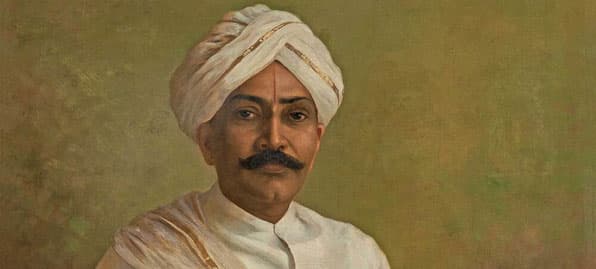
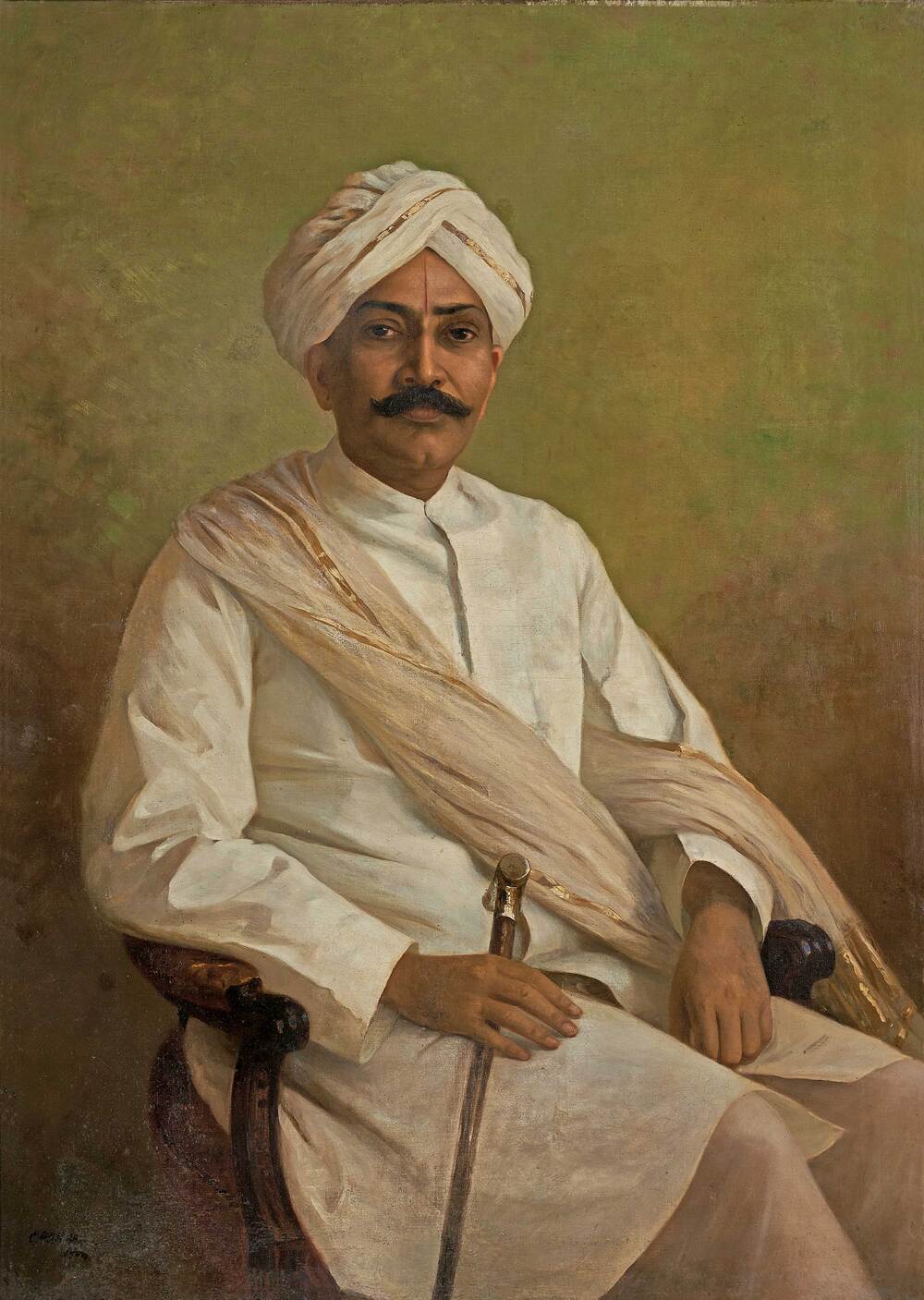
Among these figures was B. Baliah Naidu—a man who features repeatedly in Raja Raja’s diary as a friend, supporter, and host in Madras. Formerly minister to the maharajah of Vizianagram, he not only had his own portrait done by Raja Raja but also one of his wife. Baliah Naidu, of course, in addition to being dewan to a prince, is historically notable in one more way: around 1903-1904 when efforts were on to put together India’s first cricket team—a team that was to surmount differences of caste, class, and region—among those offering to sponsor the effort was Baliah Naidu, the subject of this charming Raja Raja portrait.
Raja Raja’s death—at a time when he was at last coming into his own and carving out a name independently for himself—occurred when his brother and he were in Mysore doing a series for its maharajah. An intestinal inflammation laid him up, and despite the best medical care, he succumbed in early 1905. “Many who for years past have admired his artistic work,” the Madras Weekly Mail observed, “will regret the gap that his loss has made; while those who were privileged to know him personally will mourn him as a friend.” Ravi Varma himself passed away soon after; as an obituary recorded, he “never wholly recovered” from Raja Raja’s death.
Today, the world has, at long last, woken up to Raja Raja as an artist in his own right. Yes, he was essential to all that his brother achieved, and Ravi Varma might not have become what he did were it not for this unobtrusive partner. But Raja Raja—on his own terms and in his own right—too is receiving belated acknowledgment. While money by itself is hardly an appropriate marker, it does offer a belated consolation. At an auction in 2021 by Saffronart one of his works entered the big league, selling for ?3 crore. So while it is late in the day, there is yet delight in the fact that at last Cherunni from Kilimanoor is getting his due.