


edvard munch - biography, paintings, style & facts
Edvard Munch - Learn About The Great Norwegian Artist
Edvard Munch (1863 –1944) was a Norwegian painter, printmaker & symbolist artist renowned for his psychologically intense works. His art explored complex human emotions such as love, anxiety, illness, and death, making him a pivotal figure in the development of modern Expressionism. Munch’s influence continues to resonate in the world of art today, especially through his iconic work The Scream.
Early Life
Born on December 12, 1863, in Løten, Norway, and raised in Christiania (now Oslo), Edvard Munch’s early life was marked by profound personal loss. His mother succumbed to tuberculosis when he was just five years old, and years later, his cherished sister Sophie died from the same illness. Munch himself struggled with frequent bouts of illness, which often kept him from attending school and provided extended periods of convalescence, time during which he cultivated a deep and enduring passion for drawing and painting.
Family
Edvard Munch was born in a rural farmhouse in the village of Ådalsbruk, in Løten, Norway, as the second of five children. His father, Christian Munch, was a practicing physician and a devout Christian, married to Laura Catherine Bjolstad. The family included Munch’s siblings Johanne Sophie, Laura Catherine, Inger Marie, and Peter. In 1868, when Munch was just five years old, his mother died of tuberculosis, the same year his youngest sister, Inger Marie, was born. Less than a decade later, his older sister Sophie, a talented young artist and Munch’s closest sibling, also died of tuberculosis. These early losses had a profound and lasting impact on Munch. Their father, deeply religious, struggled to cope, experiencing bouts of depression and spiritual distress, interpreting the family's misfortunes as divine punishment. Mental and physical illness continued to afflict the Munch family: one sister was later institutionalized for mental illness, and Munch’s only brother died young from pneumonia. These familial tragedies would deeply inform the emotional and thematic content of Munch's later work.
Education
Edvard Munch first studied engineering in 1879 but left after a year for art. He attended the Royal School of Art and Design in Kristiania (now Oslo) in 1881, encouraged by his aunt Karen and mentored by Christian Krohg, who urged him to find his voice in expressing deep psychological states. Early exposure to alternative spiritual ideas, Theosophy, and the works of Edgar Allan Poe further informed his artistic vision.
Later Life
Later in life, Edvard Munch suffered a nervous breakdown in 1908, triggered by years of anxiety, heavy drinking, and personal losses including his sister and father. He was hospitalized in Copenhagen for approximately eight months, undergoing treatments such as a strict diet and electrotherapy. During this period, Munch produced a lithographic series that explored complex personal relationships. Upon his discharge, heeding medical advice, he returned to Norway to lead a quieter, more isolated life. This period marked a shift in his work, characterized by a lighter, more optimistic palette and themes inspired by the Norwegian landscape and rural life, though reflections on mortality persisted in some later self-portraits.
During World War II, following the Nazi invasion of Norway, many of Munch’s works were deemed “degenerate” and removed from German museums. Of the 82 confiscated pieces, 71 were eventually recovered and returned to Norway. In his later years, Munch’s health declined, compounded by intermittent vision loss and illness aggravated by a nearby explosion. He passed away at the age of 80 in Ekely, near Oslo, leaving behind a profound and enduring artistic legacy.
Painting Style and Techniques
Edvard Munch's painting style evolved over time but consistently emphasized emotional content over realism. He often used bold colors, dramatic lines, and distorted forms to convey psychological states. His brushwork could be turbulent and expressive, heightening the emotional intensity of his subjects. Influenced by Paul Gauguin, Vincent van Gogh, and Toulouse-Lautrec, he developed a singular approach known as “soul painting,” which became foundational for Symbolism and Expressionism.
Beyond painting, Munch was also a skilled printmaker. His woodcuts and lithographs allowed him to further explore his themes and reach a broader audience. He often reused motifs across media, reinforcing the symbolic language that made his work so powerful.
Famous Paintings
Below is an overview of some of Edvard Munch’s famous paintings, highlighting their significance and artistic features.
1. The Scream (1893)
The Scream is arguably Munch’s most famous work and one of the most recognizable images in the world. The painting depicts a figure with a distorted, agonized expression set against a turbulent, swirling sky. Munch used vivid colors and dramatic lines to convey intense psychological anguish and existential dread. This piece became a symbol of human anxiety and remains a central work in Expressionism.
2. Madonna (1894–1895)
Madonna is one of Munch’s most controversial works. It portrays the Virgin Mary in a sensual, almost ethereal manner, emphasizing both beauty and spiritual mystery. The painting combines symbolism with emotional intensity, highlighting Munch’s exploration of sexuality, love, and the complex nature of human relationships.
3. The Sick Child (1885–1886)
One of Munch’s earliest masterpieces, The Sick Child reflects his personal experience with illness and loss. The painting depicts a young girl, his sister Sophie, suffering from tuberculosis. Munch’s use of loose brushstrokes and muted tones evokes sorrow and grief, marking a turning point in his focus on emotional depth rather than strict realism.
4. The Dance of Life (1899–1900)
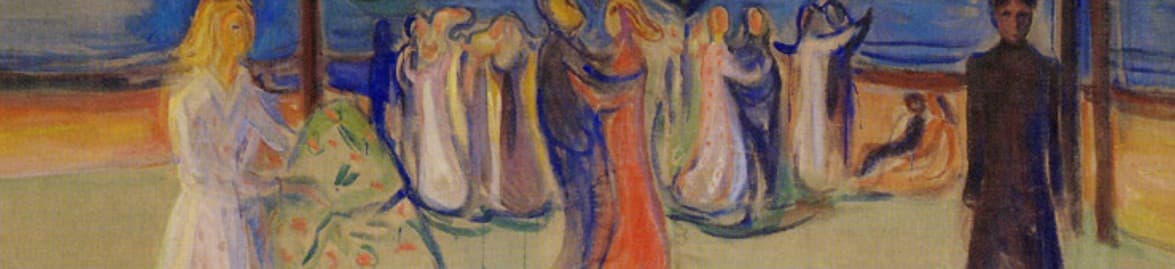
In The Dance of Life, Munch explores the cyclical nature of existence, love, and mortality. The painting depicts figures dancing along a shoreline, symbolizing different stages of life from youth and passion to maturity and reflection. The vibrant colors, rhythmic composition, and symbolic storytelling showcase Munch’s mastery in combining visual beauty with psychological insight.
5. The Sun (1911–1912)
The Sun represents a shift in Munch’s later work toward lighter, more optimistic themes. Inspired by the Norwegian landscape, this painting uses bright colors, open space, and natural motifs to depict warmth, vitality, and renewal. It reflects Munch’s later interest in life, nature, and rural settings, moving away from his earlier focus on despair and mortality.
6. Ashes (1894)
Ashes is a dramatic exploration of love, passion, and emotional turmoil. The painting depicts a man and woman in a forest, with the woman shown in a state of emotional despair. Munch’s use of shadow, color, and composition intensifies the tension between intimacy and alienation, exemplifying his symbolic and psychological approach to human relationships.
Characteristic Features of His Paintings
Edvard Munch’s works are instantly recognizable for their emotional intensity, flowing contours, use of symbolism, and haunting, dreamlike atmosphere. He often employed color to evoke mood and used distorted, stylized figures to represent psychological states. Themes of illness, death, love, and existential dread recur throughout his oeuvre.
Other Artistic Contributions
In addition to painting, Edvard Munch was a prolific printmaker. He explored lithography, etching, and woodcuts, which allowed him to experiment with line, texture, and contrast. His prints helped spread his influence across Europe and contributed significantly to modern graphic art.
Controversy
Edvard Munch’s unconventional style and morbid themes sparked controversy in conservative circles, with several exhibitions drawing harsh criticism. During the Nazi occupation, his works were condemned as “degenerate art,” removed from German museums, and banned in occupied Norway, though some Nazis ironically attempted to laud his Nordic identity.
Achievements
Edvard Munch’s influence in the birth of Expressionism is undisputed. He received the Grand Cross of the Order of St. Olav in Norway on his 70th birthday, and his works set records at auctions, including "The Scream," which sold for over $119 million in 2012. His writings, prints, and paintings are foundational in modern European art history.
Exhibitions
Edvard Munch’s works have been exhibited in Paris, Berlin, and major Norwegian galleries. The Munch Museum in Oslo, established with the artist’s bequest, houses thousands of his pieces and remains a major destination for global art lovers.
Lesser-Known Facts
• Edvard Munch never married, fearing intimacy might interfere with his art.
• He donated over 1,000 paintings, 15,000 prints, and thousands of drawings to Oslo.
• Munch’s interest in spiritualism and Theosophy deeply shaped his approach to art and color.
• His eye problems in later life inspired unique watercolor studies of impaired vision.
• The famous figure in "The Scream" was inspired by a real walk, when Munch felt nature “scream” around him.
Image Credit:
“Dance on the Beach (the Reinhardt Frieze)”, Edvard Munch, via Wikimedia Commons
– Public Domain.




.jpg)