ersari rugs: a deep dive into the kepse & tauk nuska gul
.jpg&w=3840&q=75)
When it comes to Central Asian tribal rugs, few are as richly woven with history and character as the Ersari rug. Produced by one of the largest and most widespread Turkmen tribes, Ersari rugs represent a fascinating chapter in the story of Oriental carpet weaving. Bold in color, complex in pattern, and deeply rooted in nomadic tradition, these rugs have captivated collectors and interior designers for generations.
Who Were the Ersari?
The Ersari were one of the major tribes of the Turkmen people, a nomadic group who historically inhabited the vast steppes and deserts of Central Asia, primarily in the regions that today make up Turkmenistan, northern Afghanistan, and parts of Uzbekistan. As one of the most populous Turkmen tribes, the Ersari were spread across a wide geographic area, which greatly influenced the diversity of their weaving traditions.
Unlike some of the smaller, more isolated Turkmen tribes, the Ersari had significant contact with settled populations, Persian cultural influences, and Afghan weaving traditions. This exposure gave their rugs a distinctive character that sets them apart from the work of other Turkmen groups such as the Tekke or Yomut.
History
Ersari rug weaving dates back several centuries, with the tradition passed down through generations of tribal weavers. Rugs were not simply decorative objects for the Ersari. They were functional items central to nomadic life, used as floor coverings, tent decorations, storage bags, and ceremonial pieces.
During the 18th and 19th centuries, Ersari weaving reached its artistic peak. Pieces from this period are considered the most prized by collectors, valued for their rich natural dyes, fine craftsmanship, and authentic tribal character. As the 20th century brought political upheaval and the decline of nomadic lifestyles across Central Asia, traditional weaving methods gradually gave way to more commercial production, though skilled weavers continued to preserve the old techniques.
Design and Patterns
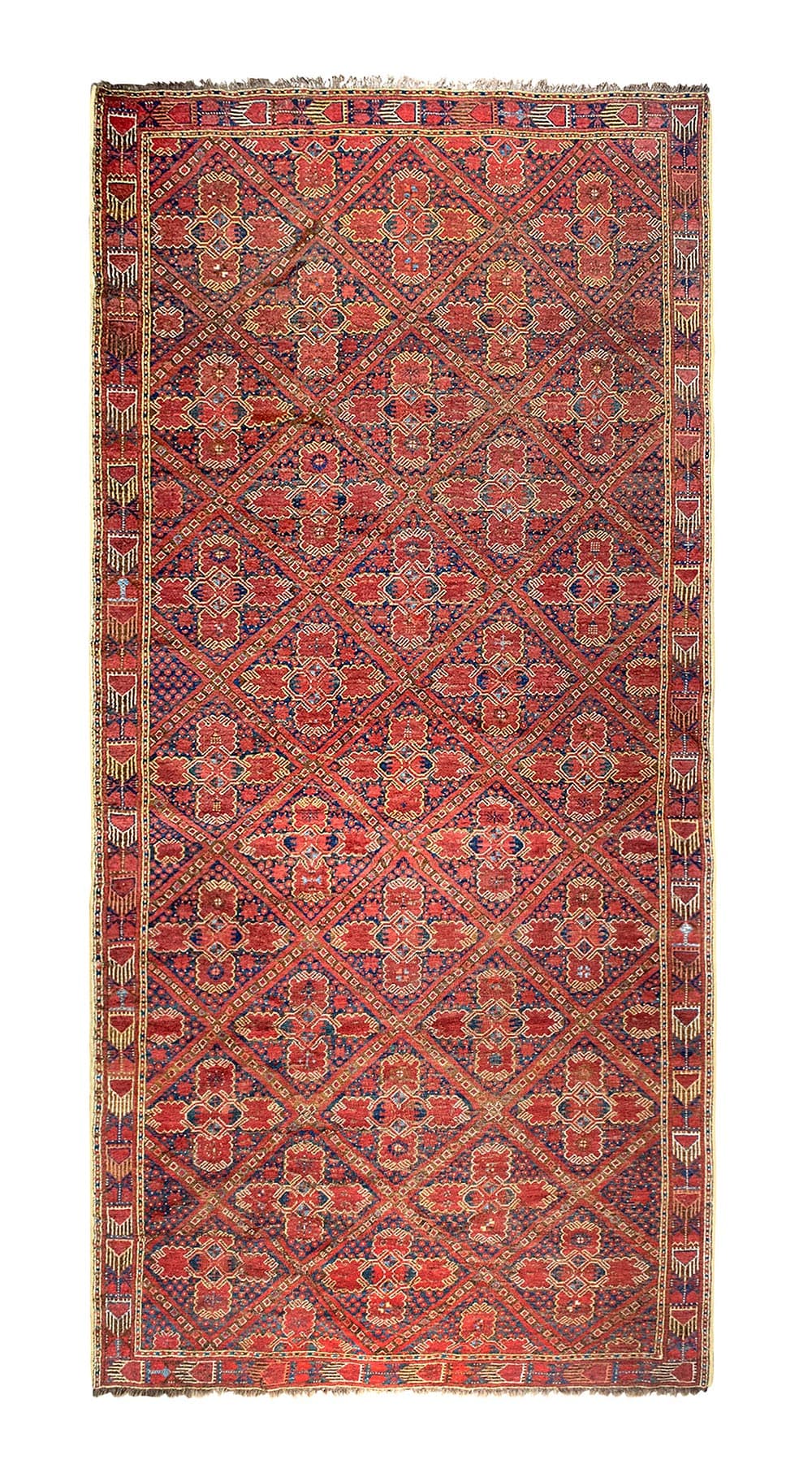 Ersari rugs are perhaps best known for their use of the gul motif, a geometric medallion that serves as the primary repeating pattern across the field of the rug. The Ersari gul is typically larger and more complex than those found on rugs by other Turkmen tribes, often incorporating bold angular forms and intricate internal detail.
Two of the most recognized Ersari gul types are the Kepse gul and the Tauk Nuska gul, each with its own distinct geometric structure and tribal significance. The arrangement of these guls across the rug's field follows a strict geometric order, creating a rhythmic, almost hypnotic visual effect.
Beyond the gul, Ersari rugs frequently feature rich border systems with repeating geometric meanders, stylized floral elements, and complex minor borders that frame the central field. Afghan Ersari rugs in particular are known for incorporating more curvilinear and floral elements, reflecting the influence of Persian and Afghan design traditions.
Colors and Dyes
Color is one of the most immediately striking aspects of an Ersari rug. Traditional examples are dominated by deep, warm tones, with rich madder reds, warm browns, dark blues, ivory, and occasional accents of orange and green. The natural dyes used by Ersari weavers were derived from plants, minerals, and insects, producing colors of remarkable depth and longevity.
Antique Ersari rugs are particularly prized for their abrash, the subtle variation in color tone that occurs naturally when different batches of hand-dyed wool are used across a rug. Rather than being seen as a flaw, abrash is celebrated as evidence of authentic hand production and adds a lively, organic quality to the finished piece.
Types of Ersari Rugs
The Ersari weaving tradition encompasses a wide range of rug types and formats, including:
• Main Carpets: Large floor rugs intended for use inside the yurt or tent, often featuring the classic gul repeat across a rich red or brown field.
• Chuvals: Large storage bags used to carry and store household goods during nomadic migrations. Chuvals are among the most collectible Ersari weavings, prized for their compact format and concentrated decorative detail.
• Torba: Smaller storage bags, similar in function to the chuval but narrower in format. Torbas often display some of the finest and most intricate weaving found in the Ersari tradition.
• Afghan Ersari Rugs: A distinct subgroup produced by Ersari weavers settled in northern Afghanistan. These rugs tend to be larger, more densely woven, and often feature a broader palette and more elaborate border systems than their Turkmen counterparts.
Ersari Rugs vs. Other Turkmen Rugs
While all Turkmen rugs share certain broad characteristics, including the use of gul motifs and a preference for red tones, Ersari rugs stand apart in several ways.
Compared to the finely woven, precisely executed rugs of the Tekke tribe, Ersari rugs are generally coarser in weave but larger in scale and more boldly designed. The Yomut tribe produced rugs with a distinctly different gul vocabulary, while the Salor, considered among the rarest and most prized of Turkmen weavers, worked on an entirely different level of technical refinement.
The Ersari tradition is perhaps best understood as the most diverse and geographically expansive of all Turkmen weaving groups, producing work that ranges from bold, rustic tribal pieces to more refined and elaborately decorated carpets influenced by neighboring weaving cultures.
Collecting Ersari Rugs
For collectors and enthusiasts, Ersari rugs offer a compelling combination of visual impact, historical depth, and relative accessibility compared to some of the rarer Turkmen tribal pieces.
When evaluating an Ersari rug, key factors to consider include the age and condition of the piece, the quality and depth of the natural dyes, the regularity and detail of the gul pattern, and the overall integrity of the weave. Antique examples with good pile, original natural dyes, and minimal restoration are the most desirable and will command the highest prices.
Afghan Ersari rugs from the late 19th and early 20th centuries represent a particularly good entry point for new collectors, offering strong visual appeal and genuine tribal character at more accessible price points than some of the older Turkmen pieces.
Caring for an Ersari Rug
Like all antique and tribal rugs, Ersari pieces require thoughtful care to preserve their beauty and integrity.
Regular gentle vacuuming, rotation to ensure even wear, and prompt attention to spills are the basics of good rug care. For antique or valuable examples, professional cleaning by a specialist in Oriental rugs is strongly recommended. Avoid harsh chemical treatments, excessive moisture, and prolonged direct sunlight, which can fade even the most stable natural dyes over time.
Final Thoughts
The Ersari rug is a testament to the extraordinary artistic tradition of the Turkmen people. Bold, geometric, and deeply human in its origins, each piece carries within it the story of a nomadic culture that shaped some of the most beautiful textiles ever produced. Whether displayed as a collector's piece or used as a living room centerpiece, an Ersari rug brings with it centuries of craft, color, and cultural heritage that few decorative objects can match.