

Blogs
.jpg&w=3840&q=75)
Everything You Need To Know About Kashan Persian Carpet
Yungming Wong | 6 Feb, 2026
When you walk into a room adorned with a Persian Kashan carpet, you are not simply stepping onto a floor covering; you are stepping into centuries of history, artistry, and cultural identity. Among the many celebrated carpet-weaving traditions of Iran, Kashan holds a uniquely exalted position. Revered by collectors, interior designers, and textile historians alike, the Kashan carpet is considered by many to be the pinnacle of Persian rug-making. But what exactly makes a Kashan carpet so special? Where do they come from, how are they made, and what should you know before buying one? This guide covers everything you need to know.
History
Kashan is an ancient city located in Isfahan Province in central Iran, situated at the edge of the Dasht-e Kavir desert. Its seemingly inhospitable location, sandwiched between arid desert and the Karkas Mountains, may seem an unlikely birthplace for one of the world's most celebrated art forms. Yet it is precisely this geography that shaped Kashan's destiny. The city's position along the historic Silk Road meant it was a hub of commerce and cultural exchange, and its artisans had access to raw materials, dyestuffs, and influences from across the ancient world.
Archaeological evidence suggests that carpet weaving in the Kashan region dates back at least to the Safavid dynasty (1501–1736 AD), considered the golden age of Persian carpet production. The Safavid court, particularly under Shah Abbas I, was a passionate patron of the arts, and the royal workshops at Kashan produced carpets of breathtaking complexity and beauty. Some of the oldest surviving Persian carpets, including the celebrated Ardabil Carpet, now housed at the Victoria and Albert Museum in London, are closely associated with this era and tradition, though scholars continue to debate the precise origins of individual masterworks.
After a period of decline following the collapse of the Safavid dynasty, Kashan experienced a remarkable renaissance in the 19th century. Enterprising merchants and master weavers revived the craft, introducing new dyes, refined techniques, and ambitious designs. By the late 19th and early 20th centuries, Kashan carpets were being exported across Europe and America, and the city's reputation as the home of fine Persian rugs was firmly cemented.
What Makes a Kashan Carpet Distinctive?
Not all Persian carpets are alike, and even within Iran's rich weaving tradition, Kashan rugs occupy a distinct and recognisable category. Several defining characteristics set them apart.
• Design and Motifs
Kashan carpets are celebrated for their formal, classical designs. The most iconic layout is the medallion pattern: a central geometric or floral medallion dominates the field, flanked by quarter-medallions at the corners, all set against a richly ornamented field filled with arabesques, palmettes (known as boteh or herati), vines, and blossoms. This symmetrical, balanced composition gives Kashan rugs an air of elegance and grandeur that suits both traditional and contemporary interiors.
Another hallmark is the garden design, which depicts an idealised Persian garden viewed from above, complete with water channels, flowering trees, birds, and geometric beds of flowers. Both styles reflect the Persian cultural ideal of paradise, a word derived from the Old Persian pairidaeza, meaning a walled garden.
• Colour Palette
The colour palette of Kashan carpets is rich and jewel-like. Deep crimsons, burgundies, and madder reds are the most characteristic background colours, often complemented by midnight blue, ivory, soft gold, hunter green, and warm caramel tones. Traditional Kashan rugs were dyed with natural plant and insect-based dyes: madder root for reds, indigo for blues, pomegranate rind for yellows, producing colours of extraordinary depth and luminosity that age beautifully over decades.
Modern Kashan carpets may use synthetic dyes, which are more consistent and colour-fast, though many buyers and collectors prefer the subtle variations and organic quality of naturally dyed rugs.
• Pile and Knot Density
Kashan carpets are typically woven using the Persian (Senneh) knot, which allows for tight, dense weaving and exceptional detail in the design. Knot density, measured in knots per square inch (KPSI) or knots per square metre, is a key quality indicator. Fine Kashan rugs typically achieve 100 to 300 KPSI, with the finest antique and workshop pieces sometimes exceeding 500 KPSI. This density contributes to the carpet's remarkable durability as well as the crispness of its motifs.
The pile is usually made from high-quality wool, often sourced from the Kork sheep of the region. Kork wool, the fine, soft fleece from the neck and underbelly of the animal, is especially prized for its silky lustre and ability to hold dye brilliantly. Some premium Kashan carpets incorporate silk highlights to accentuate certain motifs, while fully silk Kashan carpets exist at the very pinnacle of the market.
The Weaving Process: From Raw Wool to Finished Masterpiece
Creating a Kashan carpet is an extraordinarily labour-intensive process that can take months or even years. Understanding this process helps explain both the carpet's value and its artistry.
It begins with the design, called a naqqsheh, drawn on graph paper by a skilled designer. Each square on the paper represents a single knot, and the completed design may contain hundreds of thousands of squares for a large carpet. This blueprint is then handed to the weavers, who follow it row by row.
The loom, typically a vertical loom for Kashan production, is set up with cotton or silk warp threads running vertically. Weavers work from the bottom upward, tying individual knots of wool or silk around pairs of warp threads, then cutting the pile to a consistent height. After each row of knots, one or more horizontal weft threads are passed through to secure the knots in place. This process is repeated, knot by knot, row by row, until the carpet is complete.
A single square metre of a fine Kashan carpet may contain over 300,000 individual knots. A carpet measuring 3 x 2 metres (a modest living-room size) could therefore contain nearly two million hand-tied knots. When you consider this, the price of a genuine handmade Kashan carpet becomes not merely understandable but arguably astonishing value for the labour involved.
Once weaving is complete, the carpet is washed, stretched, and trimmed to an even pile height. Some carpets undergo a light chemical wash to soften the colours and give the pile a slightly antique appearance, though purists often prefer unwashed pieces.
Antique vs. Semi-Antique vs. New Kashan Carpets
When shopping for a Kashan carpet, you will encounter pieces described as antique, semi-antique, or new. Understanding the distinctions is essential.
Antique Kashan carpets are generally defined as pieces that are 80 years old or older (some dealers use the 100-year threshold). These rugs, particularly those from the late 19th and early 20th century, are highly sought after and command significant prices at auction and in specialist galleries. The natural dyes, fine kork wool, and traditional patterns of this period have a warmth and character that is difficult to replicate. Condition is crucial: antique Kashan rugs in excellent or good condition are rare, and even damaged pieces may have conservation value.
Semi-antique Kashan carpets, typically 30 to 80 years old, represent a middle ground. Many collectors consider the mid-20th century Kashan production, particularly pieces from the 1940s to 1970s, to offer excellent quality and value. These rugs are aged enough to have developed a beautiful patina, yet are generally still in serviceable condition.
New Kashan carpets, produced in the city's active workshops today, continue a proud tradition. While mass-produced machine-made rugs from other regions may sometimes be misleadingly sold as Kashan-style, genuine new Kashan rugs are still handmade in traditional workshops, often adhering closely to historic designs. Quality varies considerably between workshops, and buyers should seek out reputable dealers.
How to Identify an Authentic Kashan Carpet
The market for Persian carpets is unfortunately not free from misrepresentation, and knowing how to identify an authentic Kashan rug can save you from costly mistakes.
Look at the back of the carpet. On a genuine handmade Kashan rug, the knots should be clearly visible on the reverse, and the pattern should be nearly as clear on the back as on the front. Machine-made rugs have a flat, cloth-like backing. The fringe should be an extension of the warp threads, not sewn on or glued, which is a telltale sign of a machine-made rug trying to mimic a handmade one.
Examine the pile. Authentic Kashan wool has a natural, slightly waxy lustre. It should feel soft and slightly springy underfoot. Cheap synthetic fibres will feel flat and lifeless by comparison. Silk highlights, if present, will catch the light differently depending on the angle you view the carpet.
Check the design for slight irregularities. Paradoxically, the presence of tiny, subtle imperfections in the pattern, such as small inconsistencies in knot density or colour variations across the field, is actually a sign of authenticity. These natural variations are a hallmark of hand weaving; machine-made carpets are perfectly uniform.
When in doubt, purchase from a reputable dealer who can provide provenance information, a certificate of authenticity, or documentation of the carpet's origin. Established auction houses such as AstaGuru regularly sell certified Persian rugs.
Caring for Your Kashan Carpet
A genuine Kashan carpet, properly cared for, can last for generations and, in many cases, actually increases in value over time. Proper care is therefore both a practical and financial consideration.
Regular, gentle vacuuming is important to prevent dirt from working its way deep into the pile, where it can act like sandpaper on the fibres. Vacuum along the direction of the pile, not against it, and avoid using a beater-bar attachment on fine carpets. Rotate your carpet every year or two so that any fading from sunlight or traffic wear occurs evenly.
Spills should be addressed immediately. Blot (never rub) the affected area with a clean white cloth, working from the outside of the spill inward to prevent spreading. For serious stains or periodic deep cleaning, have your carpet professionally cleaned by a specialist in Oriental rugs. Standard carpet cleaning companies may use methods or chemicals unsuitable for wool and natural dyes.
Protect your carpet from prolonged direct sunlight, which can cause fading even in naturally dyed rugs. Use a good quality underpad to prevent slipping, reduce wear, and allow the carpet to breathe. When storing a Kashan carpet, roll it (never fold it) with acid-free tissue paper inside, wrap it in breathable cotton sheeting, and store it in a cool, dry, dark place.
Buying a Kashan Carpet: What to Expect
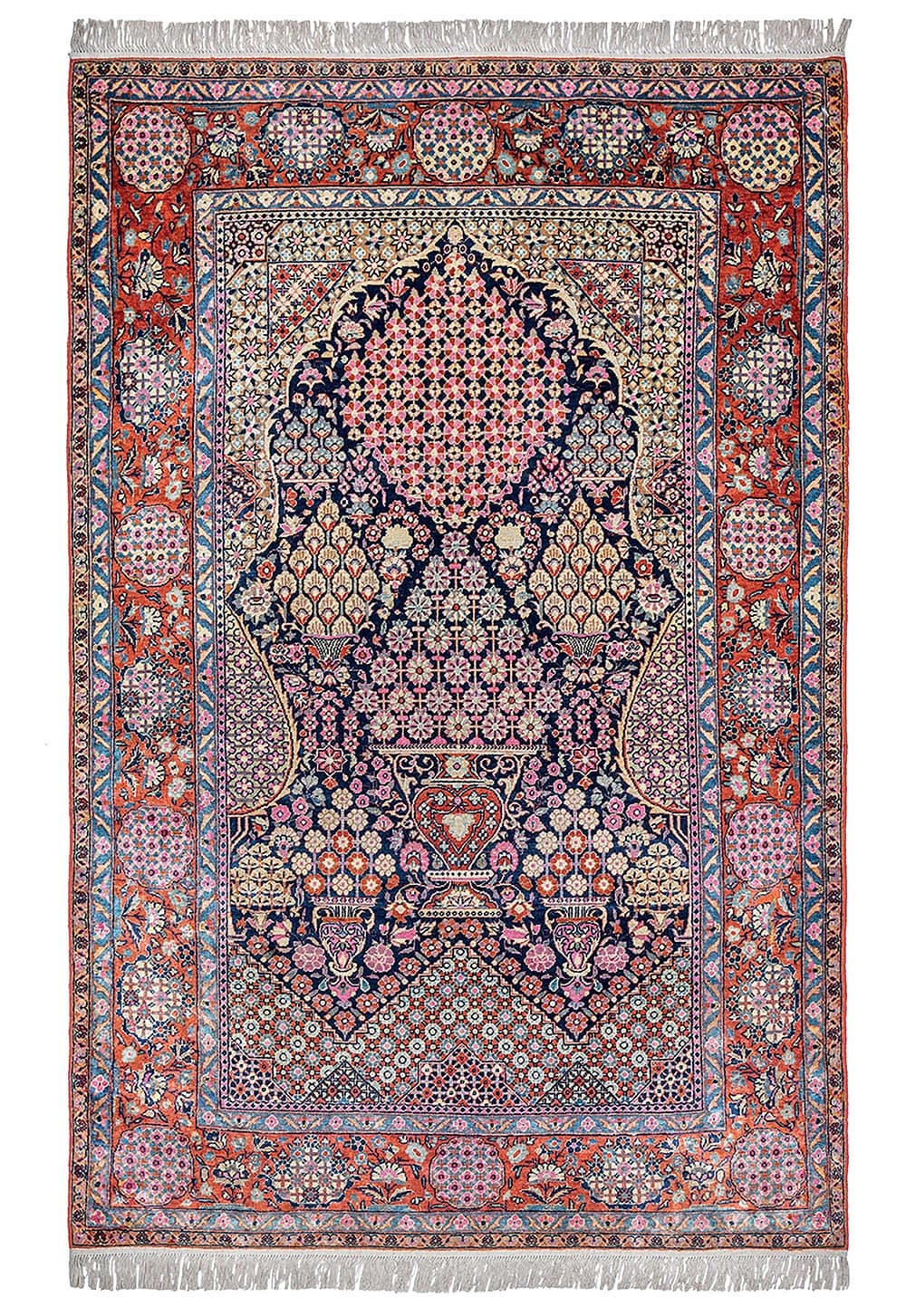 The price range for Kashan carpets is extraordinarily wide, reflecting the enormous variety of age, quality, size, and provenance available in the market. A small, modern workshop-made Kashan rug might be purchased for a few hundred pounds or dollars, while a fine antique piece in excellent condition could fetch tens or even hundreds of thousands at auction.
When buying, consider your purpose. If you are seeking a functional, beautiful floor covering for a living space, a well-made new or semi-antique Kashan in good condition offers exceptional value. If you are buying as a serious collector or investment, focus on antique pieces with documented provenance, and be prepared to invest accordingly.
Take your time. A genuine Kashan carpet is not an impulse purchase; it is an acquisition that deserves careful consideration. Visit multiple dealers, handle and compare different pieces, ask about washing history and any repairs, and do not be pressured into an immediate decision. A reputable dealer will welcome your questions and give you the time you need.
Finally, consider the room in which the carpet will live. Kashan rugs are formal in character and suit rooms with a degree of grandeur: dining rooms, entrance halls, drawing rooms, and studies. Their richly patterned surfaces work best in rooms that are not too busy in terms of other patterns and colours.
Conclusion
A Persian Kashan carpet is one of the finest things a person can bring into their home. It is the product of centuries of tradition, extraordinary skill, and an artistic sensibility honed over generations. Whether you are drawn to the deep crimson glow of an antique medallion rug or the crisp elegance of a contemporary workshop piece, a Kashan carpet offers beauty, durability, and a tangible connection to one of humanity's great craft traditions. To own a Kashan carpet is to become a temporary custodian of something that has already outlasted empires and, with proper care, will outlast you too. That, more than anything, is what makes it worth knowing about.
The Timeless Beauty Of Exceptional Carpets And Rugs And The Art Of Collecting Them
27 Jan, 2020
5 Unforgotten Craftsmanship Of The Rich Culture Of India
20 Jan, 2020
The Diverse & Ornate Carpets Of Persia
24 Feb, 2023
6 Key Motifs Found in Oriental Rugs: A Cultural Insight
22 Aug, 2024
What Are Kashan Carpets & Why You Should Get One
23 Feb, 2026
Guide To Bakhtiari Carpets: Hand-Knotted Rugs From Zagros Mountains, Iran
13 Feb, 2026
A Brief History Of The First Origins Of Persian Isfahan Carpet
5 Feb, 2026
Heriz Carpets: Vibrant Craftsmanship From The Heart Of Azerbaijan
9 Feb, 2026
The History Of Caucasian Carpet & Their Beautiful Features
17 Feb, 2026
Ersari Rugs: A Deep Dive Into The Kepse & Tauk Nuska Gul
18 Feb, 2026

KNOW MORE
Buy
Sell
Request an Estimate
FAQs
Seller Terms
Store Terms
SERVICES
Client Advisory
Restoration
DOWNLOAD THE APP


Copyright 2026 AstaGuru. All Rights Reserved


