


evolution of bracket clocks: from 17th-century origins to spring driven innovations
.jpg&w=3840&q=75)
Few objects in the decorative arts combine mechanical ingenuity with aesthetic splendour as masterfully as the bracket clock. Compact enough to sit on a mantelpiece or shelf, yet imposing enough to command any room it occupies, the bracket clock has been a symbol of refined taste and technical craftsmanship for over three centuries. Its story is one of innovation, patronage, and an enduring fascination with the measurement of time.
What Is a Bracket Clock?
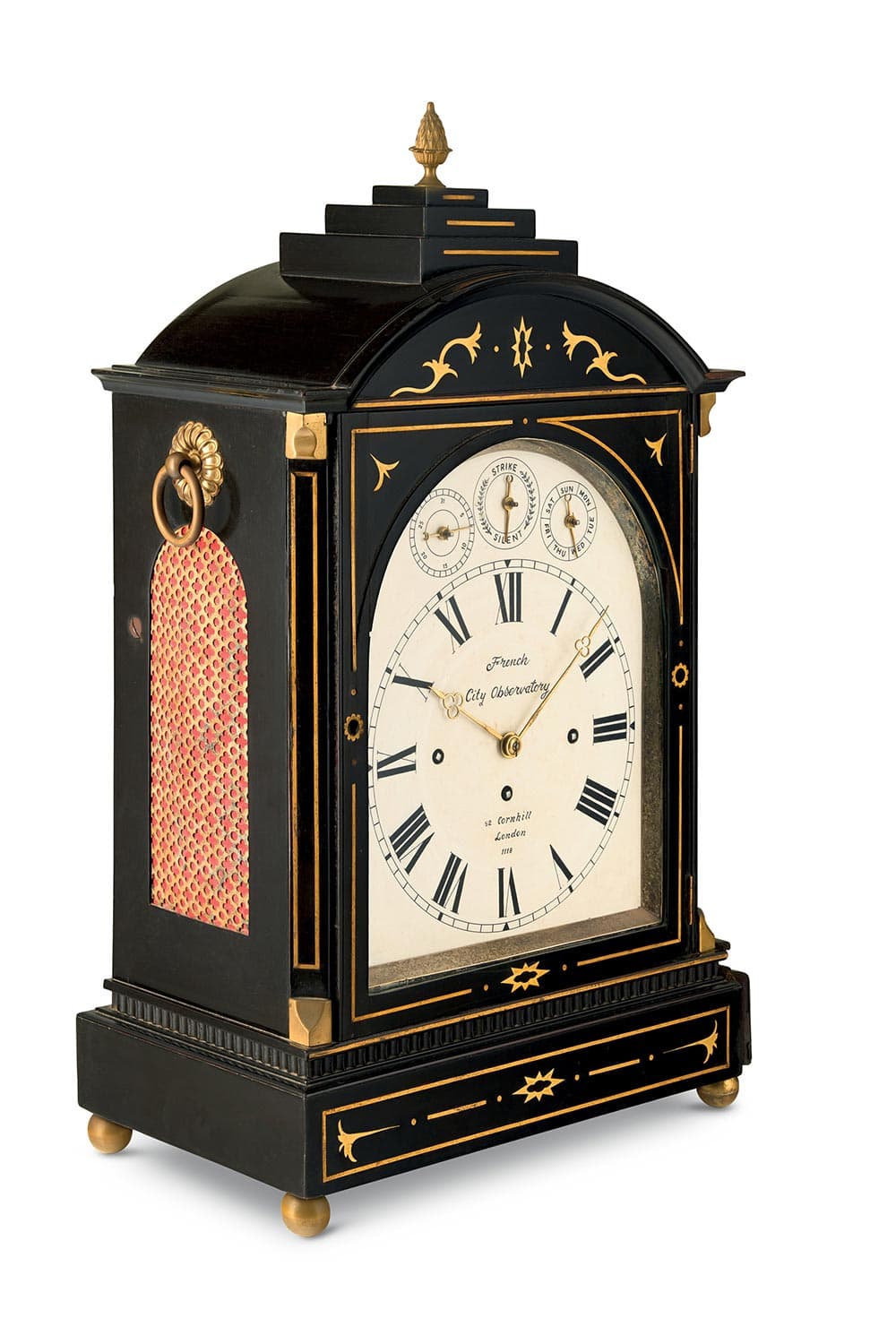 A bracket clock is a weight-driven or spring-driven clock designed to stand on a wall bracket, mantelpiece, or piece of furniture rather than on the floor. Unlike the tall case (or grandfather) clock, which relies on a long pendulum and requires floor space, the bracket clock is self-contained, typically between 30 and 60 centimetres in height, and was historically designed to be portable. Many early examples were carried from room to room by servants, enabling their owners to have accurate timekeeping wherever they were in the house.
The term "bracket clock" itself is something of a misnomer, as many of these clocks were never actually placed on brackets at all. In horological circles, they are sometimes called "table clocks," "mantel clocks," or "spring clocks," though all these terms carry slightly different connotations depending on the period and place of manufacture.
How it Works?
Unlike weight-driven longcase clocks, bracket clocks use coiled springs to power the movement. These springs gradually unwind and release energy through a gear train that regulates time via an escapement mechanism.
Most bracket clocks must be wound every 7 or 8 days, though some later models offer longer power reserves.
History
The bracket clock emerged in England in the latter half of the seventeenth century, following a critical technological breakthrough: the invention of the anchor (recoil) escapement, attributed to Robert Hooke around 1657 and refined by William Clement in the 1670s. This escapement, combined with the pendulum, allowed clocks to keep time with far greater accuracy than their verge escapement predecessors. Crucially, it also made shorter pendulums practical, enabling the compact case designs that define the bracket clock form.
The great clockmakers of Restoration England, men such as Thomas Tompion, Joseph Knibb, and Edward East, seized upon this new technology to create instruments of extraordinary quality. Their early bracket clocks often featured ebonised fruitwood cases, brass-and-silver dials, and elaborate gilt-brass mounts. Many were made for royal and aristocratic patrons: Tompion himself supplied clocks to King Charles II, and his work set a benchmark for English clockmaking that would last generations.
The Anatomy of a Bracket Clock
Understanding a bracket clock means appreciating its principal components, each of which evolved over time in response to both mechanical requirements and changing aesthetic fashions.
The Case. Early cases in England were typically ebonised (blackened pear or fruitwood), a style that reflected Continental Baroque tastes. As the eighteenth century progressed, walnut, mahogany, and lacquered cases became fashionable. By the Regency period, brass inlay and exotic veneers were common. Continental bracket clocks, particularly those from France and Germany, favoured gilt bronze (ormolu) mounts and tortoiseshell veneers.
The Dial. The dial underwent considerable transformation. Seventeenth-century English clocks typically featured a square brass dial with a silvered chapter ring, ornate corner spandrels (often cast as cherub heads or foliage), and a matted centre. The break-arch dial appeared in the early eighteenth century, with the arch often housing a strike/silent lever, a moonphase, or a decorative painted scene. By the late eighteenth century, painted enamel dials, predominantly white, became common, and the taste for restrained decoration grew.
The Movement. Bracket clock movements are almost invariably spring-driven, wound by a key inserted through holes in the dial. English movements are renowned for their robust plates, finely cut wheelwork, and intricate striking and chiming trains. The fusee, a cone-shaped device linked to the mainspring barrel by a chain or gut line, was widely used in English work to equalise the drive force of the mainspring as it unwound, ensuring consistent timekeeping.
Striking and Chiming. One of the most appealing aspects of the bracket clock is its sound. Most examples strike the hours on a bell or gong; grander versions chime the quarters on a carillon of bells. The Westminster, Whittington, and St. Michael chimes, familiar from countless English churches, were all reproduced in miniature within bracket clock movements of the Victorian era and beyond.
Bracket Clock vs Mantel Clock
While often confused, there is a subtle distinction:
• Bracket clocks traditionally have a carrying handle and were intended for wall brackets.
• Mantel clocks are designed specifically to sit on fireplace mantels and usually lack a top handle.
Over time, however, the terms have sometimes been used interchangeably.
The Golden Age of English Clockmaking
The period from roughly 1660 to 1730 is widely regarded as the golden age of English bracket clockmaking. Makers such as Thomas Tompion (c. 1639–1713), sometimes called the "father of English clockmaking," produced movements of unrivalled quality. His clocks combined impeccable mechanical execution with cases of architectural dignity. Daniel Quare (1649–1724), a Quaker maker of great ingenuity, patented the repeating mechanism, which allowed the clock to chime the most recent hour or quarter on demand, useful in an age before reliable artificial lighting. George Graham (1673–1751), Tompion's nephew and successor, made further advances in escapement design, introducing the deadbeat escapement that became the standard for precision regulators.
London dominated this trade, and the Worshipful Company of Clockmakers (founded 1631) regulated the craft through a strict apprenticeship system. A clock bearing the signature of a celebrated London maker was a mark of social distinction, and wealthy patrons commissioned elaborate pieces as diplomatic gifts and expressions of cultural prestige.
Continental Traditions
While England led the world in precision clockmaking, France developed its own magnificent tradition of bracket clocks, known as pendules de parquet (floor clocks) or pendules de cheminée (mantel clocks). French makers placed supreme emphasis on the clock as a decorative object: the movement was often housed within an extravagant case of gilt bronze, marble, and porcelain, designed by leading sculptors and cabinet-makers. The pendule religieuse of the Louis XIV period, with its architectural case and brass marquetry, gave way to the exuberant Rococo fantasies of the Louis XV era, cases shaped as urns, lyres, classical temples, or allegorical figures.
German and Austrian makers, particularly in Augsburg and Vienna, contributed their own distinctive styles. The Vienna regulator, though technically a wall clock, shared many characteristics with the precision bracket clock tradition. Black Forest clockmakers developed the cuckoo clock and other popular spring-driven timepieces, bringing bracket-style clocks to a mass market.
Victorian Abundance and Decline
The nineteenth century brought both a proliferation and a democratisation of the bracket clock. Industrial production techniques allowed manufacturers to produce movements in quantity, while improved metalworking made ornate cases more affordable. The Victorians were voracious consumers of decorative clocks, and the mantelpiece became the centrepiece of the domestic interior, often supporting an elaborate "clock garniture", a matching set of clock and flanking vases or candelabra.
English firms such as Dent, Frodsham, and Thwaites & Reed continued to produce high-quality movements, while French manufacturers like Japy Frères industrialised clock production on a vast scale. American firms, Seth Thomas, New Haven, and Ansonia among them, brought bracket-style clocks to the middle classes on both sides of the Atlantic.
Yet this abundance came at a cost. The handmade craftsmanship of the seventeenth and eighteenth centuries was difficult to sustain in an age of mass production, and critical voices lamented the loss of quality. The Arts and Crafts movement, led by William Morris and his contemporaries, called for a return to honest hand craftsmanship, a response that influenced some clockmakers to revive earlier styles and methods.
Why Every Modern Home Needs A Bracket Clock
In an era of "disposable" tech, the bracket clock stands as an antidote to the modern world. Here’s why they are becoming a staple in contemporary interior design:
• The "Slow Living" Movement: Unlike the silent, glowing numbers on a screen, a bracket clock has a heartbeat. The rhythmic tick-tock and the mechanical chime ground a room, providing a sense of calm and permanence.
• A Statement of Craftsmanship: Modern furniture is often mass-produced. A bracket clock with its hand-carved wood, brass finials, and intricate fusee movement, serves as a "functional sculpture" that sparks conversation.
• Sustainable Longevity: These clocks were built to last centuries, not years. Owning one is the ultimate form of sustainable decor; you aren't just buying an object, you're stewarding an heirloom for the next generation.
• Design Versatility: Whether your home is Industrial, Mid-Century Modern, or Traditional, the rich textures of mahogany or ebonized wood provide a sophisticated contrast to glass and steel.
Collecting Bracket Clocks Today
Bracket clocks remain among the most keenly collected of all antique horological objects, and for good reason. A fine English bracket clock by a celebrated maker represents the intersection of art, science, and social history. Collectors prize examples with original, unrestored movements in good working order; intact cases with original finish; unaltered dials; and clear maker's signatures. Provenance, a documented ownership history, can add considerably to a clock's interest and value.
Condition is paramount. A movement that has been carelessly cleaned, fitted with non-original parts, or subjected to amateur repair is far less desirable than one that retains its original fabric. The pendulum, bracket (if present), and winding key are often missing and are worth seeking; a matching bracket to an early English clock is a significant find.
Auction houses specializing in antique clocks, and dedicated horological auctions at the major London and New York salerooms, offer regular opportunities to acquire fine examples. Specialist dealers, clock fairs, and horological societies such as the Antiquarian Horological Society (founded 1953) provide invaluable resources for novice and experienced collectors alike.
Care and Maintenance
A well-made bracket clock, properly maintained, will run reliably for centuries. The movement should be serviced by a qualified horologist every five to ten years: the oil in a clock mechanism oxidises and thickens over time, and accumulated debris can cause wear. Owners should resist the temptation to oil a clock themselves with inappropriate lubricants.
When moving a bracket clock, always remove the pendulum (if fitted) and any loose weights or chime rods. Carrying a clock with a swinging pendulum risks damage to the suspension spring and the movement. The case should be kept away from direct sunlight, extreme heat, and humidity; veneers are particularly vulnerable to environmental fluctuations.
Conclusion
The bracket clock endures as one of the great achievements of European decorative arts. It tells us not only the time but also the story of the craftsmen who built it, the patrons who commissioned it, and the household that sheltered it across the centuries. Whether you admire one in a museum case, behind a dealer's counter, or on your own mantelpiece as it marks the passing hours with a silvery chime, the bracket clock offers a remarkably direct connection to a world of hand skills, mechanical ingenuity, and enduring beauty. In an age of atomic precision and digital ubiquity, there is something quietly radical about an object that has been measuring time, beautifully, honestly, mechanically, for three hundred years.




