exploring the legacy of k.h. ara’s poetic aesthetic
 Recognised as one of the most senior names in Modern Indian Art, Krishnaji Howlaji Ara was an exceptional talent whose artistic brilliance was a result of sheer passion, hard work and dedication. One of his biggest contributions to Modern Indian Art was his unique interpretation of the female nude and still-life. He was also one of the founding members of the revolutionary Bombay Progressive Artists Group alongside F.N.Souza and S.H.Raza. This Month of Masters, let us re-visit the glorious legacy of this gifted and humble artist:
The son of a bus driver in Bolarum near Secunderabad, Krishnaji Howlaji Ara was born in the 1914. Rising from very humble antecedents, Ara battled many struggles in his early life. He lost his mother when he was barely three, his father remarried soon after and by the time he was seven years old, Ara ran away to Bombay where he started working as a domestic help at an English household. Many years later, he found employment as a car cleaner with a Japanese firm, who also offered him accommodation at a tiny room in Walkeshwar, Bombay.
It was in the solitude of this small room that Ara found the inspiration to fulfill his urge to draw and paint. So masterful was the appeal of his works that they soon caught the attention of renowned art critics, Rudy von Leyden and Walter Langhammer. Being important expat patrons, academicians and practitioners of art, they encouraged Ara to paint as often as possible, supporting him financially in the process. A landmark moment of his career was when his first solo exhibition took place in 1942 at Chetna Restaurant in Bombay. It was a sell-out and Ara made a profit of Rs.2000 from the show. This gave him the financial independence to fully dedicate himself to his artistic journey.
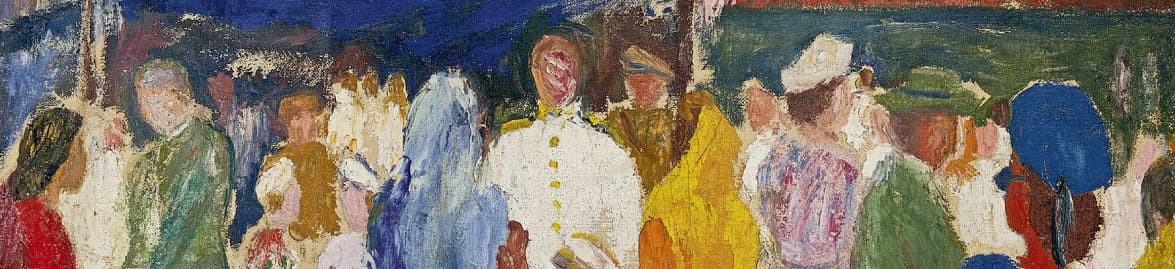
Some of Ara’s early compositions shed light upon the under-privileged people of society. He also began painting scenes of people engaged in the mundane activities of everyday life like fishing, weddings, horse-riders etc. Being largely self-taught, Ara’s works were free from the rigidity of academic articulation. His painterly forms were raw and eclectic, and represented the authenticity of his creative expression. This raw individuality of his creations proved to be an advantage for Ara as he entered the burgeoning world of Modern Indian Art.
Other than his early compositions of human realism, the key aspects of Ara’s work rested upon his preoccupation with still-life and nudes. K.H.Ara created his own unique style of painting still-life. His mis-en-scene was usually a combination of landscape and still-life. He often placed an object, often a vase of flowers or a bowl of fruits against the backdrop of a window or an open sky within the intimate setting of a closed room. Using techniques of light, shadow and perspective, Ara was able to choreograph an intimate relationship between the object and its environment, rendering his inanimate protagonists with a human-like personality.

Ara’s studio buzzed with a rhythm that celebrated the sensuousness of the female form. His female nudes exuberated a poetic simplicity that was a result of his subjects’ striking obliviousness to the external gaze. Captured in the midst of her everyday chores, Ara’s nude women are frequently paired with a luminescent vase with rounded contours where both mirror the voluptuousness of the other. These solitary women, often resting and brooding, appear at peace with their nudity, absorbed in the beauty of their painted world.
Ara brought with him a spontaneity that was independent of the tenets of academic painting. His art arose, not only from an intellectual engagement with his subjects, but also from an unrestrained expression of his innermost self. Throughout his life, he let his intuition lead the strokes of his brush. Even Jehangir Sabavala once said that, “Ara painted with this heart, not with his mind”.
K.H.Ara exhibited his works at various galleries during his career. He won the prestigious Governer’s Award in 1944. In his later years, he devoted himself to the Artist’s Centre in Bombay. He possessed a strong sense of passing his knowledge to the next generation, taking on the role of an educator and mentor, helping struggling young artists. He also held several workshops and art lessons for school children in the hopes of inspiring their young, impressionable minds.
After a long and successful life, the artist passed away in Mumbai in 1985 at the age of 71.