from trees to triangles: tracing piet mondrian’s journey to abstraction
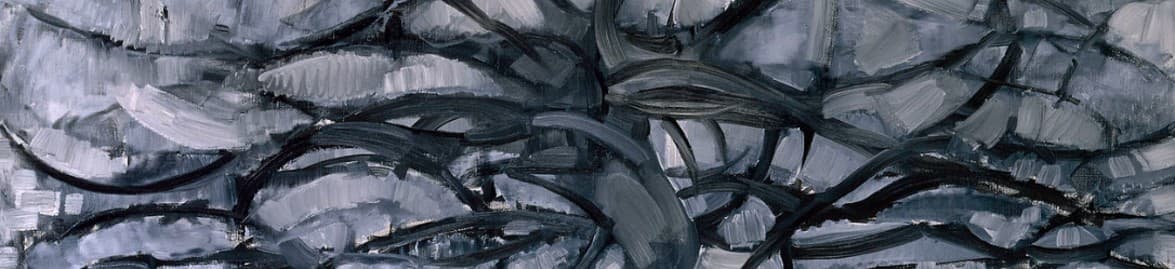
Piet Mondrian was a Dutch painter who became one of the most influential figures of the 20th-century avant-garde. As a co-founder of the De Stijl movement, he transitioned from traditional representational art to a completely non-objective style he called Neo-Plasticism. His work, characterized by a grid of black lines and primary colors, sought to reveal a universal harmony and spiritual order beneath the chaotic surface of the natural world.
Early Life
Born Pieter Cornelis Mondriaan Jr. on March 7, 1872, in Amersfoort, Netherlands, he grew up in a staunchly Calvinist household. His father was a primary school headteacher and an amateur artist who taught him the basics of drawing. Mondrian’s early environment was deeply rooted in religious and moral discipline, which later translated into the rigorous, quasi-spiritual precision of his abstract work.
Later Life
Piet Mondrian’s later years were defined by his movements between the world’s great art capitals. He lived in Paris for two decades, where he dropped the second "a" from his surname to signal his break from Dutch provincialism. Fleeing the threat of World War II, he moved to London in 1938 and finally to New York City in 1940. In Manhattan, he was revitalized by the city’s energy, its grid-like streets, and the syncopated rhythms of jazz music, which inspired his final masterpieces.
Death
Piet Mondrian died in 1944, aged 71, from pneumonia in New York. Posthumous fame exploded; his vision endures as modernism's cornerstone, blending philosophy, math, and pure form.
Family
Piet Mondrian remained a bachelor throughout his life, dedicating himself almost entirely to his aesthetic pursuits. He was close to his brother, Carel, and remained in contact with his family in the Netherlands, though his radical shift toward abstraction often confused his more traditional relatives. He treated his various studios as his "home," meticulously decorating them to reflect his artistic principles.
Education
Mondrian received a formal academic education in art. In 1892, he enrolled in the Rijksakademie van Beeldende Kunsten (Academy of Fine Arts) in Amsterdam. While he excelled in traditional landscapes and still lifes, he was a restless student. He eventually moved beyond his academic training, exploring Impressionism, Pointillism, and Fauvism before finding his true voice in abstraction.
Painting Style
Piet Mondrian’s style is the ultimate study in reduction. He believed that art should not imitate the appearance of real objects but should express the "absolute" through pure form and color. His signature style involved:
• The Grid: A structural framework of black horizontal and vertical lines.
• Asymmetrical Balance: Avoiding symmetry to create a dynamic sense of equilibrium.
• The "Primary" Palette: Restricting himself to red, blue, yellow, white, black, and gray.
De Stijl and Neoplasticism
Founding De Stijl: In 1917 Mondrian co-founded De Stijl (The Style) with Theo van Doesburg and other artists and architects. The group issued a journal that promoted a new visual language meant to reflect a modern, harmonious society.
Neoplasticism defined: Mondrian named his mature system neoplasticism (Nieuwe Beelding), arguing for art stripped of everything non-essential: no naturalistic depiction, no diagonals, no curves, no overt subject matter. Instead, only horizontals and verticals, and a palette limited to the three primary colors (red, blue, yellow), plus black, white, and gray.
Theoretical goals: Mondrian saw neoplasticism not as mere aesthetic minimalism but as a moral and spiritual pursuit. He believed that by reducing art to pure relations of form and color one could express universal harmony and equilibrium; mirroring a deeper, balanced order in life.
Evolution from Trees to Triangles
The evolution of Piet Mondrian's art towards abstraction was a profound transformation, moving from representational scenes to purely geometric forms. This critical shift was initially marked by a change in palette, influenced by styles like Impressionism, Fauvism, and Symbolism, alongside an engagement with Theosophy. Early indications of abstraction can be seen in a series of canvases from 1905 to 1908, which depicted dim, indistinct trees and houses reflected in water. While still rooted in nature, these works encouraged a focus on form over content, laying the groundwork for future developments in the art world.
His exposure to Cubism at the Moderne Kunstkring exhibition in Amsterdam around 1911 marked a pivotal moment, with the display featuring Post-Impressionist works such as The Red Mill and Trees in Moonrise. This was followed by a visit to Paris, where he was influenced by artists such as Picasso and Braque. His work rapidly reflected this, moving towards simplification. For instance, in his Still Life with Ginger Pot series, the 1911 Cubist version evolved into a 1912 version where the objects were starkly reduced to geometric shapes such as circles, triangles, and rectangles. Paintings like The Sea (1912) and his various tree studies from that period increasingly featured geometric shapes and interlocking planes, signalling his transition away from naturalistic representation (trees) toward the ultimate reduction of form to pure geometry. Mondrian viewed Cubism not as a final destination, but as a crucial "port of call" on his journey to complete abstraction.
Famous Paintings
• The Gray Tree (1911): A pivotal work showing the transition from a recognizable tree to a network of abstract lines.
• Composition with Red, Blue, and Yellow (1930): The definitive example of his mature Neo-Plastic style.
• Broadway Boogie-Woogie (1942–43): A late-career masterpiece inspired by the lights and rhythm of New York City.
• Victory Boogie-Woogie (1944): His final, unfinished work, which utilized pieces of colored tape.
Characteristic Features of His Paintings
The most striking feature of a Piet Mondrian painting is the Right Angle. He viewed the vertical as a symbol of the vital or masculine and the horizontal as the restful or feminine. By intersecting them, he believed he was capturing the "rhythm of life." Additionally, his colors are never blended; each block of primary color is flat and distinct, separated by bold black boundaries that vary slightly in thickness to create visual tension.
Design Legacy
De Stijl shaped Bauhaus, architecture (Rietveld's Red Blue Chair), and graphics; think album covers like Vogue patterns. His grids influence IKEA, fashion and urban planning proving abstraction's timeless appeal.
Exhibitions
Throughout his life and after, Piet Mondrian’s work has been the subject of major retrospectives. Significant exhibitions include:
• The 1945 Memorial Exhibition at the Museum of Modern Art (MoMA) in New York, shortly after his death.
• Mondrian: The Studios (2012) at the Tate Liverpool, which recreated his working environments.
• Mondrian Evolution (2022) at the Fondation Beyeler, celebrating the 150th anniversary of his birth.
Awards
Piet Mondrian did not receive many formal awards during his lifetime, as his work was often considered too radical for mainstream prizes. However, he was a member of prestigious groups like the American Abstract Artists and was posthumously recognized as one of the most important artists of the century. His "awards" are found in his enduring presence in every major modern art museum in the world.
Conclusion
Piet Mondrian turned the canvas into a laboratory for universal order. By stripping away the distractions of the physical world, he sought to find a visual language that everyone could understand, regardless of culture or language. His journey from the windmills of Holland to the neon lights of Broadway remains one of the most remarkable transformations in art history, proving that simplicity is often the highest form of complexity.
Lesser-Known Facts
• He Loved to Dance: Despite his rigid-looking art, Mondrian was a fan of social dancing, particularly the "Charleston," though friends noted he danced in a very stiff, angular way.
• No Green Allowed: Mondrian famously disliked the color green because it reminded him too much of raw nature. He even sat with his back to windows in restaurants to avoid seeing trees or grass.
• Hand-Painted Lines: Although they look mechanical, Mondrian never used a ruler. If you look closely at his canvases, you can see the delicate brushstrokes and the "human" texture of the paint.
• The Diagonal Feud: He quit the De Stijl movement because his colleague Theo van Doesburg started using diagonal lines, which Mondrian considered a betrayal of their vertical-horizontal philosophy.
Image Credit:
“Gray Tree 1911”, Unknown, via Wikimedia Commons
– Public Domain.