g r santosh - pyramid (1968) | overview
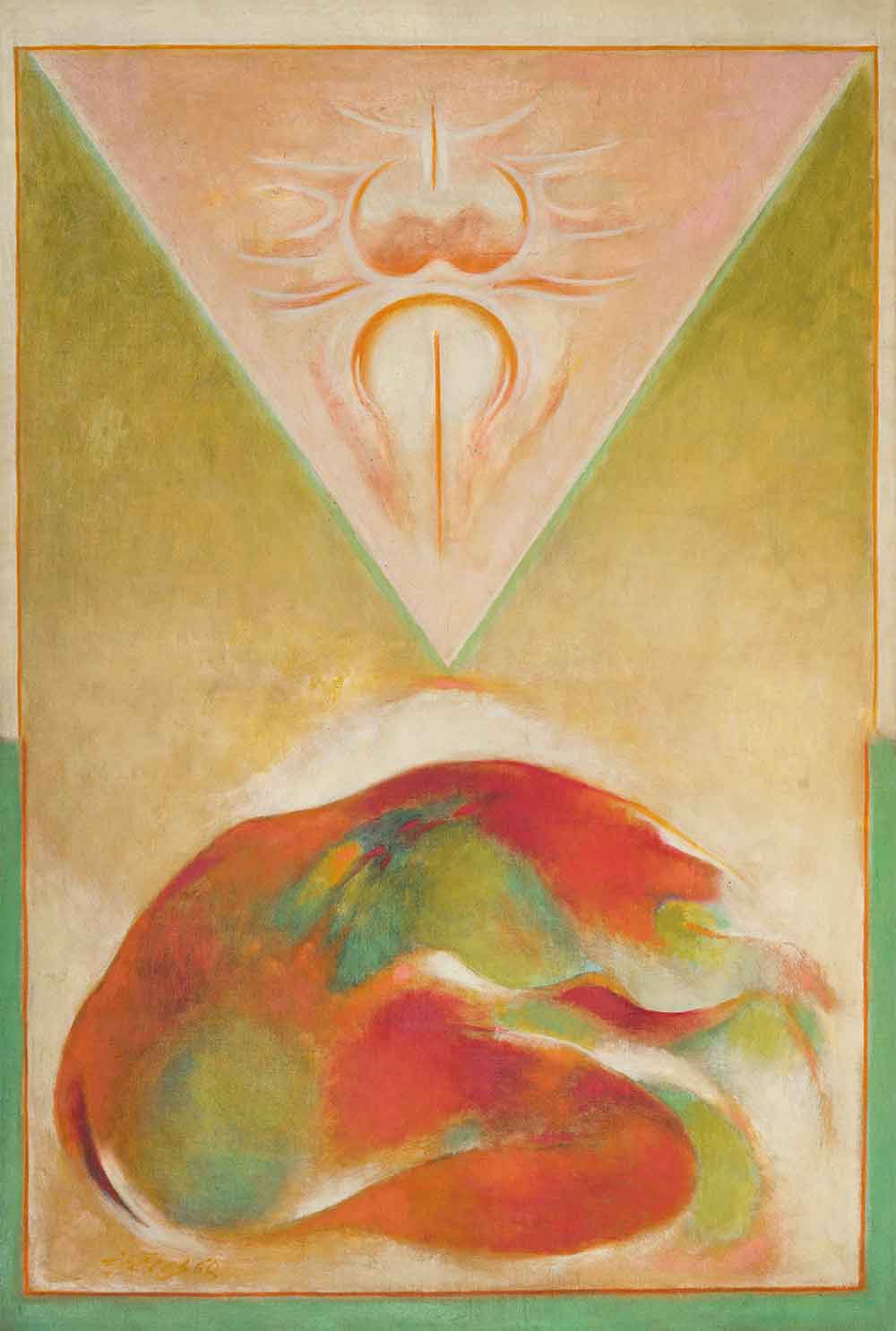
G. R. Santosh’s Pyramid (1968), an oil on canvas measuring 42 × 28 in (107 × 71.4 cm) and signed in Devnagari with the date ’68’ at the lower left, represents a defining moment in the artist’s transition toward Neo-Tantric abstraction. The work synthesizes rigorous geometric structure with the metaphysical symbolism of Kashmir Shaivism, a direction shaped significantly by Santosh’s transformative pilgrimage to the Amarnath Cave in 1964.
Historical Context
Born in 1929 in Kashmir, G R Santosh i.e Ghulam Rasool Santosh transitioned from landscapes and figurative works to Tantric-inspired forms influenced by Abhinavagupta and Ajit Mookerjee, viewing art as vibrational poetry uniting Shiva-Shakti energies. Created amid his embrace of non-dualistic philosophy, "Pyramid" embodies early Neo-Tantric exploration before deeper yogic symbolism in later decades.
 Artistic Technique
G. R. Santosh employs vibrant symbolic colors; red for Shakti, green for life, white for purity, blue for depth within neat lines and sacred geometry like triangles and bindus to evoke cosmic harmony and spiritual awakening. The pyramidal form fuses male-female principles, static-dynamic forces, transforming abstraction into a portal for divine consciousness.
Themes and Symbolism
Central to Kashmir Shaivism, the work symbolizes Purusha-Prakriti union, interconnected existence, and kundalini energy through forms like triangles (cosmic balance) and circles (eternal cycles), bridging sensuousness with transcendental unity. As poet-painter, G. R. Santosh infused canvases with Sufi-Tantric heritage, projecting Shunya (void) as timeless vibration.