gaganendranath tagore - mother & son (1928) | overview

Gaganendranath Tagore (1867–1938), a pioneering modernist painter of early 20th-century India, was a central figure in the Bengal School of Art and one of the first Indian artists to embrace cubism and other global modernist styles. His works display a remarkable ability to merge indigenous themes with contemporary international art movements, making him a crucial bridge between tradition and modernity. Among his most notable works is Mother & Son (1928), a painting that reflects both his stylistic innovation and deep human sensitivity.
Context
The 1920s were a period of artistic experimentation for Gaganendranath Tagore. Unlike his uncle Rabindranath Tagore or his brother Abanindranath, who leaned more toward romantic and revivalist aesthetics, Gaganendranath Tagore boldly engaged with cubist and expressionist tendencies. His art demonstrated an awareness of European avant-garde movements while still rooting itself in the emotional and cultural life of Bengal.
Mother & Son belongs to this phase of experimentation, where Gaganendranath Tagore explored the human figure through fractured geometries, tonal contrasts, and psychological depth.
Visual Characteristics
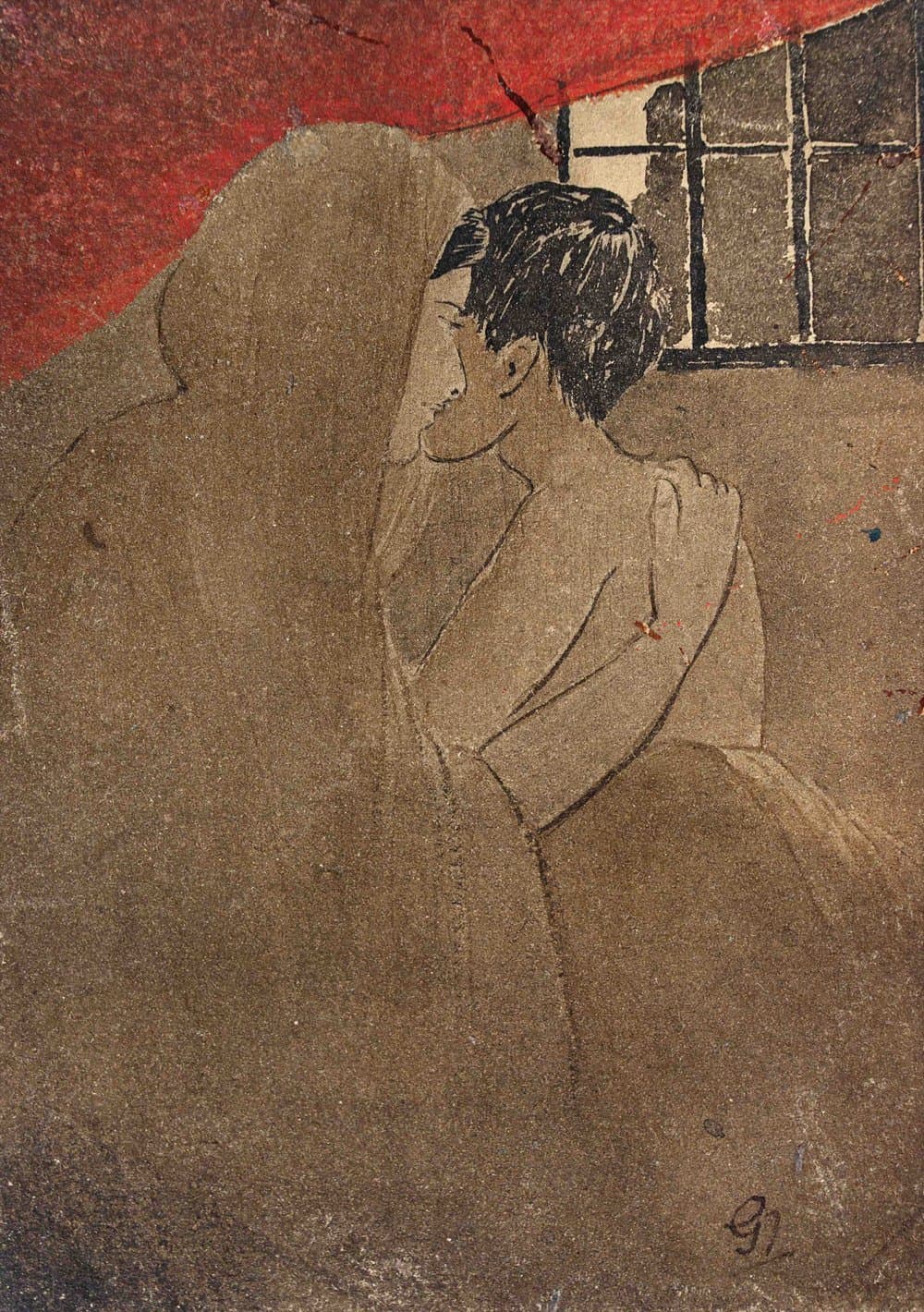 • Cubist Influence: The painting shows angular forms, broken planes, and geometric abstraction, echoing the cubist vocabulary. Yet, it is softer and more lyrical than European cubism, suggesting a conscious adaptation rather than imitation.
• Emotional Core: Despite its abstraction, the theme is universal and intimate; a mother and child. The figures are stylized but retain warmth, evoking tenderness and protection.
• Color and Tone: Gaganendranath often used monochromatic washes and muted palettes in his cubist-inspired works. In Mother & Son, tonal modulation plays a key role in creating depth, mood, and structure.
• Composition: The painting balances fragmentation with cohesion. The figures, though abstracted, remain legible, anchoring the work in human experience rather than pure formalism.
Interpretation
At its heart, Mother & Son is not only a study of form but also an exploration of emotional resonance through modernist aesthetics. The universal theme of maternal love is refracted through cubist experimentation, demonstrating how modern art could be both avant-garde and rooted in lived human experience.
The choice of subject may also reflect Gaganendranath Tagore’s broader vision of synthesizing East and West: the intimate, timeless motif of motherhood articulated through a contemporary, global visual language. It challenges the idea that modernism was exclusively Western, asserting India’s active participation in shaping modern art discourses.
Significance
• Marks one of the earliest sustained engagements with cubism in India.
• Bridges Indian themes with international styles, offering a uniquely hybrid modernism.
• Demonstrates how abstraction can deepen rather than diminish emotional expression.
• Highlights Gaganendranath’s role as a forerunner of Indian modern art, influencing subsequent generations of artists.
Conclusion
Gaganendranath Tagore’s Mother & Son painting is a landmark in Indian modernist painting. By reinterpreting a timeless theme through cubist idioms, Gaganendranath Tagore not only pushed the boundaries of artistic experimentation in colonial India but also asserted the cultural agency of Indian artists in the global art world. The work remains a testament to his originality, emotional depth, and ability to harmonize tradition with innovation.