

Blogs
.jpg&w=3840&q=75)
Guide To Bakhtiari Carpets: Hand-Knotted Rugs From Zagros Mountains, Iran
Yungming Wong | 13 Feb, 2026
Among the great carpet-weaving traditions of Iran, the Bakhtiari stands apart. Bold in colour, intricate in pattern, and built to last generations, Bakhtiari carpets are among the most recognizable and collectible of all Persian rugs. They come from a mountainous region in west-central Iran, woven by one of the country's most storied tribal confederacies, and they carry within their knotted wool a history of nomadic life, seasonal migration, and artistic ambition that stretches back centuries. This is what you need to know about them.
Who Are the Bakhtiari?
The Bakhtiari are one of the largest tribal confederacies in Iran, a people of Lur and Kurdish origin who have inhabited the Zagros Mountains of west-central Iran for centuries. Their territory, known historically as Chahar Mahal va Bakhtiari, encompasses a dramatic landscape of high peaks, deep river valleys, and fertile plains lying roughly between Isfahan to the east and Khuzestan to the west.
For much of their history, the Bakhtiari were semi-nomadic, spending summers in the high mountain pastures and winters in the warmer lowlands, driving vast herds of sheep and goats along ancient migration routes. This way of life shaped everything about their culture, including the carpets they wove. Wool was abundant, dyeing and weaving were domestic skills passed from mother to daughter, and the designs that filled their looms reflected the world they moved through: gardens, flowering trees, birds, animals, and the geometric patterns that had accumulated over generations of tribal tradition.
The Bakhtiari confederacy also produced some of Iran's most powerful tribal khans, leaders who commanded tens of thousands of warriors and played decisive roles in the political upheavals of the late 19th and early 20th centuries. It was partly the wealth and ambition of these khans that transformed Bakhtiari carpet weaving from a domestic craft into a commercial enterprise of considerable scale and sophistication.
A History of Bakhtiari Carpet Weaving
Bakhtiari carpets as a distinct and recognisable category emerged most clearly in the second half of the 19th century, though the weaving traditions that produced them are considerably older. The period from roughly 1870 to 1930 is generally regarded as the golden age of Bakhtiari carpet production, when the combination of tribal weaving skill, khan patronage, and growing international demand for Persian carpets produced some of the finest examples of the form.
The major weaving centres during this period were the towns and villages of the Chahar Mahal region, particularly Shahr-e Kord and the surrounding settlements, as well as the town of Saman and the villages clustered around it. The carpets produced in these workshop settings differ in certain respects from those woven in nomadic or semi-nomadic contexts: workshop Bakhtiari carpets tend to be larger, more regular in their knotting, and more carefully planned in their designs, while tribal pieces are often smaller, more loosely woven, and characterised by the slight asymmetries and spontaneous variations that come from weaving without a fixed cartoon.
The late 19th century also saw the involvement of Armenian and Iranian merchants in organising Bakhtiari carpet production for export, supplying weavers with materials and designs and arranging the sale of finished carpets in the markets of Isfahan, Tehran, and ultimately Europe and America. This commercialisation brought greater consistency and scale to Bakhtiari production but also, over time, some loss of the spontaneous tribal character that makes the finest early examples so compelling.
Design and Patterns
The most immediately recognisable Bakhtiari carpet design is the garden panel or compartment layout, in which the field of the carpet is divided into a grid of rectangular or diamond-shaped compartments, each containing a flowering tree, a vase of blossoms, a bird, or some other botanical or animal motif. This design is thought to reflect the ancient Persian concept of the paradise garden, an enclosed space of beauty and order set against the wildness of the natural world, and it appears in Bakhtiari carpets with a richness and variety that makes each example effectively unique.
The trees depicted in these compartments are drawn from the landscape the Bakhtiari knew well: cypress, pomegranate, pear, cherry, weeping willow, and various flowering shrubs appear alongside more stylised botanical forms. Birds perch in the branches; occasionally animals move through the undergrowth. The overall effect is of an abundant, teeming garden seen from above, rendered in wool with a palette of remarkable depth and variety.
Beyond the compartment design, Bakhtiari weavers also produced carpets with overall floral fields in which large blossoms, curving vines, and palmette forms fill the space in a more continuous pattern, and carpets with large central medallions surrounded by floral decoration. Geometric designs, drawing more directly on the tribal heritage, appear particularly in smaller and more purely nomadic pieces.
Borders in Bakhtiari carpets are typically bold and multi-layered, with a wide main border containing a running floral scroll or a series of cartouches flanked by narrower guard borders. The border design on a fine Bakhtiari carpet is often as intricate and carefully composed as the field itself, and the relationship between field and border, the way they complement or contrast with one another, is one of the things that separates a great Bakhtiari carpet from a merely good one.
Colours and Materials
The colour palette of Bakhtiari carpets is one of their most immediately striking qualities. These are not subtle carpets. The finest examples deploy rich reds, deep blues, warm greens, vivid yellows, ivory, and occasionally orange and aubergine in combinations that are bold without being garish, complex without being confused. The compartment design lends itself particularly well to strong colour, since each panel can carry a different dominant tone, creating a patchwork of colour across the field that is lively and varied but held together by the regularity of the grid.
Traditionally, Bakhtiari carpets were dyed with natural dyes: madder for reds and pinks, indigo for blues, weld and pomegranate rind for yellows, and various tannin-rich plants for browns and blacks. The finest naturally dyed Bakhtiari carpets develop a patina over time as the colours soften and harmonise with age, a quality that collectors prize highly. From the late 19th century onward, synthetic aniline and chrome dyes were introduced, and while early synthetic dyes sometimes faded unevenly or produced harsh, flat tones, later chrome dyes proved stable and are found in many good mid-20th-century examples.
The pile of a Bakhtiari carpet is almost always wool, typically hand-spun and of good quality, knotted onto a foundation of cotton warps and wefts in workshop pieces or wool warps and wefts in more tribal examples. The knot used is almost universally the asymmetric or Persian knot, tied to a relatively moderate density that allows for good detail without the extreme fineness of city workshop carpets from Isfahan or Kashan. The pile is generally clipped to a medium height, giving the carpet a solid, substantial feel underfoot and a clear, well-defined surface design.
How to Identify a Bakhtiari Carpet
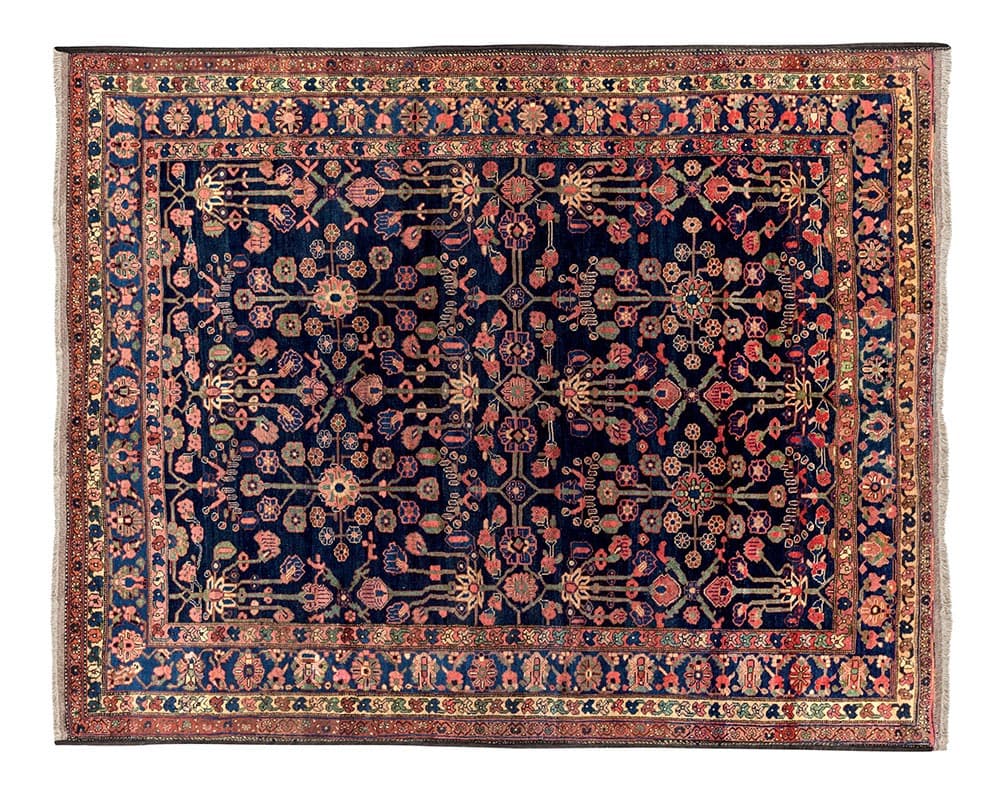 Several characteristics together help identify a Bakhtiari carpet with reasonable confidence. The compartment or garden panel layout is the most distinctive design signature, and a carpet displaying this pattern with bold colours, a wool pile on a cotton foundation, and a multi-part floral border is very likely to be Bakhtiari or strongly influenced by the tradition.
The wool quality and handle of a Bakhtiari carpet are also characteristic. The pile tends to feel dense and slightly coarse compared to the silkier pile of a fine Isfahan or Tabriz carpet, reflecting the robust, hard-wearing character of the tribal weaving tradition. The back of the carpet, where the knots are visible, typically shows the asymmetric knot structure clearly and has a somewhat irregular appearance compared to the precision of a high-end workshop carpet.
Size is another indicator. Workshop Bakhtiari carpets were produced in a wide range of sizes, including very large room-sized formats that are among the most impressive examples of the tradition. Tribal pieces tend to be smaller, in formats suited to tent or domestic use. Very small Bakhtiari pieces, including bags and other woven accessories, also exist and are collected in their own right.
Bakhtiari Carpets in the Market Today
Bakhtiari carpets have been collected and traded in Western markets since the late 19th century, and they remain one of the more accessible categories of antique Persian carpet for collectors at various levels. The combination of bold, appealing designs, good structural quality, and the relative abundance of surviving examples means that a fine antique Bakhtiari carpet can be found at auction or through specialist dealers at prices ranging from a few thousand pounds or dollars for a good mid-20th-century piece to considerably more for an exceptional late 19th-century example in original condition with saturated natural dyes.
Condition matters greatly, as it does with all antique carpets. Even wear across the field is far preferable to localised damage, and a carpet with some overall pile reduction but an intact structure and unfaded colours will almost always be more desirable than one with a thick pile in some areas and bare foundation in others. Repairs, if well executed and not extensive, need not be disqualifying, but large areas of reweaving or heavily repiled sections reduce both the aesthetic and the monetary value of a carpet significantly.
The question of natural versus synthetic dyes is important to many collectors, though not to all. Naturally dyed Bakhtiari carpets from before roughly 1900 are generally the most sought after, while later pieces dyed with stable chrome dyes are perfectly respectable and often very attractive. The harsh early aniline-dyed carpets of the 1880s and 1890s, identifiable by their sometimes faded or unevenly coloured appearance, are less prized, though even these can be charming objects in the right context.
For buyers new to Persian carpets, Bakhtiari pieces offer an excellent entry point. They are visually immediate, structurally robust, historically significant, and available in enough variety that finding an example suited to a particular space or budget is rarely difficult. They also wear well, both literally and aesthetically: a good Bakhtiari carpet improves with use, its colours deepening and harmonising with age in a way that synthetic floor coverings cannot replicate.
Caring for a Bakhtiari Carpet
A Bakhtiari carpet, like any hand-knotted wool carpet, benefits from straightforward but consistent care. Regular vacuuming, without a beater bar, removes the dust and grit that accumulate in the pile and can abrade the fibres over time if left in place. Rotating the carpet every year or two ensures that it wears evenly and that any differential fading from light exposure is minimised.
Spills should be addressed promptly by blotting rather than rubbing, working from the outside of the spill inward to avoid spreading the stain. Water can be used carefully for fresh spills, but any significant cleaning or treatment of stains should be entrusted to a specialist in antique textile cleaning rather than attempted with household products, which can damage both the dyes and the fibres.
Bakhtiari carpets should be laid on a good quality non-slip underlay, which protects both the carpet and the floor beneath it, cushions the pile, and prevents the creeping and bunching that can distort the structure over time. In storage, carpets should be rolled rather than folded, wrapped in breathable fabric rather than plastic, and kept in a cool, dry environment away from direct light and potential pests.
A Living Tradition
Bakhtiari carpet weaving is not only a matter of historical record. Weaving continues today in the Chahar Mahal va Bakhtiari region, though the conditions under which carpets are produced have changed considerably from the nomadic and semi-nomadic context in which the tradition developed. Contemporary Bakhtiari carpets vary considerably in quality and ambition, from factory-produced pieces aimed at the mass market to carefully made workshop carpets that draw directly on the classic designs and materials of the tradition's golden age.
For collectors and enthusiasts, the antique and old pieces remain the primary focus of serious attention. But the continuing vitality of weaving in the region is a reminder that the Bakhtiari carpet tradition is not simply a museum piece. It is a living craft, rooted in a particular landscape and a particular people, still capable of producing objects of genuine beauty and lasting worth.
The Timeless Beauty Of Exceptional Carpets And Rugs And The Art Of Collecting Them
27 Jan, 2020
5 Unforgotten Craftsmanship Of The Rich Culture Of India
20 Jan, 2020
The Diverse & Ornate Carpets Of Persia
24 Feb, 2023
6 Key Motifs Found in Oriental Rugs: A Cultural Insight
22 Aug, 2024
What Are Kashan Carpets & Why You Should Get One
23 Feb, 2026
A Brief History Of The First Origins Of Persian Isfahan Carpet
5 Feb, 2026
Heriz Carpets: Vibrant Craftsmanship From The Heart Of Azerbaijan
9 Feb, 2026
The History Of Caucasian Carpet & Their Beautiful Features
17 Feb, 2026
Ersari Rugs: A Deep Dive Into The Kepse & Tauk Nuska Gul
18 Feb, 2026

KNOW MORE
Buy
Sell
Request an Estimate
FAQs
Seller Terms
Store Terms
SERVICES
Client Advisory
Restoration
DOWNLOAD THE APP


Copyright 2026 AstaGuru. All Rights Reserved


