


gurcharan singh - paintings, life history, achievements & style
.jpg&w=3840&q=75)
A prominent figure in the world of Indian art, Gurcharan Singh’s works, often reflecting deep social and cultural themes, have made a lasting impact on the art scene. His paintings, which capture the nuances of human emotions and relationships, engage with complex themes like inequality and the primal side of human nature.
Background & Education
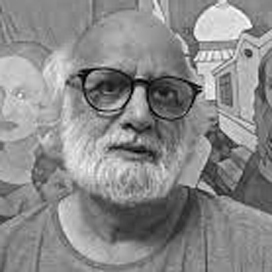 Gurcharan Singh's artistic journey began with a passion for capturing the essence of life on canvas. Born in 1949 in Patiala, he was exposed to a rich cultural heritage that deeply influenced his artistic sensibilities. His early experiences and observations of the world around him laid the foundation for his artistic pursuits. Singh's formal training in art at the Government College of Arts and Crafts, Chandigarh, honed his skills and provided him with a platform to express his creativity. He immersed himself in various art forms, experimenting with different techniques and mediums. His dedication and commitment to his craft were evident in his continuous exploration and evolution as an artist.
Themes
1. Everyday Life: Gurcharan Singh's paintings are a testament to his keen observation and interpretation of the human experience. His works often depict scenes from everyday life, capturing the nuances of human emotions and relationships. His portraits are particularly striking, revealing the inner world of his subjects with remarkable depth and sensitivity.
2. Birds: His portrayal of birds transcends mere representation; it captures their essence, beauty, and grandeur, often evoking a sense of awe and reverence in the viewer. Singh's birds are not simply static subjects; they are imbued with life, movement, and personality. Through his masterful use of colour, light, and texture, he creates a visual symphony that celebrates the avian world in all its diversity and splendour.
3. Social & Cultural Issues: Singh's art also reflects his deep engagement with social and cultural issues. His paintings often address themes of inequality, injustice, and oppression. His works serve as powerful commentaries on the human condition, prompting viewers to question and challenge the status quo.
4. Animals & Prostitutes: Another recurring motif in his paintings is the juxtaposition of animals and prostitutes, which he uses to symbolise the raw, primal aspects of human nature. This powerful approach allows him to explore the deeper connections between our animal instincts and human behaviour, highlighting how closely they are intertwined. Singh challenges us to consider the human instinct for survival, the dehumanising effects of societal norms, and the struggles faced by those pushed to the margins.
Art Style & Techniques
Gurcharan Singh's art style is a harmonious blend of realism and abstraction. He masterfully captures the likeness of his subjects while infusing his works with a sense of dynamism and movement. His use of colour is particularly noteworthy, ranging from vibrant and bold to subtle and evocative. Singh's brushstrokes are confident and expressive, conveying a sense of energy and vitality. His compositions are carefully balanced, drawing the viewer's eye to the focal point of the artwork.
Famous Paintings
1. The Red Light in Black and White: The painting starkly contrasts the vibrancy of the red-light district with the somber tones of the artist's perspective. A solitary woman, caught in a moment of waiting, stands frozen at a traffic signal, her life suspended between red and green, symbolising danger and hope. The work emanates a sense of grim inevitability, a haunting portrayal of human despair and the loss of innocence.
2. Les Miserables: The painting captures a gritty, urban scene steeped in raw emotion, where the harsh realities of life unfold through the lens of an individual's weary gaze. A sense of darkness and introspection pervades, suggesting that beneath the surface of society's moral decay lies an uncomfortable, though honest, truth.
3. Untitled Abstract Works: Some of Gurcharan Singh’s notable works include his abstract compositions. His use of vibrant colours, especially reds, yellows, and blues, contributed to the dynamic quality of his works. His more experimental pieces included blending forms and textures to create a sense of movement and energy.
Exhibitions & Awards
The artist has exhibited his works in several solo shows, including 'Twilight Tales', The Viewing Room, Mumbai in 2008; Jehangir Art Gallery, Mumbai in 2008; and Gallery 7, Mumbai in 1989 and 1986. He has also participated in various group exhibitions such as Black is Beautiful, India Fine Art, Mumbai in 2012; Sacred and Secular, India Fine Art, Mumbai in 2009, and more. His works were shown at the International Biennales in Tokyo, Seoul, and London. He was awarded the National Award in 1976 and the Padma Shri by the Government of India, New Delhi, in 1991.
Legacy & Influence
Gurcharan Singh's contributions to the Indian art scene are undeniable. He has inspired countless aspiring artists with his unique vision and artistic expression. His works have been exhibited in prestigious galleries and museums across India and abroad, garnering critical acclaim and recognition.
Singh's legacy extends beyond his paintings.
Conclusion
Gurcharan Singh's artistic journey is a testament to the power of art to transcend boundaries and connect people across cultures. His paintings are a window into the human soul, inviting viewers to explore the depths of their own emotions and experiences. His art style continues to inspire and captivate art enthusiasts around the world.




