heriz carpets: vibrant craftsmanship from the heart of azerbaijan
.jpg&w=3840&q=75)
Few names in the world of antique and decorative rugs carry the weight and recognition of Heriz. Woven in the mountainous villages of northwestern Iran, Heriz carpets have captivated collectors, interior designers, and art lovers for well over a century. Their bold geometric patterns, robust construction, and rich palette of deep reds, navy blues, and warm ivories make them among the most immediately recognizable and most enduringly desirable floor coverings in the world.
Origins and History
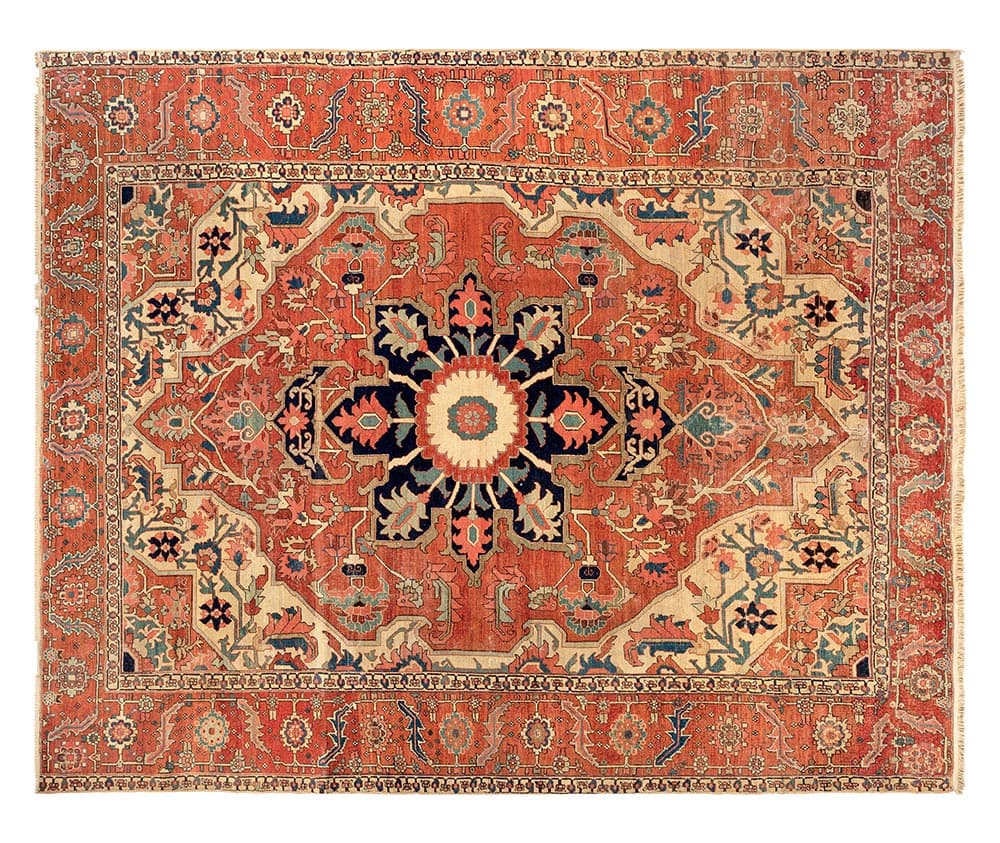 Heriz carpets take their name from the town of Heris (also spelled Heriz) in the East Azerbaijan province of northwestern Iran, not far from the city of Tabriz. The region sits at high altitude, and the local water, said to be rich in copper, is often credited, in local lore, with giving the wool of Heriz rugs its characteristic lustrous sheen and extraordinary durability.
Carpet weaving in the Heriz district has roots stretching back several centuries, though the distinctive style most collectors associate with the name truly came into its own during the late 19th century. During this period, European and American demand for Persian rugs surged dramatically, and the villages surrounding Heriz became major production centers catering to this export market. American merchants in particular developed an enormous appetite for Heriz carpets, and many of the finest examples produced during the late 1800s and early 1900s were shipped directly to the United States, where they graced the parlors and dining rooms of affluent households.
This export-driven heritage is one reason why antique Heriz carpets remain so abundant in the American market today, and why they have long been a staple of estate sales, auction houses, and antique dealers across the country.
Design and Aesthetics
The visual language of a Heriz carpet is bold, confident, and unmistakable. Unlike the delicate curvilinear patterns found in city rugs from Tabriz or Isfahan, where professional designers drafted intricate floral arabesques, Heriz weavers worked from memory and tradition, producing geometric interpretations of classic Persian medallion designs.
At the center of most Heriz carpets sits a large, angular medallion, typically rendered in deep navy blue or brick red. This central motif is surrounded by similarly geometric corner pieces, known as spandrels, that mirror the medallion's palette and form. The field between these elements is filled with stylized floral and botanical forms, including palmettes, vine scrolls, and leaf motifs, all translated into the angular, rectilinear vocabulary that defines the Heriz aesthetic.
The border system in a Heriz carpet is equally assertive. Main borders are wide and boldly patterned, often featuring a reciprocating vine or palmette repeat, and are flanked by narrower guard borders that frame the composition with confidence.
Color is one of the most celebrated aspects of Heriz weaving. The characteristic palette leans toward warm, earthy tones, including burnt sienna, terracotta, and deep madder reds, offset by rich navy and midnight blues, accents of ivory and cream, soft gold, and occasional notes of green or camel. These colors were traditionally produced using natural vegetable and mineral dyes, which have the remarkable property of mellowing beautifully over time. An antique Heriz carpet with original dyes will display a patina of harmonious, softened color that synthetic dyes simply cannot replicate.
Construction and Quality
Heriz carpets are village rugs in the truest sense. They were woven not in urban workshops under the supervision of professional designers, but in village homes by weavers who carried their craft knowledge from one generation to the next. This vernacular tradition gives Heriz carpets a vitality and directness that more formally produced city rugs sometimes lack.
The foundation of a Heriz carpet is typically cotton, both the warp (the vertical threads stretched on the loom) and the weft (the horizontal threads that lock the pile knots in place). The pile itself is wool, and it is this wool that accounts for much of the carpet's legendary durability. Heriz wool is thick, springy, and tightly spun, producing a pile that wears exceptionally well over decades and even centuries of use.
Heriz weavers use the symmetrical (Turkish) knot, which suits their angular, geometric designs. Knot counts are relatively low by the standards of fine Persian city rugs, typically somewhere between 40 and 100 knots per square inch, but this is entirely appropriate for the bold, large-scale designs these carpets feature. High knot counts are necessary for intricate curvilinear work; for geometric compositions, a lower count produces a result that is sturdy, expressive, and entirely fit for purpose.
The combination of cotton foundation and thick wool pile makes Heriz carpets remarkably resilient. Antique examples from the 1880s and 1890s regularly survive in excellent condition, having served as primary floor coverings in active households for more than a century.
Heriz and Its Cousin Serapi
No discussion of Heriz carpets is complete without a mention of Serapi rugs, which occupy a closely related but distinct place in the collector's world. Serapi (or Serab) refers to carpets woven in the same general region of northwest Iran, but produced somewhat earlier, roughly from the mid-19th century through the 1880s, and often distinguished by larger formats, more spacious compositions, and a slightly softer, more faded palette.
The term "Serapi" is largely a market designation rather than a strict geographical or historical category, and its application can vary among dealers and scholars. In general, collectors use it to describe earlier, more loosely drawn, and more highly prized examples from the Heriz weaving region. Serapi rugs tend to command significant premiums over later Heriz production, and the finest antique Serapis rank among the most desirable Persian village rugs on the market.
Whether classified as Heriz or Serapi, carpets from this corner of Azerbaijan share the same fundamental design vocabulary, materials, and spirit of bold, confident craftsmanship.
Collecting Heriz Carpets
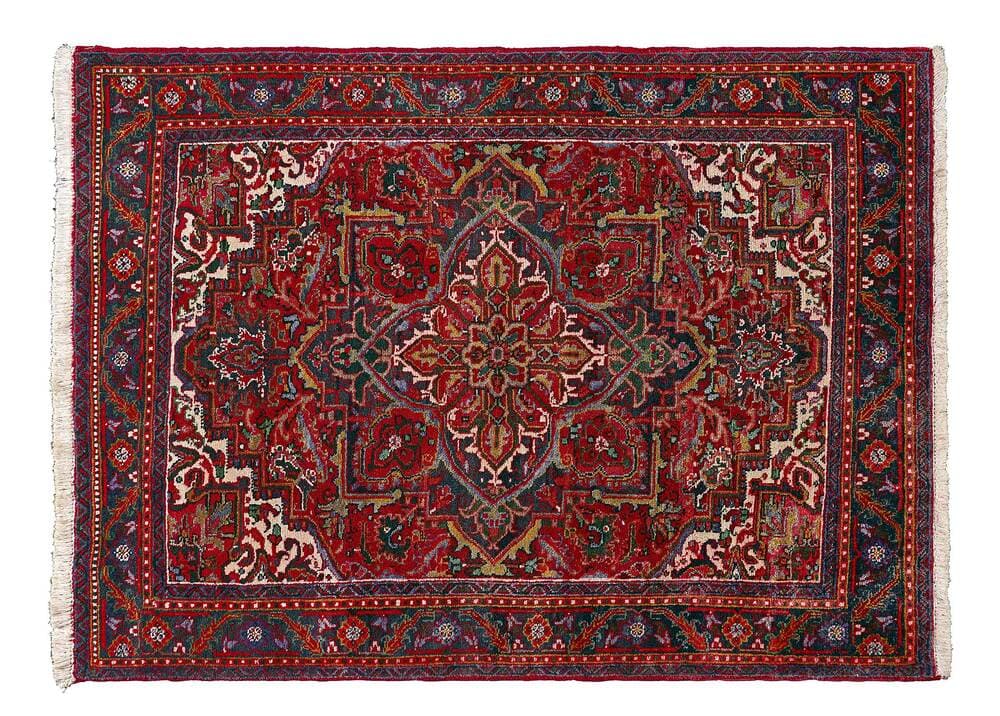 Heriz carpets occupy a uniquely accessible position in the world of antique Persian rugs. Unlike extremely rare or delicate weavings that require museum-like care, Heriz rugs were made to be used. Their robust construction means that even carpets with significant age and wear can continue to serve as practical, beautiful floor coverings in active homes.
When assessing a Heriz carpet, collectors and buyers typically consider several factors. Age is significant, with carpets woven before roughly 1920 generally considered antique and prized for their natural dyes and the depth of their aged patina. Condition matters, though modest wear is expected and even appreciated in older examples; it is evidence of a life well lived. Pile height, evenness of wear, and the integrity of the foundation are all worth examining.
Color is perhaps the most immediate indicator of quality. Natural dye Heriz carpets have a luminosity and complexity that is difficult to describe but unmistakable in person. Colors interact harmoniously, and even quite faded or worn examples retain a chromatic warmth that synthetic dye rugs typically lack. Harsh, flat, or overly bright colors in an older-looking carpet can indicate re-dyeing or the use of synthetic dyes, both of which diminish value.
Design quality varies considerably across the Heriz production spectrum. The most prized examples feature compositions that are well-balanced and spatially intelligent, where the central medallion, corner spandrels, field, and border work together as a coherent whole. Less successful examples can feel crowded or awkward in their proportions.
Size is also an important consideration. Heriz carpets were produced across a wide range of formats, from room-sized carpets measuring twelve by eighteen feet or larger, to more modest scatter sizes. Large-format antique Heriz rugs are among the most sought-after pieces in the entire Persian rug market, capable of anchoring even grand architectural spaces with ease.
Heriz Carpets in Interior Design
One of the reasons Heriz carpets have remained perennially popular with interior designers is their extraordinary versatility. Their bold geometric patterns and warm, earthy palettes integrate naturally into a remarkable range of decorating styles, from traditional to transitional to surprisingly contemporary.
In a classically furnished room, a large antique Heriz anchors the space with authority, its deep reds and navies harmonizing with mahogany furniture, oil paintings, and leather upholstery. In a more contemporary setting, those same colors and bold geometric forms can read as graphic and almost modern, offering a counterpoint to clean-lined furniture and neutral walls.
The aged patina of an antique Heriz also contributes to its design appeal. The mellow, complex colors of a century-old carpet add layers of visual richness that new furnishings cannot replicate, lending a sense of history and depth to any room they inhabit.
For high-traffic areas such as dining rooms, hallways, and family rooms, the durability of Heriz construction makes them a practical as well as aesthetic choice. Few rugs in the world can match the combination of beauty and resilience that a well-made Heriz carpet offers.
Care and Preservation
Heriz carpets, for all their durability, benefit from attentive care. Regular rotation is advisable for carpets in high-traffic areas, ensuring that wear is distributed evenly rather than concentrated in one zone. Padding beneath the carpet protects both the rug and the floor, reduces slipping, and extends the life of the pile.
Professional cleaning by a specialist in antique and Oriental rugs is strongly recommended for valuable examples. Household vacuum cleaners, used with care and without the beater bar, can remove surface dust between professional cleanings. Spills should be addressed promptly and gently, blotting rather than rubbing to prevent the spread of staining.
Exposure to direct, prolonged sunlight will fade any carpet over time, a consideration worth keeping in mind when placing a Heriz in a sun-filled room. Rotating the carpet periodically, or using UV-filtering window treatments, can help preserve color integrity.
Conclusion
Heriz carpets represent one of the great achievements of the Persian weaving tradition, not in the delicate, technically complex sense of a fine Isfahan or Kashan, but in the bold, vital, deeply human sense of a village craft practiced with conviction and passed down through generations. Their geometric power, their warm and enduring palette, and their remarkable physical resilience have made them beloved by collectors and designers for well over a century.
To own a Heriz carpet, particularly a fine antique example, is to possess something that connects the modern home to a long and distinguished tradition of human making. These are rugs built not merely to be admired, but to be lived with, and they repay that use with a presence and beauty that only deepens with time.