himmat shah - a lifelong exploration in sculpture & innovation
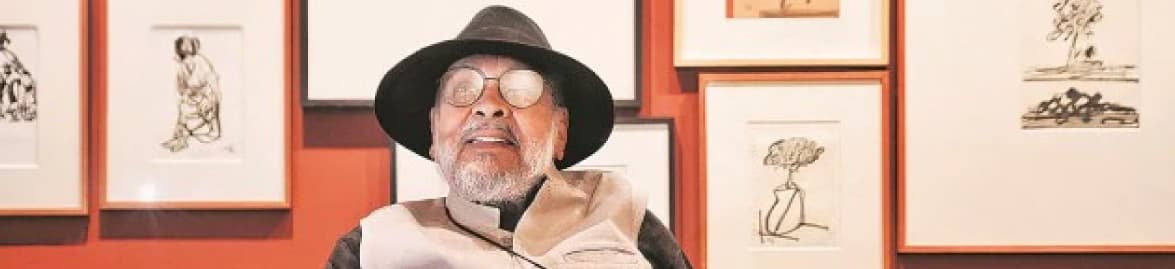
Himmat Shah, one of India’s foremost sculptors, is widely celebrated for his innovative and exploratory approach to sculpture. His work, spanning over several decades, has been instrumental in defining the modern sculptural landscape of India. Known for his versatile use of materials and an ever-evolving exploration of form, Shah’s art is both deeply rooted in tradition and innovative in its approach. He is not just a sculptor but an artist whose constant curiosity and search for new artistic vocabularies have made him a pioneer in Indian contemporary art. In this article, we take a deep dive into his life, art, influences, and lasting contributions to the world of sculpture.
Early Life & Background
Himmat Shah was born in 1933 in the town of Lothal in Gujarat, India. Growing up in a region rich in historical significance, particularly with its proximity to the ancient Harappan civilization, he was influenced by the sense of antiquity and the enduring legacy of ancient Indian art. Though born into a family of modest means, his innate curiosity and inclination toward art were evident from an early age. His early years were shaped by a deep fascination with the ancient sculptural forms of India, particularly those of the Indus Valley Civilization, which often depicted human figures and animals in abstract forms. These early experiences of interacting with historical remnants would go on to inform his work and his ideas about form, space, and texture.
Shah’s journey into the world of art began when he moved to the city of Ahmedabad to study at the prestigious M.S. University of Baroda. Here, he honed his skills as a sculptor under the guidance of eminent teachers, notably in the art department led by artists like K.G. Subramanyan. Shah's formal training exposed him to a rich palette of artistic traditions, both Western and Indian, helping him forge his distinctive sculptural language. During this time, he was profoundly influenced by modernist movements in sculpture that were emerging in Europe and the United States, especially the works of artists like Henry Moore and Pablo Picasso, as well as traditional Indian sculpture forms such as those seen in temples and ancient sites.
Early Work & Breakthrough
Shah’s early works were characterized by an adherence to the traditional principles of sculpture, but it was soon clear that he was determined to break free from the rigidity of classical forms. His focus was on exploring the very essence of form itself—its ability to evoke emotions, stir the imagination, and challenge the viewer’s perception of space. Through his experiments with various materials such as stone, bronze, clay, and wood, Shah developed a unique vocabulary that blurred the lines between abstraction and representation. One of his early exhibitions in the 1950s marked the beginning of a career that would push the boundaries of conventional sculpture in India.
While his initial works had some figurative elements, it was his movement toward abstraction that made him a trailblazer in Indian sculpture. Shah's shift to abstraction was not a rejection of tradition but rather an attempt to find a contemporary expression of Indian cultural and spiritual ideas through sculptural forms. He sought to create works that were more than just physical representations; they were reflections of the inner world, the spiritual self, and the universal forces that govern existence.
One of Shah's breakthrough works was the creation of large-scale sculptures that explored the human body through minimalist abstraction. His sculptures were often of abstracted human figures, fragmented but still clearly evoking human shapes or forms. For example, works like “The Human Form” demonstrated his mastery of form and his ability to distill the human figure down to its most essential and evocative shapes. This approach was both an homage to classical traditions and a challenge to contemporary norms, setting him apart from his peers.
Philosophy Of Abstraction
Himmat Shah’s art is deeply philosophical. His shift toward abstraction was not just an aesthetic choice but a deliberate move to explore the deeper metaphysical dimensions of human existence. For Shah, sculpture became a means of understanding and expressing the spiritual realm, where the physical form served as a vehicle to engage with the immaterial. His abstract sculptures were often inspired by the dynamic interplay between the internal and external worlds, and he frequently spoke about his desire to break free from the constraints of traditional representation in art.
Shah’s abstraction is unique because it is not disconnected from the human experience; rather, it emerges from the human experience itself. Whether it was his forms depicting human faces, bodies, or symbolic animals, there was always a suggestion of an underlying connection to the real world. This allows the viewer to interpret his work on a visceral level, engaging with it emotionally and intellectually.
Shah’s work in abstraction was particularly unique in the context of Indian art. While many contemporary Indian artists were turning to Western abstraction, Shah sought to connect his abstractions to the rich spiritual and cultural history of India. His use of the human form, combined with an almost cosmic sense of space, was reflective of the deeply spiritual and philosophical inquiries that dominated much of traditional Indian sculpture, particularly in ancient temple art. In this way, Shah’s abstraction was an exploration of both the personal and the universal, drawing from his deep understanding of both Western modernism and Indian spiritual traditions.
Mastery Of Materials
One of the distinctive features of Shah’s work is his fearless experimentation with materials. Throughout his career, he constantly experimented with different media, evolving his practice and pushing the boundaries of what sculpture could be. Initially working with traditional materials like stone and clay, Shah moved on to explore the possibilities of bronze, steel, wood, and other industrial materials. This experimentation allowed him to create diverse textures and surfaces in his work, from the rough and organic textures of his clay sculptures to the smooth, polished forms of his bronze pieces.
Shah's approach to materials was innovative in that it often involved a process of transformation—materials were not just used to construct a form, but were allowed to dictate the final appearance of the work. For example, in his clay works, the tactile nature of the medium played a significant role in shaping the final piece. Similarly, when using stone or wood, he often allowed the natural properties of the material to interact with his creative vision, resulting in sculptures that felt both organic and intentionally crafted.
This fearless exploration of materials culminated in Shah's series of "Waves" and "Human Faces" sculptures, where his handling of industrial materials such as stainless steel, aluminum, and even glass created complex compositions that were as much about the interplay of materials and space as they were about the forms themselves. The use of these materials allowed Shah to break from traditional sculpture and engage with modernity in a way that was fresh and unique. His mastery of material, form, and texture resulted in works that invited deep reflection on the nature of creation and existence.
Evolution & Iconic Works
As Himmat Shah's career progressed, his works became increasingly diverse, yet always rooted in his core principles of abstraction, spirituality, and the human condition. His most iconic works—whether abstract forms of the human body, faces, or animals—have captivated audiences both in India and internationally. Shah's sculptures are known for their ability to communicate complex emotions and ideas through simple yet powerful forms. The works evoke an intellectual response, compelling the viewer to engage with the piece on a deeper level, whether through its physical presence or its philosophical underpinnings.
One of the most important series in Shah's career is his "Kali" series, which is an abstraction of the powerful Hindu goddess Kali. Through his rendering of Kali, Shah took a deeply spiritual and religious figure and deconstructed her into a minimalist abstraction. This series is significant for its fusion of the traditional with the modern and its bold reimagining of a familiar cultural symbol. The "Kali" sculptures are a testament to Shah’s ability to convey the power and complexity of the goddess, yet his abstractions leave much to the viewer’s interpretation, inviting them to experience the divinity of Kali in a deeply personal way.
In another iconic series of "Face Sculptures", Shah used his mastery of form to create face-like shapes from the most basic elements of clay and metal. These faces, while abstract, communicate emotion and expression through the purity of form and the rough texture of the medium. The facelessness of the forms, combined with the organic textures, results in sculptures that convey human emotion without being tied to any specific individual or identity. These pieces reflect Shah’s ongoing engagement with themes of identity and transformation, often leaving the faces open to interpretation, allowing viewers to project their own feelings and thoughts onto the sculptures.
International Recognition
Himmat Shah's work has not only earned him recognition in India but also on the global stage. His sculptures have been exhibited in several prestigious galleries and museums worldwide, including the Louvre in Paris, the Royal Academy of Arts in London, and galleries in the United States, Europe, and Asia. His ability to blend traditional Indian motifs with modernist abstraction made his work appealing to an international audience, where it was appreciated not only for its aesthetic appeal but also for its philosophical depth.
Shah's participation in major exhibitions, including The Venice Biennale, further cemented his reputation as an international artist. His work was also featured in various curated exhibitions that explored the intersection of tradition and modernity, a theme central to Shah’s work. His exhibitions have attracted collectors and art lovers alike, with his sculptures appearing in private collections and major museum collections around the world.
Legacy & Impact
Himmat Shah’s lifelong exploration of sculpture has left a lasting impact on the world of art, particularly in the realm of Indian contemporary sculpture. His innovative approach to materials, form, and abstraction has opened new avenues for sculptors in India and abroad. Shah’s exploration of abstraction through the lens of spirituality and humanism has also influenced a generation of young sculptors to challenge conventions and pursue their own unique artistic paths.
His work continues to be a source of inspiration, and his legacy as a pioneering sculptor is firmly entrenched in the annals of Indian art history. Himmat Shah’s sculptures invite viewers to look beyond the physical form and engage with the deeper questions of existence, identity, and spirituality. As an artist who always sought to innovate, to push boundaries, and to create meaning through form, Himmat Shah’s contribution to the world of art remains invaluable.
In conclusion, Himmat Shah’s life and work embody a lifelong commitment to innovation, abstraction, and spiritual exploration. Through his sculptures, he has not only redefined the boundaries of contemporary Indian sculpture but has also contributed to the global conversation about the role of art in expressing the human experience. His work, characterized by its simplicity, profundity, and philosophical depth, will continue to influence generations of artists and art enthusiasts for years to come.
As we bid farewell to this introduction to Himmat Shah's artistry, continue the experience by exploring the profound meanings in his work—click here to connect with his vision.