history of persian luri carpets, from its origins till today
.jpg&w=3840&q=75)
Persian Luri Carpets: Woven Stories from the Zagros Mountains
Few textile traditions capture the spirit of a nomadic people as vividly as the carpets of the Luri tribes of Iran. Bold, unselfconscious, and alive with an almost untamed energy, Luri carpets are among the most distinctive weavings in the entire canon of Persian rug-making. They are not carpets designed to impress a royal court or satisfy the refined tastes of urban collectors. They are, at their core, functional objects charged with personal and cultural meaning, and that is precisely what makes them extraordinary.
Who Are the Lurs?
The Lurs are an ancient Iranian people who inhabit the Zagros Mountain range in western and southwestern Iran, primarily in the provinces of Lorestan, Kohgiluyeh and Boyer-Ahmad, Chaharmahal and Bakhtiari, and parts of Khuzestan and Fars. Linguistically and culturally distinct, though related to the Bakhtiari and other Zagros tribes, the Lurs have maintained a semi-nomadic or transhumant way of life for centuries, moving their flocks between highland summer pastures and lowland winter grazing grounds along routes their ancestors have traveled for millennia.
This nomadic rhythm shaped every aspect of Luri material culture. Carpets, kilims, and woven bags were not decorative luxuries; they were essential equipment. A family's weavings served as floor coverings, bedding, room dividers, saddlebags, and storage containers. When the time came to pack up and move, everything was rolled or folded and loaded onto mules. Durability, portability, and practicality were not afterthoughts; they were embedded in the structure of the cloth itself.
The Aesthetic of Luri Weaving
What immediately distinguishes a Luri carpet from the more polished productions of urban workshops in Isfahan or Tabriz is its raw, instinctive visual power. Luri weavers typically worked from memory and tradition rather than from paper cartoons or workshop patterns. Designs were passed down from mother to daughter, adapted freely, and sometimes invented on the fly. The result is a vocabulary of forms that feels simultaneously ancient and spontaneous.
Geometric motifs dominate. Medallions, lozenges, hexagons, and stepped diamonds fill the central field in arrangements that can feel boldly rhythmic or delightfully eccentric, depending on the piece. Stylized animals, including horses, deer, birds, lions, and fantastical creatures, appear with a directness that verges on the heraldic. Human figures, though rarer, turn up occasionally, rendered with a charming abstraction that recalls cave paintings more than court art. Floral forms exist, but they are always angular, stripped of the sinuous naturalism found in classical Persian design.
The borders of Luri carpets tend to be robust and assertive, often featuring reciprocating vine-and-leaf patterns, running dog motifs, or rows of stylized blossoms. They frame the central composition with authority rather than delicacy.
Color is perhaps the most immediately striking feature of Luri work. The palette is deep and saturated: rich crimsons, warm madder reds, dark indigo blues, forest greens, and warm camel and ivory tones. These colors were traditionally achieved using natural dyes: madder root for reds and oranges, indigo for blues, pomegranate rind and oak galls for yellows and greens. The wool itself, often spun from the fleece of the tribe's own sheep, has a lustre and lanolin content that gives it an almost luminous quality, especially in older pieces where the pile has developed a natural patina.
Materials and Construction
Luri carpets are almost always pile weavings knotted on a wool foundation, with both warp and weft typically wool, giving the finished carpet a suppleness and warmth that wool-on-cotton pieces rarely match. The knots used are predominantly the asymmetric (Persian or Senneh) knot, though symmetric (Turkish or Ghiordes) knotting appears in some tribal sub-groups, reflecting the complex ethnic mosaic of the Zagros region.
Knot counts tend to be moderate rather than high. This is not a limitation so much as a deliberate consequence of working with coarser tribal wool on a hand-spun foundation. The relatively open weave allows for boldness of design; the thick pile, often left quite long, contributes to the carpet's tactile richness and durability. A well-made Luri carpet, used and loved for generations, develops a surface patina of extraordinary beauty.
Flatweave kilims also occupy an important place in Luri textile production. Luri kilims feature the same geometric vocabulary as pile carpets but rendered in pure weft-faced tapestry, sometimes supplemented with soumak wrapping for textural contrast. These flatweaves were used as prayer rugs, room dividers, and decorative wall hangings.
Regional Variations
The Luri people are not a monolithic group, and their weaving traditions reflect this diversity. Carpets from Lorestan tend toward particularly dark, dramatic coloration and bold, almost architectural patterning. Those attributed to the Bakhtiari-adjacent Luri communities of Chaharmahal and Bakhtiari Province often show slightly more organized field compositions, a consequence of greater contact with settled weaving traditions. Pieces from Kohgiluyeh can be wilder and more improvisational in their layout.
Some of the most celebrated Luri weavings come from the area around Khorramabad, the provincial capital of Lorestan, and from scattered tribal groups in the high valleys of the central Zagros. Collectors and dealers have long distinguished between "Luri" and "Bakhtiari" attribution, though in practice the boundary is often blurred, with many families and sub-tribes moving between these categories over centuries of migration and intermarriage.
Symbolism and Meaning
Like all tribal textiles, Luri carpets are repositories of symbolic meaning, though decoding that symbolism is a task fraught with difficulty. Some motifs carry pan-Iranian resonance: the Tree of Life, the flowering garden as paradise, the protective eye. Others are specific to Luri tradition, their meanings now partially obscured by the passage of time and the disruption of nomadic lifestyles.
Animals carry particular symbolic weight. The horse is associated with nobility, freedom, and the heroic ideal that runs deep in Luri oral poetry and epic tradition. Birds, especially the peacock and the hoopoe, suggest paradise and the soul. Serpentine forms, sometimes woven into border designs, may carry protective or fertility symbolism. Weavers themselves, when asked about individual motifs, sometimes offer explanations and sometimes shrug; the forms were learned by watching and doing, not by reading a manual of symbolic codes.
Persian Luri Carpets in the Market Today
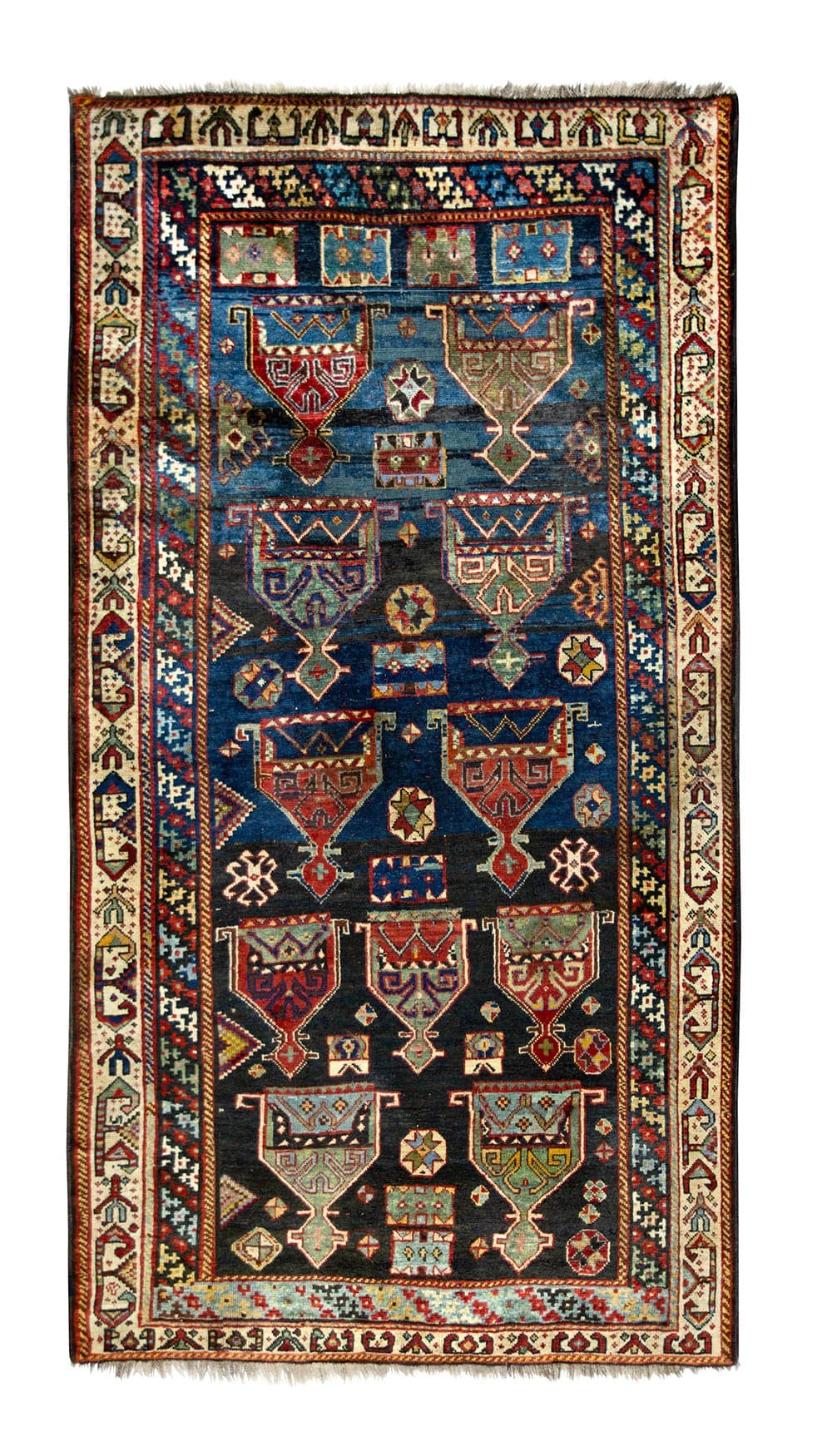 Antique and semi-antique Persian Luri carpets, those woven before roughly the mid-twentieth century, are avidly collected worldwide and command strong prices commensurate with their artistic quality and rarity. The best pieces, with harmonious compositions, vibrant natural dyes, and well-preserved pile, can sell at major auction houses for tens of thousands of dollars. More modest examples remain accessible to collectors of modest means, particularly room-sized pieces with some wear or minor repairs.
Contemporary Luri weaving continues, though it has changed substantially. Settled lifestyles, the availability of synthetic dyes, and changing economic pressures have altered the production of tribal carpets across Iran, and Luri weaving is no exception. The most vigorous current production tends to come from villages rather than nomadic camps, and quality varies enormously. A small number of cooperatives and individual weavers, often working with NGO support, have attempted to revive the use of natural dyes and traditional designs, with results that range from genuinely impressive to merely nostalgic.
Buyers seeking new Luri work are advised to look carefully at wool quality, dye authenticity, and design integrity, and to be skeptical of pieces labeled "tribal" that show the mechanical regularity of workshop production. The genuine article retains an energy, an asymmetry, a willingness to depart from strict geometric order, that no amount of workshop training can convincingly simulate.
Caring for Luri Carpets
Luri carpets are robust objects built to withstand hard use, but they repay sensible care. Regular rotation helps even wear. Gentle vacuuming, taken in the direction of the pile, removes grit that would otherwise act as an abrasive on the foundation. Spills should be blotted immediately; professional cleaning is recommended for serious soiling or staining. Antique pieces benefit from moth-proof storage when not in use, and from occasional airing in indirect sunlight.
Conclusion
The Luri carpet is an object of remarkable integrity. It was made by people who needed it, from materials they raised or gathered, in patterns they inherited and made their own, without recourse to fashion or foreign approval. That self-sufficiency is visible in every knotted row: in the confident handling of color, the free-handed geometry, the bold disregard for perfect symmetry. These are carpets that do not ask to be admired. They simply are what they are, and what they are is extraordinary.
For anyone interested in the intersection of art, craft, culture, and history, the Luri carpet offers an endlessly rewarding subject. Each piece is a small archive of a people's aesthetic sensibility and lived experience, a document woven in wool, as durable and as warm as the hands that made it.