


How Dhruva Mistry Became One of India’s Most Internationally Acclaimed Sculptors

Dhruva Mistry’s rise from a sculptor with a distinctive artistic sensibility to an internationally recognized name is best understood as a long process rather than a single breakthrough. International acclaim is usually earned through a combination of exceptional craft, a consistent and recognizable visual language, meaningful professional visibility, and the ability to connect with audiences beyond the artist’s home cultural context. In Dhruva Mistry’s case, these factors appear to have converged in a way that transformed skilled sculpting into global reputation.
This article explores how sculptors like Dhruva Mistry typically move from local recognition to international acclaim, while focusing on the elements that most strongly explain why his work has drawn attention from galleries, collectors, and art audiences worldwide.
Early Foundations: The Baroda School connection
Dhruva Mistry was born in 1957 in Kanjari, Gujarat. His formal artistic journey began at the prestigious Faculty of Fine Arts, Maharaja Sayajirao University (MSU) of Baroda, where he completed his Bachelor’s (1979) and Master’s (1981) degrees in Sculpture.
Baroda at the time was the epicenter of a radical shift in Indian art. Moving away from rigid academic realism and defensive nationalism, the "Baroda School" encouraged a narrative, figurative approach that was deeply aware of international trends yet rooted in local contexts. Under the mentorship of pioneering teachers like K.G. Subramanyan and Sankho Chaudhuri, Mistry developed a profound respect for materiality and a unique visual vocabulary that fused the monumental weight of ancient Indian sculpture with a clean, contemporary edge.
The British Breakthrough: The Royal College of Art and Beyond
The turning point in Dhruva Mistry’s international career came in 1981 when he was awarded the prestigious British Council Scholarship to study at the Royal College of Art (RCA) in London.
Arriving in the UK, Dhruva Mistry did not just adapt to the Western art world; he challenged it. At a time when British sculpture was leaning heavily toward conceptualism and abstract assemblages, Mistry boldly championed the human figure.
• The 1983 Solo Exhibition: Just two years after arriving in the UK, Mistry held a landmark solo exhibition at the Institute of Contemporary Arts (ICA) in London. The art world took notice of this young Indian artist who was creating enigmatic, polychromed plaster figures that felt both ancient and shockingly modern.
• Artist in Residence at Kettle’s Yard: In 1984, 1985, Dhruva Mistry was appointed Artist in Residence at Kettle's Yard and Fellow Commoner at Trinity College, Cambridge. This residency solidified his reputation, allowing him to create works that integrated seamlessly into British public spaces.
Merging the Sacred and the Secular: Mistry’s Aesthetic Philosophy
What made Dhruva Mistry’s work resonate so deeply on an international scale was his ability to evoke a sense of the universal. His sculptures often reference Indian mythological archetypes, Egyptian sphinxes, and classical Greco Roman forms without mimicking any of them directly.
Key Themes and Stylistic Traits
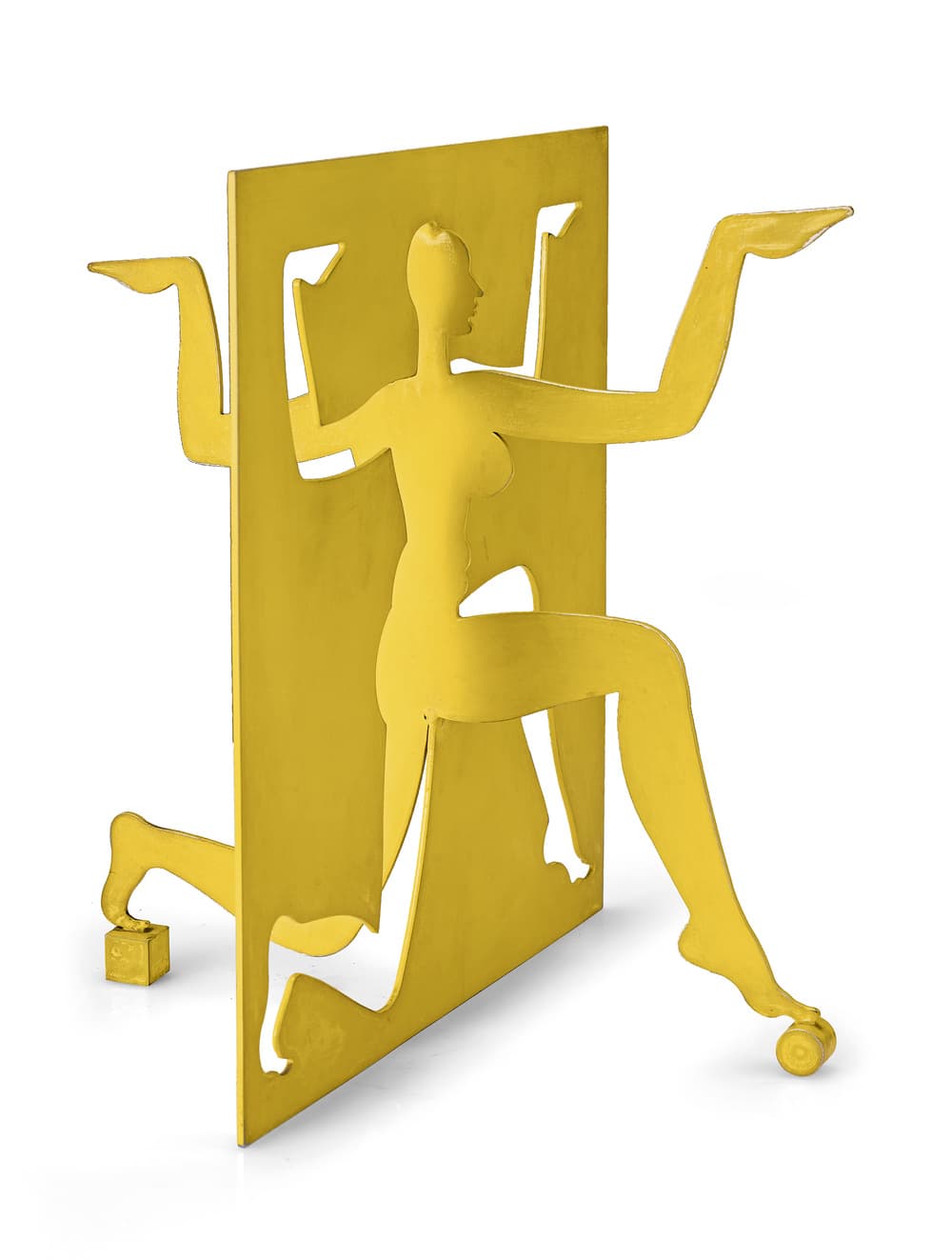 • The Hybrid and the Mythical: Mistry is famous for creating creatures that straddle the line between human and animal such as his Creature series and sphinx like guardians. These figures evoke a sense of quiet majesty and spiritual timelessness.
• Polychromy: Breaking away from the monochromatic tradition of Western bronze and marble, Mistry frequently painted his plaster and fiberglass sculptures in vivid colors. This was a direct nod to traditional Indian temple sculptures and folk art.
• The Interplay of Mass and Void: Whether carving in stone, casting in bronze, or cutting through sheets of steel, Mistry explores how a solid form commands the space around it. His later works became more abstract, using layered, spatial cutouts to let light and air pass through the artwork.
Institutional Recognition: The Royal Academy of Arts
In 1991, at the age of just 34, Dhruva Mistry achieved a historic milestone: he was elected a Royal Academician (RA) of the Royal Academy of Arts, London. He was one of the youngest artists, and the first Indian national, to receive this distinct honor in the 20th century.
Two years later, in 1993, he was selected for the Victoria Quarter Public Art Project in Leeds, where he created The Victoria Fountain. By the mid 1990s, Mistry was firmly embedded in the upper echelons of the British art establishment, represented in major public collections including the Tate Gallery in London and the National Museum of Wales in Cardiff.
The Crowning Achievement: The River in Birmingham
Perhaps Dhruva Mistry’s most famous international commission is The River (1993), a monumental public artwork designed for Victoria Square in Birmingham, England.
"The River" is one of the largest monumental sculpture schemes in Europe, featuring a massive bronze female figure representing the spirit of the river, surrounded by fountains, stepping stones, and two guardian sphinxes carved from Darley Dale stone.
This public installation cemented his legacy in the UK, transforming a major civic center into an open air dialogue between civic architecture and mythic sculpture.
Returning to India and Global Legacy
In 1997, after nearly two decades of international acclaim in the UK, Dhruva Mistry made the conscious decision to return to India. He stepped into the role of Professor of Sculpture and Dean at his alma mater, the Faculty of Fine Arts at MSU Baroda, serving until 2002. Through teaching, he mentored a new generation of Indian contemporary artists, passing down his rigorous understanding of form and scale.
In recognition of his immense contribution to the arts, Mistry was appointed a Commander of the Most Excellent Order of the British Empire (CBE) in 2001.
Today, Dhruva Mistry continues to work from his studio in Vadodara, Gujarat. His trajectory from Baroda to London and back exemplifies how an artist can remain profoundly tethered to their cultural roots while speaking a cosmopolitan language that commands the global stage. He remains a towering figure who proved that contemporary Indian sculpture does not just belong in ethnographic museums, but on the main plazas and contemporary galleries of the world.




