how nalini malanis reverse painting subverts traditional art making
.jpg&w=3840&q=75)
In a traditional studio setting, most artists begin their process with the background, such as a broad wash of sky or a solid structural wall and gradually layer forward until the final, minute details complete the work. These final touches might include a glint in an eye or a stray lock of hair.
Nalini Malani, among India’s most influential contemporary artists, utilizes a methodology that is the exact inverse of this convention: Reverse painting. In this challenging medium, the artist must prioritize the "final" details first by applying highlights and intricate features directly onto a transparent substrate before layering the background behind them.
•> What Is Reverse Painting In Art?
Reverse painting is a technique where artists apply paint to the back of a transparent surface, like glass or acetate, so the image is viewed from the front through the material. It is often called Hinterglasmalerei, which is German for "behind-glass painting" or Verre Églomisé when it involves gold leaf.
•> The "Reverse Logic" of the Medium
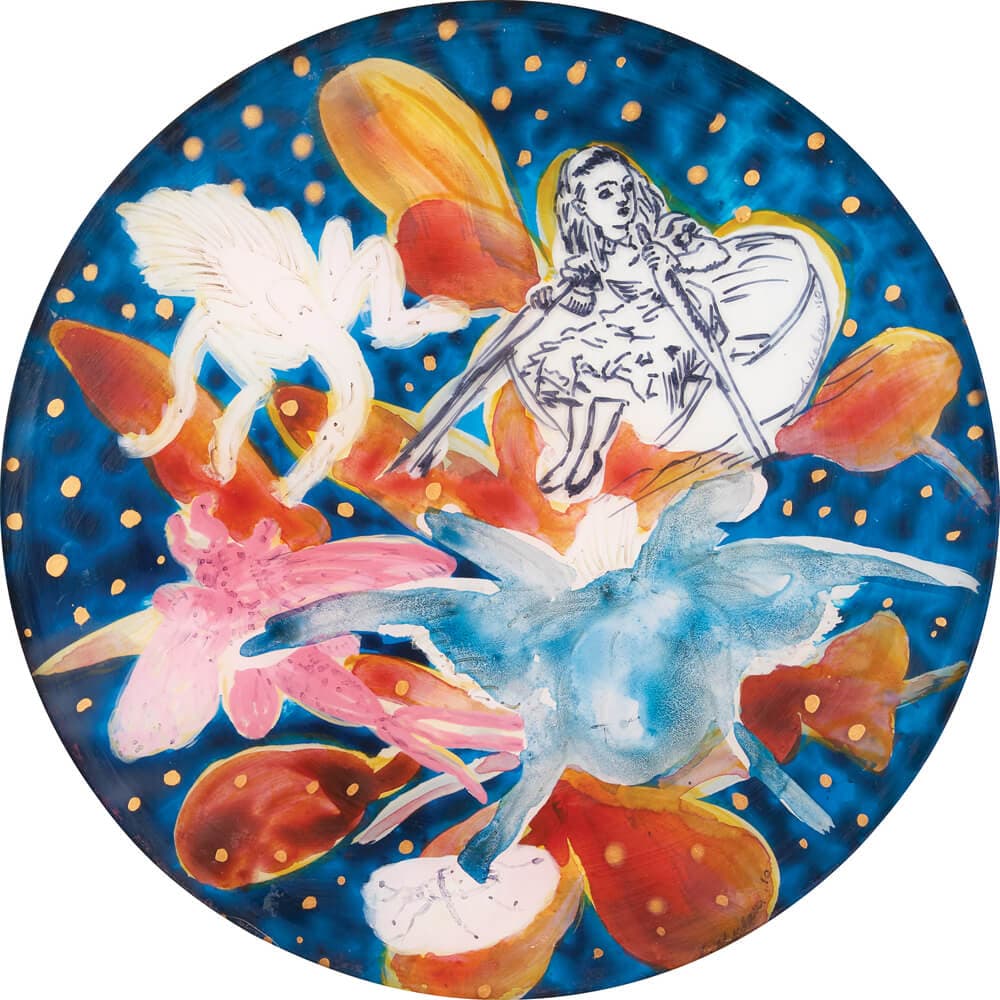 Traditionally, reverse glass painting was used to create static, decorative icons. Nalini Malani, however, uses it as a tool for disruption. When painting on the back of a transparent sheet (such as acrylic or Mylar), the artist must paint the foreground details first and the background last. If you make a mistake on the "top" layer, you cannot simply paint over it; the error is literally baked into the foundation of the image.
• Subversion of Control: This process demands a total mental reversal. Nalini Malani must hold the entire finished image in her mind before the first stroke is even dry.
• The "Final" Layer as Foundation: In a traditional oil painting, the background supports the figure. In Malani’s work, the background is the final act of erasure or enclosure, effectively "trapping" the figures behind the glass or plastic.
•> From Elite Glass to Industrial Plastic
While traditional practitioners used glass, Nalini Malani frequently opts for Mylar and Plexiglass. This shift is a deliberate subversion of the medium’s history:
• Portability and Fragility: Glass is heavy and breaks. Mylar is thin, industrial, and flexible. By using Mylar, Malani takes a "high art" or "courtly" technique and applies it to materials that feel contemporary, transient, and even "disposable," reflecting the precarious lives of refugees and the marginalized.
• The Glow of the Unseen: Because the viewer looks through the support at the paint, the colors take on a luminous, jewel-like quality. Malani uses this beauty to "seduce" the viewer into looking at "unpalatable" themes like violence, displacement, and the "shadows" of the Partition.
•> The Shadow Play: Breaking the Frame
Nalini Malani’s greatest subversion of traditional painting is her refusal to let the image remain static. In her famous "Video/Shadow Plays" she paints on large Mylar cylinders that rotate.
• Painting in Motion: As light passes through the painted cylinders, the images are projected onto the walls as moving shadows. The painting is no longer a fixed object on a wall; it becomes an immersive, cinematic environment.
• Layering Time: She often overlaps these hand-painted shadows with digital video projections. This creates a "palimpsest," which is a surface where multiple layers of history (mythical, colonial, and modern) are visible at once.
•> The Origin of Nalini Malani’s Reverse Painting Practice
Nalini Malani learned the technique of reverse painting from the celebrated Indian artist Bhupen Khakhar in the late 1980s, a method she would go on to use extensively in her subsequent work.
Studying reverse painting under Bhupen Khakhar enabled Nalini Malani to develop a profound sense of character in her figurative compositions. The technique involves painting on a transparent surface, such as glass or mylar, so that the image is viewed from the reverse side. Malani adapted the medium in innovative ways, including on rotating transparent cylinders for her acclaimed video and shadow play installations.
Nalini Malani's introduction to reverse painting occurred under specific circumstances:
• The Occasion (1988): While collaborating on a mural project at Shah House with Bhupen Khakhar and Vivan Sundaram, Khakhar offered to teach the technique to the participants.
• The Source: Bhupen Khakhar had recently returned from Hungary, where he had acquired expertise in painting on the reverse side of glass.
• The Motivation: Nalini Malani had long been fascinated by the historical “profane” and erotic reverse glass paintings brought to India by Chinese traders in the 18th century, which were later adapted into sacred imagery by Tanjore artists. She sought to use reverse painting to challenge and “unlearn” the conventions of her traditional art school training, reintegrating social and profane themes into the medium.
•> Myth as a Tool of Resistance
In traditional Indian art, figures like Sita or Radha are often depicted as symbols of virtue or devotion. Nalini Malani subverts these archetypes by painting them into "reverse" narratives of trauma and protest. By placing these mythical figures in the same space as contemporary political violence (such as the 2002 Gujarat riots), she forces the viewer to see myth not as a dead past, but as a living "link language" that explains the present. The transparency of her medium allows these figures to hover like ghosts: always present, but never quite solid.
•> Conclusion
Nalini Malani’s use of reverse painting is more than a technical choice; it is a philosophical stance. By painting "backwards" she suggests that to understand our current world, we must look through the layers of the past that have been obscured. She turns the act of viewing into an act of uncovering, proving that art is most powerful when it refuses to stay within the lines or even on the right side of the glass.