jamini roy - black horse (kalo ghora) | overview
.jpg&w=3840&q=75)
Black Horse (Kalo Ghora) is one of Jamini Roy’s most iconic paintings, epitomizing his transition from academic realism to a distinctive folk-inspired modernism. Created in the 1930s, this artwork stands as a testament to Roy’s deep engagement with indigenous art forms and his quest to forge a uniquely Indian artistic identity.
Physical Facts
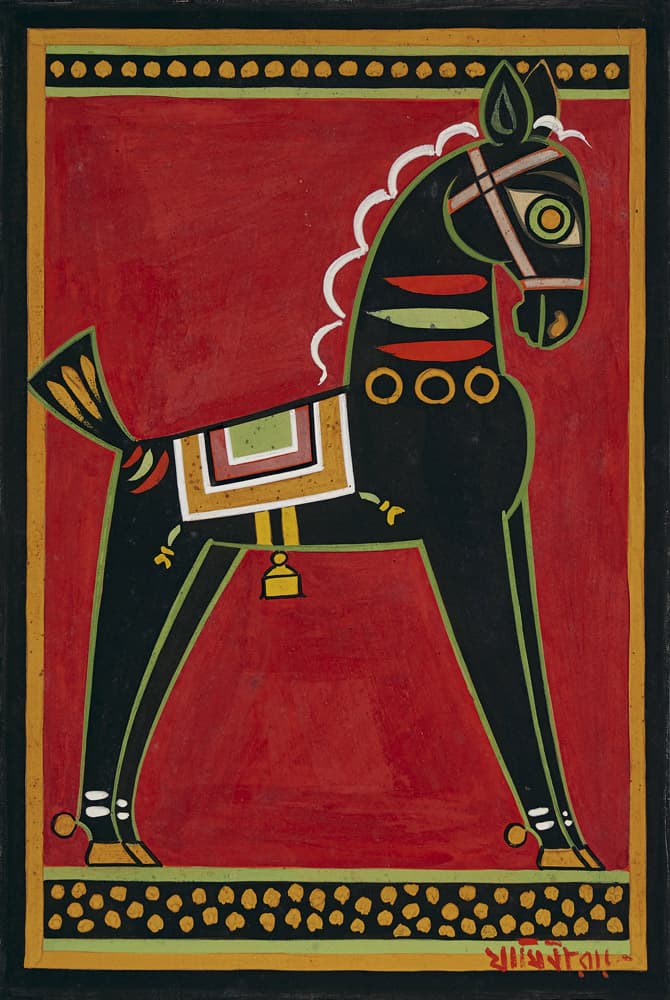 • Title: Black Horse (colloquially Kalo Ghora in Bengali)
• Artist: Jamini Roy (1887–1972)
• Medium: Natural earth-based tempera on woven mats or card
• Dimensions: c. 30 × 47 cm (numerous autograph versions exist)
• Palette: Lamp-black body, dull vermilion background, chalk-white highlights, cadmium-yellow accents
• Line: One continuous, confident brush-stroke outlines the entire silhouette; no corrections, no erasures.
Visual DNA
• Stance: The animal stands frontal, legs slightly splayed, head turned as if listening to the viewer; an impossible, heraldic pose borrowed from terracotta horses of Bankura temples.
• Eyes: Large, fish-shaped, and deliberately asymmetrical; Roy called them “the window to the animal’s spirit”.
• Surface Pattern: White scrolls on the neck and haunches echo alpana rice-paste motifs painted by Bengali women during harvest festivals.
• Background: A flat, earthy red field; no horizon, no shading turns the creature into a floating icon rather than a grazing farm horse
Artistic Style and Technique
In Black Horse, Jamini Roy employs bold, angular lines and a limited color palette dominated by deep blacks, reds, and ochres. The horse is rendered in a stylized manner, reminiscent of traditional Bengali folk art, particularly the Kalighat Pat style. This approach reflects Roy’s move away from Western academic traditions towards a more indigenous visual language. The rich Indian red background enhances the painting's dramatic effect, imbuing it with a sense of fantasy and cultural resonance.
Cultural Context
The horse in Indian folklore and rural life is a significant motif, symbolizing power and mobility. Jamini Roy’s "Black Horse" taps into this cultural resonance, transforming a familiar rural subject into a modern artistic icon. The painting reflects Roy’s commitment to elevating indigenous themes and styles within the broader narrative of Indian modern art .
Genesis of the Motif
Jamini Roy first painted horses in the 1921 Kalighat-influenced phase, but the Black Horse crystallised after 1935 when he observed the terracotta Bankura horses fired in village kilns. He simplified the clay contours into a calligraphic sign, repeating the image in countless versions each slightly different, never mechanical so that the horse became his signature in the same way the bull was Picasso’s
Legacy and Influence
Black Horse exemplifies Jamini Roy’s commitment to making art accessible and relevant to the Indian populace. His works, including this painting, were exhibited internationally, garnering acclaim and influencing subsequent generations of Indian artists. The painting remains a significant example of how traditional themes and modern techniques can converge to produce art that is both culturally rooted and universally appealing.
Why It Matters
Black Horse is not a portrait; it is a distillation of identity i.e regional yet universal, ancient yet urgently modern. In its mute, self-contained presence Jamini Roy offers a manifesto for Indian modern art: look inward, look around and the world will look back with respect.