jayasri burman - artist profile, history, art style & paintings
.jpg&w=3840&q=75)
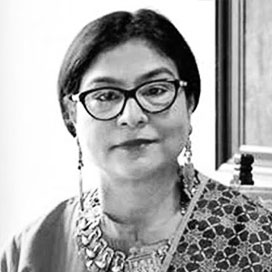 Jayasri Burman (b. 21 October 1960) is a prominent contemporary Indian artist celebrated for her vibrant and intricate artworks that blend mythology, nature and femininity. With a career spanning over four decades, her canvases adorned with intricate patterns and bold colors, breathe life into ancient narratives, reimagining them for a modern audience. As a leading contemporary artist, Burman has inspired countless emerging artists to embrace their cultural roots and pursue artistic expressions, contributing to the growth and vitality of the Indian art scene. This article delves into the life, family, works and enduring impact of Jayasri Burman, exploring how her art has shaped and continues to influence the landscape of Indian art.
Early Life
Jayasri Burman was born on October 21, 1960, in Kolkata, India, into a family with a rich artistic heritage. Her childhood was filled with cherished memories and storytelling, shaping the foundation of her artistic journey. She often spent holidays along the beaches of Bengal, collecting shells and conches—experiences that left a lasting imprint on her creative vision. She was also captivated by the intricate idol-making process she observed around her.
During visits to the Indian Museum in Kolkata, she was particularly drawn to the Archaeological Section, where she would sit for hours sketching sculptures and artifacts. Her father nurtured her curiosity, taking the family annually to the banks of the Ganga River on Lakshmi Puja, where she witnessed people performing Surya Pranam while mourning widows cast their shakha-pola bangles into the sacred waters. These experiences deeply influenced her perception of the world, and the Ganga became a recurring motif in her artistic expression.
In 1996, she made the bold decision to leave Kolkata and relocate to Delhi, seeking a fresh start in her modest abode in Chittaranjan Park.
Education
Jayasri Burman’s educational journey began at Christ Church Girls' High School in Kolkata, where she completed her schooling from 1966 to 1976. She then pursued formal art training at Kala Bhavan, Visva-Bharati University, Shantiniketan, studying there from 1977 to 1979. In 1980, she earned a Master of Arts in Painting from the Government College of Art and Craft, Kolkata. In 1984, she expanded her artistic horizons by participating in a graphic art workshop in Paris, where she learned print-making under the guidance of Monsieur Ceizerzi and did a graphic art workshop with Paul Lingren.
Family
Jayasri Burman comes from an affluent business family and is the second daughter of Satya Prasad Ray Burman & Namita Ray Burman. Her father, Satya Prasad Roy Burman, was the founder of Khadim, a well-known footwear company in India. She has been married twice; her first marriage lasted 17 years. Later, she married renowned painter and sculptor Paresh Maity. The couple has a son, Riddhibrata Burman i.e Rid Burman, who is a noted photographer. Her uncle, Sakti Burman, is a celebrated painter and sculptor based in France. Her aunt Maite Delteil (i.e Sakti Burman's wife) is a French painter too. Besides, her cousin, Maya Burman is also an accomplished artist.
Artistic Style & Themes
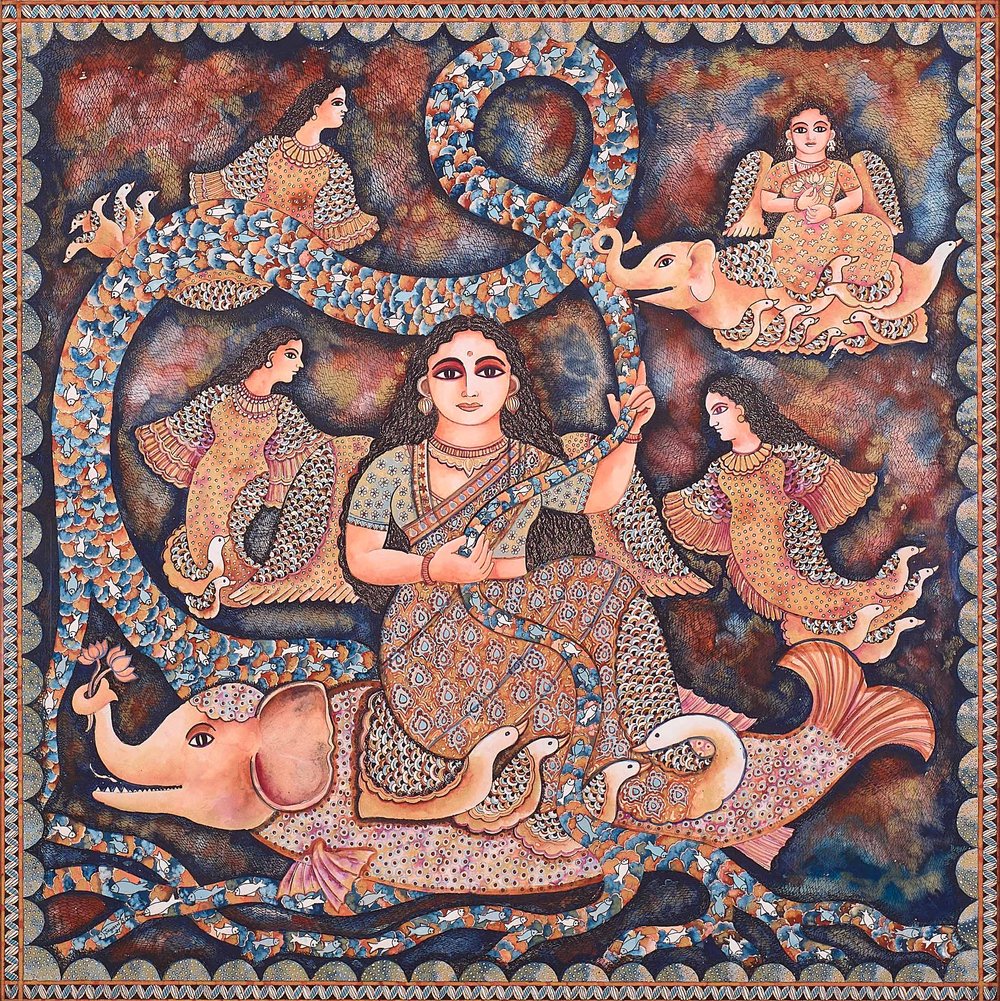
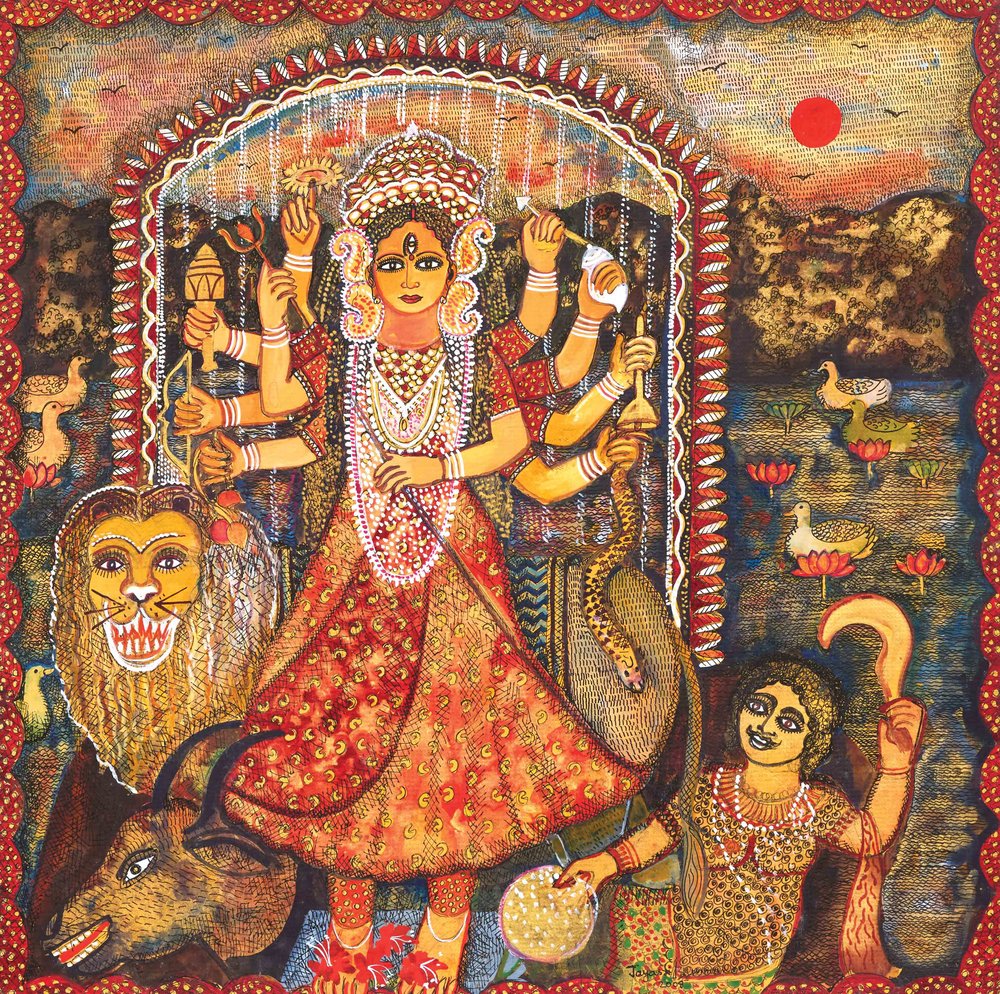
Jayasri Burman’s artworks predominantly explore bold themes, particularly feminism. While she does not explicitly identify as a feminist, her work consistently portrays women in positions of strength and empowerment. Notably, she rarely depicts male deities in her art, with the exception of Lord Krishna and Buddha, who occasionally feature in her compositions. Her artwork is characterized by intricate depictions of Indian deities, often complemented by elaborate floral motifs, particularly the lotus, as well as symbolic representations of cows, deer, fish, elephants, and other elements drawn from nature and mythology. While she is best known for her mastery of watercolors, Jayasri Burman also experiments with ink, charcoal, acrylics, bronze sculptures, and mixed media, showcasing her versatility as an artist.
Jayasri Burman’s painting style is characterised by vibrant colours, intricate patterns and detailed linework. Drawing inspiration from Kalighat paintings and patachitra (Bengali scroll paintings), she reimagines mythological characters with contemporary sensibilities. Recurring motifs include birds, animals, trees and celestial figures that symbolise harmony between humans and nature.
Use Of Cowries & Shells
Cowries are traditionally associated with prosperity & growth. This connection is rooted in Indian mythology, particularly the story of Samudra Manthan, where cowries emerged as treasures from the ocean, representing wealth and fertility. In Jayasri Burman's work, Cowries symbolize seeds and the cycles of creation, reflecting the eternal aspects of nature.
The use of Shells in her art is deeply symbolic, representing the fluidity of time and the weight of tradition. Additionally, Burman has noted that the inner surface of a shell resembles the female organ, while its outer half mirrors a pregnant belly, adding layers of meaning to her work. This symbolism aligns with her focus on femininity, ecology and cultural symbolism, marking a new direction in her creative exploration.
Jayasri Burman incorporates cowries and shells into her artwork to explore unconscious thoughts while staying connected to modern issues. This motif allows her to delve into subtle nuances of the unconscious while remaining true to contemporary themes.
Designing Radhika Merchant Ambani’s Lehenga
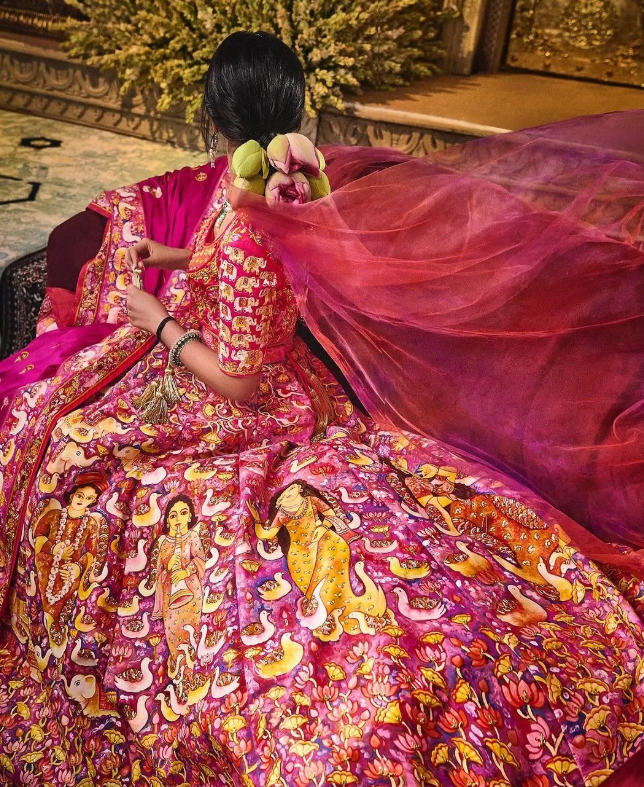 In a remarkable fusion of art and fashion, Jayasri Burman collaborated with designers Abu Jani and Sandeep Khosla to create a bespoke hand-painted lehenga for Radhika Merchant & Anant Ambani's 'Shubh Aashirwad' ceremony. The project aimed to transform Burman's artistic vision into a wearable piece of art, reflecting the couple's love story through intricate designs. This unique garment featured 12 meticulously hand-painted panels, each illustrating elements of mythical aesthetics, human figures symbolizing the couple & fauna reflecting Anant Ambani's affection for animals. The lehenga predominantly showcased shades of pink & orange, colors favored by the Ambani family, symbolizing joy and celebration. To bring this vision to life, Burman dedicated 15 to 16 hours daily over a month, painting directly onto a special Italian canvas without preliminary sketches. The result was a harmonious blend of traditional artistry & contemporary design, showcasing Jayasri Burman's signature style and elevating the ensemble to a wearable masterpiece. Jayasri Burman’s decision to create this lehenga stemmed from Radhika's Merchant's heartfelt admiration for her work, which made the collaboration particularly meaningful. Burman expressed that this would be her first & last lehenga painting, emphasizing its uniqueness.
Famous Paintings & Sculptures
Some of Jayasri Burman’s notable paintings include:
• Dhara: Exhibited in 2023, this series is an ode to motherhood, nature, and the experience of being a woman. Painted mostly in a monochromatic palette, it features a poetry reading by cultural theorist and poet Ranjit Hoskote.
• Jahnavi: This powerful charcoal work, measuring 84x216 inches, portrays the resilience of the River Ganga. Created in response to the 2021 images of corpses floating in the Ganga during the COVID-19 pandemic, Burman depicts the river's strength and purity amidst adversity.
• Dharitri: This piece exists in two mediums: an oil, pen, and ink on canvas measuring 80 inches by 63 inches, and a pen and watercolor on paper version sized at 72 inches by 55 inches. Both interpretations reflect Burman's engagement with themes of earth and femininity.
• Ashawari: This watercolor, pen, and ink piece on paper measures 6.6 feet by 5.1 feet. It showcases Burman's signature style of blending mythological themes with intricate detailing.
• Panchaya Kanya: This 3-foot by 3-foot watercolor and ink on paper piece delves into themes of womanhood and mythology, rendered in Burman's detailed and colorful style.
• Adhishree: An acrylic on canvas work, sized at 7 feet by 6.6 feet, this painting reflects Burman's exploration of divine femininity and nature.
• Kushmanda Series: An homage to feminine energy, this series reflects the boundless life, wisdom, and sustenance associated with the archetypal mother figure.
• River of Faith: This series, exhibited in 2021, is a tribute to the Ganges River. Jayasri depicts the river in myriad forms, embodying both fantasy and reality, fertility and ferocity, origin and annihilation, hope and despair. The series is strongly influenced by spiritual beliefs and sacred texts.
• Kashi Ghat: A painting that showcases various deities along with everyday people engaged in rituals at the ghats, merging the divine with the mundane.
• Jalyatra: This artwork features mythological elements intertwined with scenes from daily life in Banaras, illustrating how spirituality permeates everyday existence.
• The Draupadi Series: This series reinterprets the character of Draupadi from the Mahabharata, highlighting her strength and complexity as a woman in a patriarchal society.
• The Tree of Life: This painting is a visual representation of the interconnectedness of all life forms. The tree, with its sprawling branches and roots, serves as a central symbol, surrounded by human figures, animals, and mythical creatures.
• The Lotus Pond: A serene and meditative piece, this painting depicts a lotus pond with blooming flowers and tranquil waters. The lotus, a recurring motif in Burman's work, symbolizes purity, enlightenment, and spiritual growth.
• Prakriti: This painting, created in acrylic on canvas, explores the theme of nature and its elements. It features detailed flora and fauna with delicate lines.
• Guru Nanak and Lord Buddha: These paintings, created in watercolor, pen, and ink on paper, depict the revered figures of Guru Nanak and Lord Buddha with intricate details and a dreamlike aesthetic.

Awards & Exhibitions
Jayasri Burman has received numerous accolades & has exhibited her work extensively both in India & internationally. Here are some of her notable awards and exhibitions:
Awards:
• Outstanding Merit in Tempera (1979): Awarded by the College of Visual Arts for her exceptional work in tempera during their Annual Exhibition.
• National Academy Award (1984): Received for her painting "Jeley (The Fisherman)" recognizing her significant contribution to Indian art.
• Certificate of Merit (1987): Bestowed by the All India Youth Art Exhibition, acknowledging her artistic excellence.
• Commemorative Stamp Release (2007): In celebration of International Women's Day, the Government of India released a series of stamps featuring Burman's artworks, honoring her impact on Indian art.
• Indian Federation Chamber of Commerce Award (2008): Recognized for her outstanding contributions to the arts.
• Durga Puja Idol Award (2016): Awarded by the Government of West Bengal for creating the best Durga Puja idol for Behala Notun Dal, a cultural association in Kolkata.
• ICON of Indian Art Award (2017): Presented by Verve Magazine, celebrating her status as a leading figure in Indian art.
• Beti Bachao Beti Padhao Award (2018): Conferred at the 20th Beti FLO GR8 Awards, recognizing her role in empowering women through her art.
• She Award (2021): Given by The Telegraph, acknowledging her contributions and achievements in the field of art.
• Artist-in-Residence at the President’s House: Invited as an Artist-in-Residence, marking a significant recognition of her artistic stature.
Exhibitions:
• The Whisper of Water, The Song of Stars (2025): An ongoing exhibition at Art Alive Gallery, New Delhi, exploring themes related to spirituality and nature through motifs of shells and cowries.
• Dhara (2023): A monochromatic exhibition at Art Musings, Mumbai, focusing on motherhood and nature.
• River of Faith (2022): An exhibition in New Delhi influenced by spiritual beliefs and sacred texts.
• International Triennial (1987): Held in Germany, showcasing contemporary art from around the world.
• Bharat Bhavan Biennale (1986): A significant event for contemporary Indian artists.
Impact On Indian Art
Jayasri Burman has significantly influenced Indian art by seamlessly blending traditional mythological narratives with contemporary artistic expressions. Her reimagining of female goddesses from Hindu mythology, infused with vibrant colors and energy, revitalizes ancient stories for modern audiences. Burman's work celebrates womanhood, emphasizing strength and resilience and often highlights the duality of Indian women poised between tradition and modernity.
Conclusion
In conclusion, Jayasri Burman remains an illustrious figure in contemporary art, seamlessly blending creativity with cultural preservation. Her recent exhibitions, including River of Faith, exemplify her dedication to exploring environmental and cultural themes, reinforcing her artistic versatility and relevance. As she continues her journey, her influence will undoubtedly endure, sparking meaningful conversations about identity, tradition and creativity in an ever-evolving world.