jivya soma mashe: father of warli art
Jivya Soma Mashe (1934–2018) was born in the village of Dhamangaon, in what was then Thane district (now part of Palghar), Maharashtra. When he was just seven years old he lost his mother. The trauma left him speechless for several years, and during that time he expressed himself by drawing figures in the dust, marking the beginning of his lifelong engagement with art.
At the age of eleven his family relocated to the village of Kalambipada in Dahanu taluka. Though from a community in which the traditional art form Warli painting was typically practised by women on mud-walls during ceremonies and festivals, Jivya Soma Mashe began absorbing the rhythms and motifs of that visual language. Over time he began to paint, first in the traditional medium on mud-walls, then gradually shifting to paper and canvas, a step that would redefine Warli art’s possibilities.
His talent was discovered in the 1970s by a crafts-board fieldworker from Mumbai, who helped bring Jivya Soma Mashe’s artwork to the urban art world. In 1975 his first major exhibition was held at the Chemistry Gallery, Jehangir Art Gallery, Mumbai. This landmark show brought mainstream attention to his work and marked the beginning of Warli painting’s journey from rural ritual art to globally recognized contemporary art.
From that moment on, Jivya Soma Mashe’s paintings traveled internationally. His first overseas exhibition was in France in 1976. Over the years his work appeared in numerous international exhibitions, including those at prestigious institutions in Europe, the United States and beyond. Through these shows, Mashe helped place Warli art on the global art map.
Artistic Style, Themes and Innovation
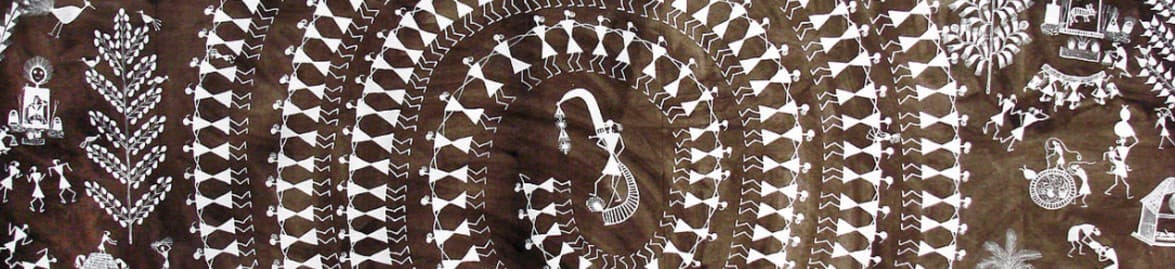
Jivya Soma Mashe remained true to the visual vocabulary of Warli painting using simple, symbolic forms like circles, triangles and squares, often painting in white on earthen or brown backgrounds. Human figures are commonly depicted as two triangles joined together, a minimalist style that nevertheless conveys rhythm, movement and life.
Yet, Mashe did much more than replicate traditional motifs. He expanded Warli art’s scope by bringing in themes drawn from daily tribal life, nature, rituals, festivals, forest life, and the natural environment; birds, animals, trees, tribal dances, harvests, weddings, community gatherings. He also incorporated newer motifs like bicycles, trains and fishing nets, reflecting the merging of traditional tribal existence with modern influences. This blend gave his work vitality, narrative depth and universality.
The compositions are dense, full of dots, lines and stick figures, evoking a sense of movement and continuity, a visual celebration of life’s interconnectedness. Jivya Soma Mashe described his own worldview as rooted in movement: humans, animals, birds, insects “everything moves, day and night.” This philosophy finds expression in every stroke of his art.
The Style & Significance of Warli Art
Warli art is characterized by geometric patterns i.e circles, triangles, and squares that represent nature, animals, human figures, and daily activities. Its simplicity is deceptive; each figure and motif conveys deep cultural and spiritual significance. Common themes include:
• Agricultural life – plowing, harvesting, and sowing.
• Rituals and ceremonies – weddings, festivals, and tribal dances.
• Nature and animals – trees, birds, and wildlife.
Jivya Soma Mashe elevated this traditional art form by bringing it onto paper and canvas, allowing it to reach urban and international audiences.
Famous Paintings
While many of his works are untitled or simply titled by scene/subject, some important collective works and exhibitions include: Paintings like “Village Scene” “Harvest” “The Tarpa Player” “Warli Villag,” “Harvest Dance” “Fisherman” among others.
Awards & Honours
Over his lifetime, Jivya Soma Mashe received many prestigious recognitions:
• National Award for Tribal Art (1976)
• Shilp Guru (2002) — a recognition by Government of India for master craftsmen.
• Prince Claus Award (2009) — international award celebrating artists who make significant contributions to culture and development.
• Padma Shri (2011) — one of India’s highest civilian honours.
These honours recognized not just his talent, but his role in preserving, transforming, and globalising a tribal art form.
Exhibitions
• 1976: Palais de Menton, France (first show abroad)
• 1989: “Magiciens de la Terre” at Centre Pompidou, Paris
• 2003: Joint show with Richard Long at Museum Kunst Palast, Düsseldorf, Germany
• 2004: Exhibition at Padiglione d’Arte Contemporanea, Milan, Italy
• 2006: Show at Shippensburg University, USA; 2007: Exhibited at Halle Saint-Pierre, Paris (with tribal and folk artists)
Family and Legacy
Jivya Soma Mashe passed away on 15 May 2018 at his home in Ganjad village near Dahanu (Palghar district), Maharashtra. He is survived by children: two sons; Sadashiv Mashe and Balu Mashe both of whom are also practitioners of Warli art, and a daughter.
Conclusion
Jivya Soma Mashe brought the rhythms of tribal life to the canvas, showing the world that simplicity can hold profound beauty and meaning. His art continues to inspire artists and enthusiasts worldwide, keeping the vibrant Warli tradition alive for generations to come.
Image Credit:
“Warli painting by Jivya Soma Mashe”, Unknown, via Wikimedia Commons
– Public Domain.