Social & Political Themes in Adeela Suleman’s Sculptures
Adeela Suleman is a Karachi-based artist whose practice engages deeply with the socio-political realities of the city she inhabits. Known for her evocative sculptural language, Suleman draws from lived experience to examine structures of violence, power, and memory. In her work, Karachi is not simply a backdrop, it is a charged, volatile presence that shapes both form and meaning.
Having lived through decades of political unrest, targeted violence, and systemic instability, Suleman draws directly from the lived realities of the city of Karachi, where she lives and works. Yet, what begins as deeply local often expands into something far more universal.
Her practice is rooted in specific histories: the everyday violence that marks Karachi’s streets, the precariousness of civilian life, and the visible as well as invisible mechanisms of state control. This becomes particularly evident in works responding to real incidents, such as the extra-judicial killing of Naqeebullah Mehsud or the controversial removal of her own installation during the 2019 Karachi Biennale. These are not treated as isolated events but as symptoms of a larger condition, an ongoing cycle of violence that blurs the line between governance and brutality.
In this way, Suleman’s work becomes an unfolding of the city’s volatile history, one that negotiates atrocity not as rupture but as continuity. The dissonance embedded within these realities is neither resolved nor softened; instead, it is rearticulated through form, provoking the viewer while quietly valorising resistance. Karachi, in her work, becomes both specific and symbolic, a site through which broader questions of power, nationhood, and survival are examined.
Allegory of War and the Question of the Grievable Life
Violence, in Suleman’s practice, rarely appears as direct reportage. Instead, it is filtered through allegory, through layered visual narratives that draw equally from Mughal miniature painting, mythological battles, and contemporary conflict. In her exhibition Allegory of War, for instance, hand-painted ceramic plates initially appear pastoral and serene. Figures gather in lush landscapes, animals wander across idyllic terrain, and the compositions recall the elegance of courtly miniatures. But on closer inspection, these scenes unravel, severed heads lie scattered, prisoners are bound, and violence quietly permeates the image. This strategy allows Suleman to collapse time, bringing together histories of war across centuries into a single visual field. The past is not distant, it is active, repeating, and unresolved.
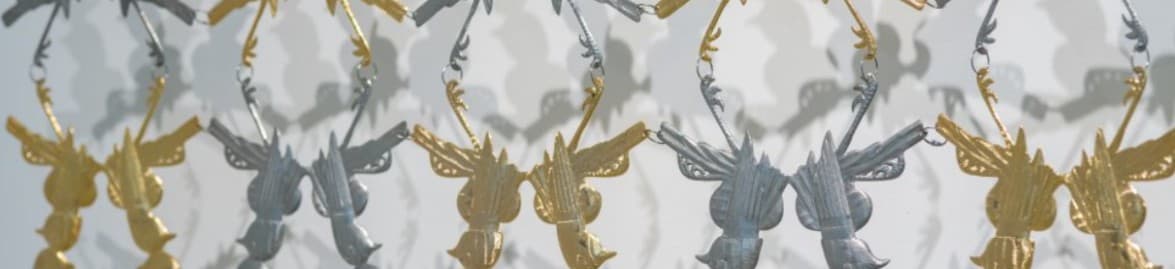
Thinkers like Judith Butler have written about how societies determine which lives are publicly mourned and which are ignored. Suleman’s work responds to this idea not through theory alone, but through form. In installations like Killing Fields of Karachi, rows of tombstones and numbered markers stand in for lives lost, each one anonymous, yet insistently present. Similarly, her chandelier-like bird installations, such as I Don’t Want to Be There When It Happens, transform delicate metal sparrows into memorials, each bird standing in for a life extinguished by violence. Where photography might document a moment, Suleman’s work lingers. It constructs an emotional and symbolic archive, one that insists on remembrance, even when official narratives erase or obscure.
Material as Language: Found Objects and Vernacular Memory
A defining aspect of Suleman’s practice is her use of material, particularly found, everyday objects. Plates, knives, cleavers, metal fragments, helmets, and objects that belong to domestic or utilitarian spaces are reassembled into works that speak of violence, memory, and history.
In her painted ceramic plates, scenes of brutality are rendered with miniature-like precision onto surfaces traditionally associated with food and hospitality. The familiarity of the object heightens the shock of the imagery. Similarly, in works like History Will Erase Itself, meat cleavers are painted with blurred, almost photographic scenes of unrest. The object itself, a tool of cutting, becomes inseparable from the violence it depicts.
Critics like Hameed Haroon have described these materials as forming an “alphabet” in Suleman’s work. Individually mundane, collectively they become a language, one that speaks of inherited trauma, suppressed histories, and lived realities. Large-scale installations, constructed from hundreds of metal components, take on the appearance of ornate tapestries or armour. Yet beneath their decorative surfaces lies a dense layering of meaning, each element contributing to a larger narrative of loss and endurance.
Her engagement with traditional techniques such as filigree and repoussé further complicates this relationship. These are labour-intensive, historically rich crafts, often associated with beauty and ornament. In Suleman’s hands, they are repurposed to tell stories of violence, embedding political urgency within aesthetic refinement.
Beauty and Violence: A Disquieting Coexistence
At first encounter, Suleman’s works are strikingly beautiful. Intricate metalwork, luminous surfaces, and carefully composed forms draw the viewer in. There is a sense of spectacle, of grandeur and precision, that commands attention.
But this beauty is never stable. It begins to fracture the longer one looks.
In many of her works, what appears decorative reveals itself as deeply unsettling. A richly painted plate, framed in carved wood, unfolds into a scene of massacre. A shimmering installation of metal foliage conceals imagery of conflict. Even her use of enamel and vivid colour, like crimson reds, deep greens, intensifies this tension, evoking both aesthetic pleasure and visceral discomfort.
This coexistence of beauty and violence is not incidental, it is central to her practice. By rendering violence beautiful, Suleman does not soften it; she makes it more insidious. The viewer is drawn in, seduced by form, only to be confronted with the content. The moment of recognition is abrupt, almost jarring.
Historically, weaponry in South Asia was often ornamented, crafted with the same care as jewellery. Suleman extends this logic into her work, where knives, cleavers, and other instruments of harm are both aestheticised and exposed. The result is a visual language that destabilises the viewer, forcing them to navigate the uneasy space between attraction and horror.
The Human Psyche: The Lure and Fetishisation of Violence
Underlying Suleman’s work is a persistent question: why does violence fascinate us? Why are we drawn to it, even as we recoil?
In her series Home Front, painted cleavers depict serene Himalayan landscapes, snow-capped mountains, quiet valleys, and postcard-like imagery. There is no visible violence within these scenes. And yet, the object itself, the cleaver, carries an implicit threat. The violence is not shown, but it is felt. The landscape becomes charged, its beauty shadowed by histories of conflict along the India–Pakistan border.
Suleman has spoken about the intensity and even pleasure associated with violence, the way it can evoke excitement, much like other sensory experiences. Her work does not shy away from this discomfort. Instead, it exposes it. By placing violent imagery within aesthetically compelling forms, she reveals how violence is consumed by us, visually, emotionally, and even culturally.
This is not a new phenomenon. Across religious and historical traditions, images of suffering have long held a powerful place, from the crucifixion of Christ to the martyrdom of Husayn ibn Ali. Suleman draws upon these visual histories, not to replicate them, but to question their enduring impact. Why do such images persist? What do they reveal about collective memory and morality?
Her work suggests that violence is not only enacted, it is also remembered, aestheticised, and, at times, desired. This recognition makes the viewing experience both compelling and deeply unsettling.
The Political Function of Art: Resistance, Accessibility, and Afterlife
In Suleman’s practice, art is not passive. It does not merely reflect reality, it intervenes in it. Through her use of beauty, material, and narrative, she constructs works that resist indifference. They demand attention, not through shock alone, but through sustained engagement. Her work challenges the longstanding critique of art’s supposed impotence.
This becomes particularly evident in works like After All It’s Always Somebody Else Who Dies, where repeated metal forms, initially resembling weapons, reveal themselves as falling birds. Each bird stands in for a life lost, transforming the work into a quiet yet powerful memorial. Similarly, her large-scale installations, whether composed of tombstones, crows, or metal foliage, operate as collective sites of remembrance.
Her monograph, Not Everyone’s Heaven, extends this engagement beyond the gallery. It offers a way to encounter her work in a more intimate, accessible format, carrying its narratives into everyday spaces. In doing so, Suleman resists the isolation of art within institutional frameworks, allowing it to circulate, to be revisited, to linger.
Conclusion
Ultimately, Suleman does not offer a resolution. There is a certain agility to her practice, a refusal to remain fixed. As she moves between sculpture, installation, and publication, her work continues to negotiate the boundaries between art and activism, beauty and brutality, memory and forgetting. She creates spaces of confrontation, where viewers are asked not only to see, but to reckon. Violence, in her work, is not distant or abstract. It is immediate, embedded, and inescapably present. And through her practice, it is made visible in beautiful, painful, and persistent ways.