


jyoti bhatt - artist profile, history, art style & paintings
.jpg&w=3840&q=75)
Jyoti Bhatt (Born - Jyotindra Manshankar Bhatt) is a distinguished Indian artist celebrated for his modernist contributions to painting & printmaking, as well as his invaluable photographic documentation of rural Indian culture. As both a creator and a preserver of artistic heritage, Bhatt’s dual legacy as a printmaker and cultural documentarian provides a profound insight into India’s evolving artistic landscape during a period of significant cultural transformation. As we delve into the life and work of artist Jyoti Bhatt, we uncover the layers of his artistic genius and the enduring impact of his contributions to the world of art.
Early Life
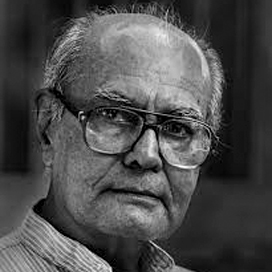 Jyoti Bhatt was born on March 12, 1934, in Bhavnagar Gujarat, India. From an early age, he was deeply influenced by traditional Indian art forms, which would later become a defining element of his work. He developed a keen interest in folk art, textiles, and regional crafts, seamlessly integrating these influences into his printmaking. His early career was characterized by extensive travel, both within India and abroad, allowing him to engage with diverse cultures, artistic traditions, and techniques. These experiences enriched his artistic perspective, shaping his distinctive style and broadening the scope of his creative expression.
Family
Jyoti Bhatt’s father, Manshankar Bhatt, was a distinguished educationist and nationalist. Bhatt was married to the renowned potter and ceramic artist, Jyotsna Bhatt, whom he met during their college years. The couple resided in Vadodara and had a daughter, Jaii. Jyotsna Bhatt was not only a celebrated ceramic artist but also a respected professor of ceramics. Unfortunately, she passed away in 2020, leaving behind a lasting legacy in the field of ceramic arts.
Education
Jyoti Bhatt pursued his studies in painting and graphic arts at the Faculty of Fine Arts, Maharaja Sayajirao University (M.S.U.) in Baroda, where he trained under eminent artists such as N. S. Bendre, Sankho Chaudhari, and K. G. Subramanyan. He further honed his skills in fresco and mural painting at Banasthali Vidyapith in Rajasthan. In 1961, Bhatt was awarded a two-year scholarship by the Italian government to study mural painting at the Accademia di Belle Arti in Naples, Italy. There, he engaged with European painters working in the post-World War II era, gaining exposure to new artistic movements and techniques. Subsequently, he received a Fulbright Scholarship along with a J.D. Rockefeller III Fund fellowship grant, enabling him to study printmaking at the Pratt Institute in New York (1964–66). During this time, he was introduced to the intaglio process and deeply influenced by Abstract Expressionism, further shaping his distinctive artistic approach.
Teaching Experience
Throughout his career, Jyoti Bhatt remained a dedicated educator, serving as a professor at the Faculty of Fine Arts, Maharaja Sayajirao University (M.S.U.), Baroda, from 1964 until his retirement in 1993. His passion for the intaglio process inspired several prominent artists, including Jeram Patel, Bhupen Khakhar, and Gulam Mohammed Sheikh, to explore and adopt the technique. Bhatt’s contributions to art education played a pivotal role in shaping The Baroda School, a significant movement in modern Indian art, fostering a generation of artists who blended traditional influences with contemporary artistic expressions.
Artistic Journey & Development
Jyoti Bhatt’s artistic journey was shaped early on by Shishu Vihar, an educational institute for young artists run by his father, where he developed a passion for drawing from a young age. He later pursued formal training at the Faculty of Fine Arts, Maharaja Sayajirao University, Baroda (1950–56), initially working as a painter influenced by Cubism before transitioning to printmaking. As a printmaker, he experimented with various techniques, including etching, lithography, and screen printing, refining a distinctive visual language. In 1967, Bhatt’s journey as a photographer began when the Bharatiya Vidya Bhavan, Mumbai, commissioned him to document Gujarat’s folk art. During his travels through rural Gujarat, he captured a wide range of traditional art forms, including Bandhani textiles, Kutch crafts, tattooed bodies, intricately designed havelis, painted temples, and embroidery. His extensive photographic documentation of rural Indian culture has since become an invaluable part of his artistic legacy, preserving and celebrating India’s rich heritage.
Painting Style
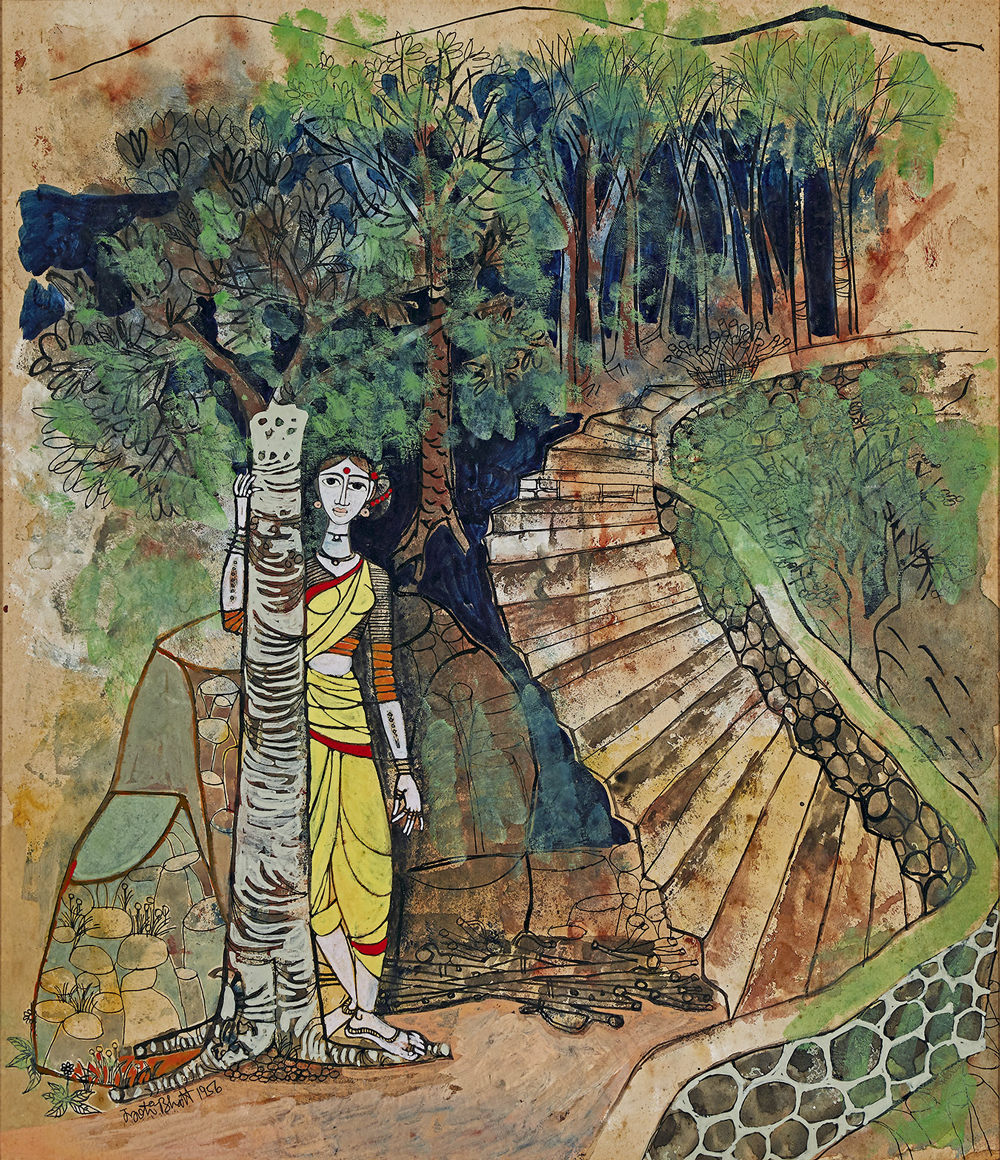 Jyoti Bhatt’s painting style is a harmonious blend of modernist techniques and traditional Indian folk art motifs. His early works reflect a Cubist influence, characterized by abstract forms and fragmented perspectives. As his artistic journey evolved, his style transitioned into vibrant, densely patterned compositions, drawing inspiration from the rich visual traditions of rural India. A defining feature of Bhatt’s work is his use of symbolism deeply rooted in Indian culture, incorporating elements such as peacocks, lotuses, parrots, and stylized depictions of deities. These motifs are often rendered with a playful, colorful pop-art sensibility, creating a striking fusion of traditional themes and contemporary aesthetics. His exposure to intaglio printmaking further enriched his artistic vocabulary, enabling him to explore intricate textures and fine details, making his compositions both visually and conceptually compelling.
Painting Techniques
Jyoti Bhatt mastered various techniques including frescoes, murals, watercolors, oils and later digital printing and holography. However, it was his expertise in intaglio printmaking that gained him widespread recognition.
Famous Paintings
Jyoti Bhatt's artistic repertoire includes several renowned paintings that showcase his unique style and cultural influences. Here is a list of some of Jyoti Bhatt's most famous paintings: Devi, Mother & Child, Woman With Parrot, Home coming, Seaview Scenery, Image Under The Warm Sky, Villayatea Table, Queen Of The Heart, Tirthankara, Sorath Malhaar, Jal Thal Babh, Emergent Patterns, Kali, Kalpvruksha, Forgotten Monuments. Sita’s Parrot.
Characteristics Features Of His Paintings
Artist Jyoti Bhatt's paintings are distinguished by their use of intricate patterns and symbolic imagery. His works often feature stylized representations of Indian gods and goddesses, as well as elements from nature such as peacocks, parrots and lotuses.
Printmaking
 Printmaking holds a central place in Jyoti Bhatt’s artistic practice, reflecting his deep fascination with the medium’s ability to produce multiple yet uniquely expressive impressions. He explored a range of printmaking techniques, including etching, lithography, and screen printing, continuously experimenting with form and texture. His prints often draw inspiration from Indian folklore, mythology, and rural life, distinguished by intricate line work, rich textures, and a sophisticated interplay of tone and color.
A pivotal moment in Jyoti Bhatt’s printmaking journey came after his training at the Pratt Institute, New York, where he specialized in graphic arts under the Fulbright and John D. Rockefeller III grants. This experience introduced him to intaglio processes, which he later innovated upon, marking a turning point in his career as he shifted his focus more intensely toward printmaking. Among his notable print series are "Aripana" and "Rangavali," inspired by traditional Indian floor decorations.
Bhatt’s printmaking has been widely exhibited both in India and internationally, with significant showcases such as "Graphic Prints: An Overview" at Anant Art Gallery, New Delhi (2005), and "Printed Image: An Overview Retrospective" at ABS Bayer Gallery, Vadodara (2004). His works are part of numerous private and public collections, solidifying his legacy as a pioneering figure in Indian printmaking.
Photography
Jyoti Bhatt’s foray into photography began as a means of documenting traditional crafts in Gujarat, a pursuit encouraged by his mentor, K.G. Subramanyan. His initial experiments with the medium started with a borrowed camera, eventually leading him to acquire his first— a German-made Voigtländer with no focus adjustment tools. Despite lacking formal technical training, Bhatt mastered the craft through experimentation and practice, evolving into one of India’s most celebrated documentary photographers. Jyoti Bhatt’s photographs go beyond mere documentation; they serve as symbolic representations of cultural beliefs and religious practices, capturing an extensive range of traditional Indian art forms. His meticulous visual archive includes memorial stone carvings, village shrines, temple murals, embroidered textiles, beadwork, tattoos, and ceremonial decorations on animals and homes. Through his lens, Bhatt preserved the rich visual heritage of Gujarat, Rajasthan, Odisha and Madhya Pradesh, ensuring that these fading traditions remain an integral part of India’s artistic legacy.
Famous Quotes
"I was never interested in studies. You may say that since I was not good for anything else in life, I became an artist"
Accomplishments & Awards Won
Over his illustrious career, Jyoti Bhatt has received numerous awards and honors in recognition of his artistic achievements. Below is an overview of his accomplishments and the awards he has won.
1. Padma Shri (1989)
Description: The Padma Shri is one of the highest civilian awards in India, awarded for distinguished service in various fields.
Significance: Jyoti Bhatt was honored with the Padma Shri in 1989 for his significant contributions to the field of art. This award recognized his pioneering work in printmaking and his role in promoting and preserving traditional Indian art forms.
2. Kalidas Samman (1995)
Description: The Kalidas Samman is a prestigious award given by the Madhya Pradesh government to artists who have made outstanding contributions to the arts.
Significance: Jyoti Bhatt received the Kalidas Samman in 1995 for his exceptional work in the visual arts. This award highlighted his innovative approaches to traditional art forms and his impact on contemporary Indian art.
3. Lalit Kala Akademi Fellowship (2004)
Description: The Lalit Kala Akademi Fellowship is one of the highest honors bestowed by the Lalit Kala Akademi, India's National Academy of Art.
Significance: Jyoti Bhatt was awarded the Lalit Kala Akademi Fellowship in 2004 for his lifetime achievements and contributions to the field of art. This fellowship recognized his pioneering work in printmaking, painting, and photography.
4. Gujarat Gaurav Puraskar (2011)
Description: The Gujarat Gaurav Puraskar is a state-level award given by the Government of Gujarat to individuals who have brought honor and recognition to the state through their work.
Significance: Jyoti Bhatt received the Gujarat Gaurav Puraskar in 2011 for his outstanding contributions to the arts and his role in promoting Gujarat's rich cultural heritage through his work.
5. Honorary Doctorate from Maharaja Sayajirao University of Baroda (2014)
Description: An honorary doctorate is a prestigious recognition given by universities to individuals who have made significant contributions to their field.
Significance: Jyoti Bhatt was awarded an honorary doctorate by the Maharaja Sayajirao University of Baroda in 2014. This honor recognized his lifelong dedication to the arts and his contributions as an educator and mentor to numerous students.
6. Tagore National Fellowship (2015)
Description: The Tagore National Fellowship is a prestigious award given by the Ministry of Culture, Government of India, to scholars and artists for research and creative work in the arts.
Significance: Jyoti Bhatt was awarded the Tagore National Fellowship in 2015 for his research and documentation of traditional Indian art forms and crafts. This fellowship supported his ongoing efforts to preserve and promote India's rich cultural heritage.
7. Distinguished Alumnus Award, Maharaja Sayajirao University of Baroda (2019)
Description: The Distinguished Alumnus Award is given by educational institutions to alumni who have achieved significant success and brought honor to their alma mater.
Significance: Jyoti Bhatt received the Distinguished Alumnus Award from the Maharaja Sayajirao University of Baroda in 2019. This award recognized his outstanding contributions to the field of art and his role as a mentor and educator.
8. Vishwa Gurjari Award (2020)
Description: The Vishwa Gurjari Award is given by the Gujarat Samachar group to individuals who have made significant contributions to the fields of art, culture, and literature.
Significance: Jyoti Bhatt received the Vishwa Gurjari Award in 2020 for his lifelong achievements in the arts and his role in promoting Gujarat's cultural heritage.
Later Life
In his later years, Jyoti Bhatt remained a prominent figure in the Indian art scene, actively contributing through exhibitions, mentorship, and the documentation of India's rich artistic heritage. Following his retirement from the Faculty of Fine Arts, Maharaja Sayajirao University, Baroda, in the 1990s, Bhatt’s artistic pursuits only intensified. Liberated from academic responsibilities, he dedicated more time to his creative practice, continuing to experiment with printmaking techniques while furthering his photographic documentation of India’s folk and tribal arts. His unwavering commitment to preserving and innovating traditional art forms cemented his legacy as a pioneering force in Indian contemporary art.
Contributions & Impact On Indian Art
As an artist, Jyoti Bhatt helped forge a distinctive modern Indian visual language that synthesized indigenous traditions with contemporary global art movements, demonstrating how artists could be internationally engaged while remaining culturally grounded. His pioneering work in printmaking expanded the technical and expressive possibilities of the medium in India, inspiring generations of printmakers. By elevating printmaking from a reproductive technique to a primary creative medium, he helped establish its significance in Indian contemporary art. Perhaps his most enduring contribution lies in his photographic documentation of folk and tribal arts. This extensive archive not only preserved visual records of endangered cultural practices but also helped legitimize these vernacular traditions within mainstream art discourse. His photography challenged hierarchical distinctions between "fine art" and "folk art" arguing for recognition of the sophisticated aesthetic systems present in rural and tribal cultural expressions. As an educator at the Faculty of Fine Arts in Baroda for over three decades, Bhatt shaped the artistic development of countless students who went on to become significant artists in their own right. The "Baroda School" approach, which he helped develop, encouraged technical excellence combined with conceptual rigor and cultural awareness.
Conclusion
Jyoti Bhatt's legacy as a pioneering figure in contemporary Indian art is both profound and enduring. His work exemplifies a seamless fusion of tradition and innovation, a rare quality that distinguishes him as a trailblazer in modern Indian art. Through his mastery of printmaking, evocative paintings, and meticulous documentation of rural and tribal art, Jyoti Bhatt has made an indelible impact on the artistic landscape. His legacy continues to serve as an inspiration for future generations, encouraging artists to embrace creativity, challenge conventions, and celebrate the richness of their cultural heritage.




