k h ara - still life with fish (circa 1950) | overview
.jpg&w=3840&q=75)
K H Ara's Still Life With Fish (circa 1950, watercolour on paper, 21 x 28.5 in or 53.34 x 72.39 cm) revitalizes the genre through raw sensuality, placing fish amid everyday objects against luminous backdrops to evoke life's buoyant intimacy.
Key Visual Elements
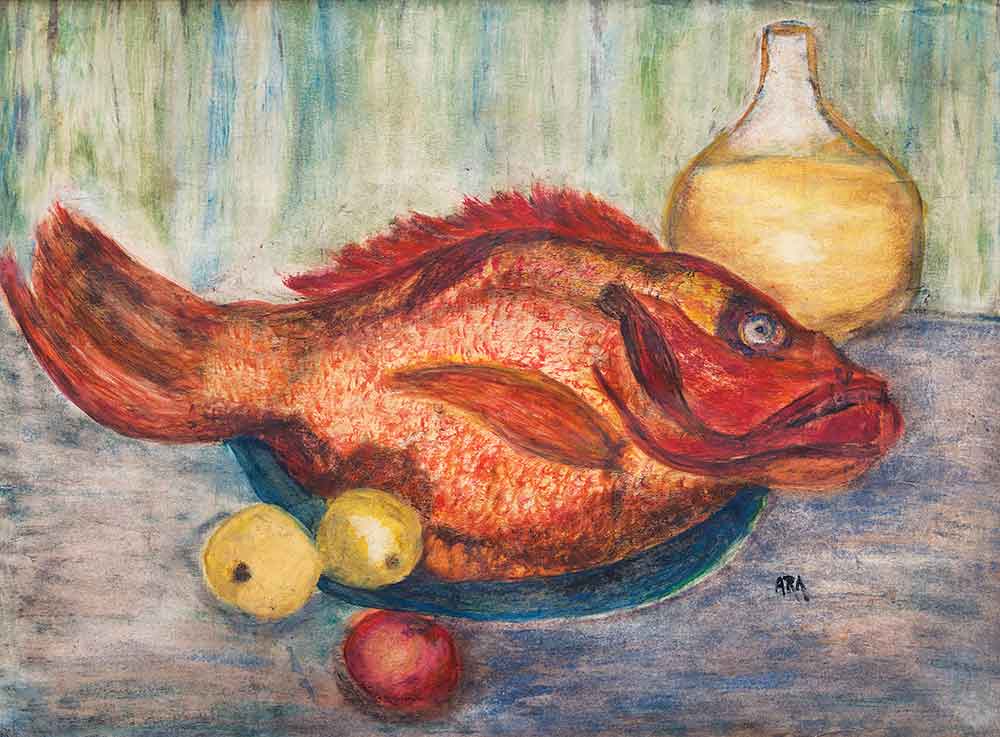 The Fish - K.H. Ara captures the tactile richness and natural vitality of the fish with remarkable precision. Unlike the glossy perfection of traditional European still-lifes, Ara's subjects possess a lived-in, unpolished quality. The textures are emphasized through his signature use of bold, confident brushstrokes and a dry, often impasto-like application of colour, injecting energy into the inanimate forms.
The Arrangement - The scene typically anchors around simple objects of utility, such as a humble vessel (ceramic or earthenware) and a selection of fruit. These elements serve to construct a tableau of rustic elegance, where quotidian objects are imbued with a subtle, poetic sophistication. The rounded forms of the fruit often complement the contours of the fish, demonstrating Ara's keen sense of compositional balance.
Light and Shadow - The dimensionality of the still life is enhanced by Ara's careful modulation of light. Reflective highlights breathe luminosity into the textured surfaces, while subtle gradations of tone model the forms. This technical virtuosity not only heightens the realism but imbues the work with a contemplative mood, inviting the viewer to savor its quiet beauty.
Artistic Technique
K H Ara applied watercolour straight from the tube in dry impasto, mimicking oil's texture with jagged, uneven forms and masterful whites that overflow objects, infusing inanimate subjects like fish with human-like vitality and emotional depth. Self-taught, his deliberate roughness rejected academic polish, blending landscape elements with still life for choreographed light, shadow, and perspective.
Context and Modernist Contribution
K H Ara's dedication to the still-life genre was pioneering. While his contemporaries in the PAG such as F.N. Souza, M.F. Husain, and S.H. Raza were primarily concerned with radical figurative, landscape, or narrative forms, Ara quietly carved out a distinctive space for the study of objects. His focus was less on overt political or social commentary and more on the poetics of form, colour, and texture. By selecting subjects like fish, jugs, and fruit, he connected his modern language to the classical traditions of the still-life, which often explored themes of sustenance, transience (vanitas), and the cycles of nature.
His unique, non-academic style born from his lack of formal training and his raw, instinctive approach was a powerful form of modernism in itself. He took inspiration from European modernists like Paul Cézanne but filtered it through a distinctly Indian sensibility, celebrating the dignity of the ordinary and finding grace in the mundane elements of daily life.
Conclusion
Still Life With Fish is a testament to K H Ara's enduring legacy. It showcases a painter whose humanity and social goodwill manifested in an art that honored the simple, tactile reality of life. The painting challenges the viewer to appreciate the texture, colour and form of the everyday, confirming Ara's place as a foundational and essential figure in the history of Indian Modern Art.