krishnaji howlaji ara - still life with fruits (1964)
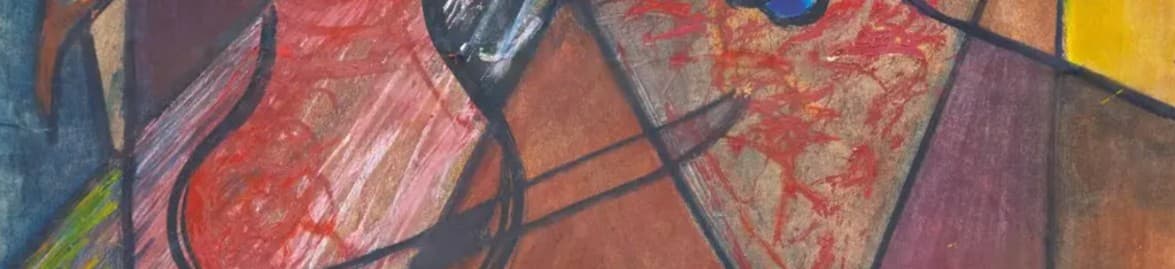
K. H. Ara was a self-taught Indian painter associated with the emergence of modern art in India, particularly recognized for his still-life and nude works. Below is an overview of K H Ara's Still Life With Fruits within the context of the artist’s practice, his techniques and the significance of his still-life genre.
Artist Background
Krishnaji Howlaji Ara grew up in modest circumstances, and did not receive formal art schooling. He became associated with the Progressive Artists’ Group in Bombay (formed 1947–48) which included major Indian modernists such as F.N. Souza and M.F. Husain. Over the 1940s and into the 1960s, K. H. Ara developed a distinctive approach to everyday objects; vases, fruits, bowls, drapes rendered in a style that balances recognizable subject matter with painterly experimentation.
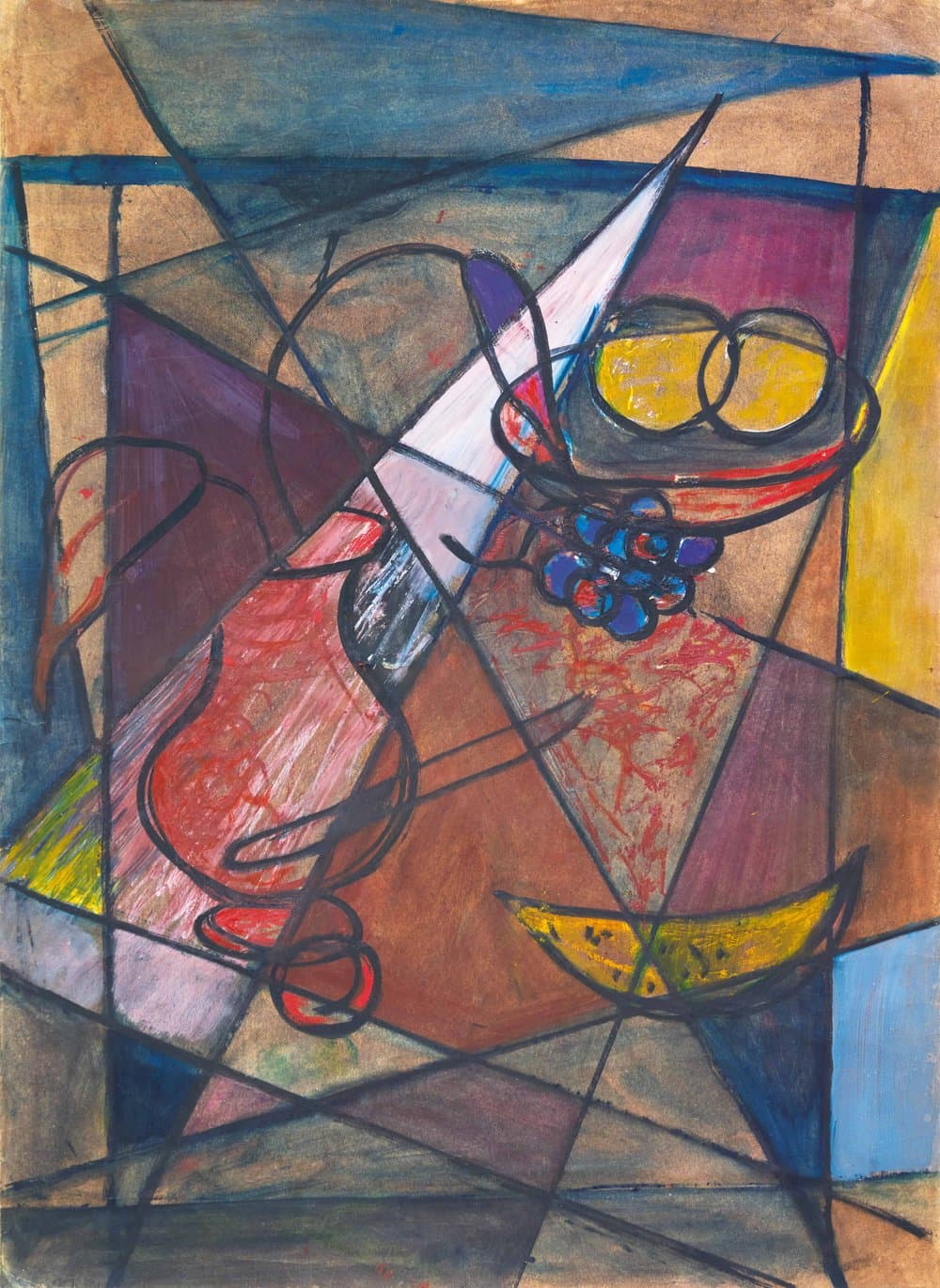 The Painting: Still Life With Fruits (1964)
Medium & Dimensions: The work is described as “mixed media on paper” and measures 30.2 × 22 in.
Date: 1964, placing it in the later part of Ara’s still-life exploration.
This painting thus belongs to the period when Ara was firmly engaged with the still-life genre, applying his mature visual language to arrangements of everyday objects.
Artistic Technique & Visual Language
In his still-life paintings, K. H. Ara employed several distinctive technical strategies:
• He often worked on paper, a support that enabled immediacy and responsiveness.
• The term “mixed media” suggests that beyond watercolour or gouache, Ara may have used other materials (such as crayon/pastel, ink, or thicker applications) to explore texture and surface.
• His still-life works are noted for a “deliberate roughness in both drawing and applying paint”.
• While he started with watercolour/gouache, he developed an approach in which the flatter medium appears more painterly.
• Compositionally, his still-life arrangements are simple yet dynamic: objects are placed with awareness of volume, shadows, and space but not in a purely academic manner. The work of 1964 would reflect his matured confidence in this registration.
• The palette and forms are less about detailed realism and more about the relationship of form, colour, surface and space: “He experiments with bowls, fruits and vases with flowers… to develop into beautiful composition to which he gave a distinctive style.”
Significance of Still Life in K H Ara’s Oeuvre
The still-life genre in K. H. Ara’s body of work is central for several reasons:
• Genre-pioneering: As noted, still-life was not a major strand of modern Indian painting until artists such as Ara elevated it. The TIFR collection statement remarks on this genre coming into its own with him.
• Everyday objects as formal challenge: By choosing bowls, fruits, vases mundane subjects, he shifted focus from narrative to form, colour and composition.
• Bridge between representation and modernism: While the images are still-life, Ara’s handling of them aligns with modernist concerns flattening, texture, expressive paint, surface awareness.
• Maturity by the 1960s: By 1964, the year of the work in question, Ara had had over a decade of exploration in this genre, enabling a refined handling of his still-life idiom.
Interpretation
• Material presence: The texture and medium on paper invite close viewing of how the materials are handled; the marks, layering, edges.
• Object arrangement: Note the spatial relationships, how the fruits and vessels relate to the surface, to one another, to the background. Even simple still-life becomes about rhythm and balance.
• Colour and form: Observe how the colours function not only to depict fruit, but to set tone and atmosphere; how the forms are simplified yet substantial.
• The painter’s hand: Ara’s style often evidences confident brushwork or mark-making; the “roughness” is intentional and expressive rather than casual.
• The still-life’s metaphorical register: While still-life can be seen as mere depiction of objects, in Ara’s hands the objects become vehicles for exploring form, time, material, and the act of looking.
Conclusion
Still Life With Fruits (1964) by K. H. Ara exemplifies the artist’s innovation within one of his most characteristic genres: the still-life. Its medium (mixed media on paper), its date (1964) and its dimensions mark it as part of Ara’s mature phase. The painting stands as a testament to his commitment to everyday subject matter, his evolving technique and his place in the narrative of modern Indian art.