life & legacy of k laxma goud - a journey through art & identity
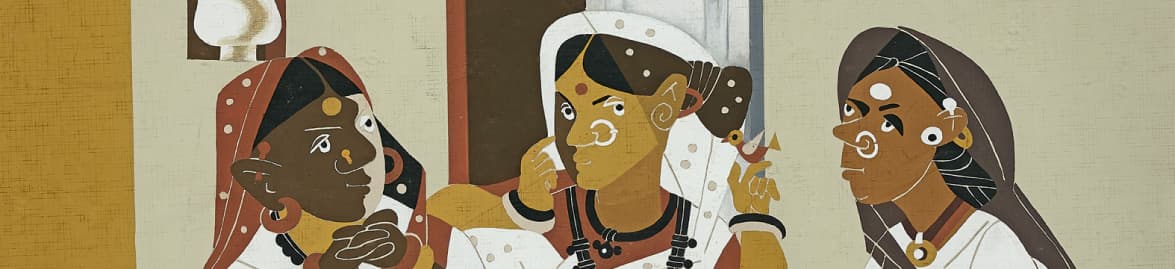
K. Laxma Goud is a renowned Indian contemporary artist who is widely regarded for his significant contributions to Indian art. A master of multiple mediums, including printmaking, painting, and drawing, his work explores themes related to rural life, the human form, and the interplay of light and darkness. His distinct style, coupled with a deep connection to his roots, has made him one of the most important artists of his generation.
Early Life and Education
Born in the village of Nizampur in Telangana, Laxma Goud was drawn to art from a young age. Growing up in the rural landscape of southern India, he developed a strong connection to his surroundings, which would later influence his work. Laxma Goud moved to Hyderabad to pursue his formal education in art. He studied at the Government College of Fine Arts in Hyderabad, where he earned a diploma in painting. The academic training exposed him to various styles and techniques, but it was the traditional art forms of India and the experiences of his rural upbringing that left a lasting impression on him.
Artistic Development and Style
Laxma Goud's work is marked by its strong connection to the rural life he experienced in his youth. His art often depicts rural scenes, human figures, animals, and traditional Indian symbols. Over time, he developed a unique, expressive style characterised by the use of bold lines, intricate patterns, and an earthy colour palette. His works often carry an emotional intensity, drawing from his deep understanding of human nature and the rural environment. Texture plays a significant role in Laxma Goud's works, especially in his printmaking. He uses materials like copper plates, etching techniques, and drypoint methods to create tactile, layered surfaces that enhance the emotional depth of his art. The physicality of the materials used is often an extension of the emotional weight of the themes he portrays. The texture of the print naturally evokes a tactile sense of the human experience.
Depiction Of The Female Form
One of the most prominent motifs in Laxma Goud's art is the depiction of women. His works frequently feature the female form, with an emphasis on physicality and sensuality. The women in his art are often portrayed in intimate or contemplative poses, highlighting their beauty and complexity. The women are not idealised or romanticised but rather presented in a raw, earthy manner, which is a hallmark of Goud's style. These depictions often carry a sense of empowerment, resilience, and sensuality.
Elements of Spirituality and Mythology
K Laxma Goud occasionally incorporates elements of Indian mythology and spirituality into his work. However, his approach is often abstract or symbolic, rather than literal. He might use elements like gods, goddesses, and mythical creatures, though these often take on a more modern or personal interpretation. This motif reflects the rich cultural and spiritual heritage of India, often through symbols or forms that evoke a sense of reverence, mysticism, and connection to the divine.
Notable Themes
1. Rural Life: Laxma Goud’s art celebrates the simplicity, beauty, and struggles of rural life. His work often portrays farmers, cattle, and landscapes, reflecting the deeply ingrained connection between people and nature in Indian villages.
2. Human Form: His explorations of the human body, especially in his prints, are striking. He focuses on sensuality, the lines of the human form, and the emotional expression that emerges from it. The human body, whether through faces, hands, or silhouettes, is a recurring theme in his works.
3. Cultural Identity: Throughout his career, Laxma Goud has explored the cultural identity of India, particularly in the context of a rapidly changing society. His works are steeped in tradition, but they also reflect the tensions of modernity. He often merges abstract elements with more realistic forms to create a sense of continuity between the past and the present.
4. Symbolism and Spirituality: In many of his pieces, Laxma Goud employs spiritual and symbolic motifs that represent human emotions, desires, and struggles. His work often features symbolic representations of fertility, life, death, and the cyclical nature of existence.
Recognition and Impact
Laxma Goud’s art has been widely recognised both in India and internationally. His works have been exhibited in numerous solo and group shows, including prestigious galleries in cities like New York, London, and Paris. His exhibitions often explore the richness of Indian cultural heritage while addressing universal themes of human existence, identity, and the connection between man and nature.
Beyond exhibitions, his works have been collected by major art institutions and collectors. Laxma Goud’s influence on Indian contemporary art cannot be overstated, as his ability to blend traditional influences with modern artistic sensibilities has been groundbreaking.
Legacy
Laxma Goud’s legacy goes beyond his own artistic achievements. He is a symbol of the bridging of traditional Indian art with contemporary styles, offering new ways of expressing age-old themes. His ability to convey complex emotions through simple forms and his deep understanding of rural life continue to inspire generations of artists. His work is a testament to the enduring power of art to reflect identity, culture, and the human experience.