longcase clocks: what they are & why we call them grandfather clocks
.jpg&w=3840&q=75)
Walk into an antique shop, a stately home, or a well-appointed hallway, and you will likely encounter one: a tall, slender wooden clock standing quietly against the wall, its pendulum swinging in a slow, unhurried arc. Most people call it a grandfather clock. Fewer know it by its proper name: the longcase clock. Fewer still know the story behind why the nickname stuck, or quite how remarkable an object this is in the history of timekeeping. This article explores both.
What Is a Longcase Clock?
A longcase clock is a tall, freestanding pendulum clock housed within a narrow, upright wooden cabinet. The cabinet typically stands between 1.8 and 2.4 metres (roughly 6 to 8 feet) high and is divided into three sections: the hood at the top, which encloses the movement and dial; the trunk in the middle, which conceals the swinging pendulum; and the base or plinth at the bottom, where the descending weights come to rest before the clock is wound again.
The clock is almost always weight-driven. Heavy lead or iron weights hang from lines or chains inside the case, and as they descend slowly under gravity, they power the clock's gear train. The pendulum, swinging back and forth at a precise and regular rate, acts as the regulator, controlling how quickly the gears are allowed to turn. Together, the weights and pendulum create a mechanism of considerable accuracy and remarkable simplicity.
What made the longcase clock such a significant invention was not merely its appearance but the length of its pendulum. A pendulum one metre long completes each swing in almost exactly one second. This "seconds pendulum," as it came to be known, gave clockmakers a level of accuracy that had been impossible to achieve with earlier mechanisms. Before the longcase clock, a domestic timepiece might lose or gain several minutes a day. A well-made longcase clock could keep time to within a few seconds per week.
The tall wooden cabinet existed, in its earliest form, for purely practical reasons: the long pendulum needed space to swing freely, and the descending weights needed somewhere to travel. Over time, however, the case became an opportunity for craftsmanship and display, and the longcase clock evolved into one of the great forms of decorative furniture.
Longcase Clock History
The longcase clock was born in England in the years following 1670, when the anchor escapement was introduced. This was the mechanism that made the long pendulum practical for the first time, and its effect on clockmaking was transformative. Within a few years, London's finest clockmakers were producing longcase clocks of exceptional quality for aristocratic and wealthy merchant clients.
The earliest longcase clocks were relatively restrained in their decoration, housed in cases of oak or ebony-veneered wood with square brass dials engraved with restrained ornament. But as the form matured through the late 17th and early 18th centuries, it grew more ambitious. Walnut cases with fine marquetry inlay became fashionable, followed by lacquered cases decorated in the chinoiserie style that was sweeping English interiors during the reign of Queen Anne. By the Georgian period, mahogany had become the wood of choice for the finest examples, and dials had grown to include arched tops painted with moonphase indicators, rotating globes, and pastoral scenes.
The longcase clock was never exclusively a London product. Provincial clockmakers across England, Scotland, Wales, and Ireland produced their own regional variants, and the form traveled with emigrants and trade to colonial America, where craftsmen in Philadelphia, Boston, and the Connecticut River Valley developed distinctly American interpretations. American longcase clocks are generally recognisable by their use of native woods such as cherry and tiger maple, and by the painted iron dials that replaced brass as the fashionable choice from the late 18th century onward.
Production of longcase clocks continued in earnest through the 19th century, with the Victorian period bringing both a nostalgia for earlier styles and the efficiencies of industrial manufacture. By the early 20th century, however, the mantel clock, the electric clock, and eventually the wristwatch had displaced the longcase from its position at the centre of domestic timekeeping. Today, longcase clocks are no longer made in meaningful commercial quantities, and the finest examples are prized antiques.
Oldest Longcase Clocks
The oldest longcase clocks date back to the late 17th century, shortly after the invention of the anchor escapement around 1670. This development allowed clockmakers to use longer pendulums that swung more slowly and accurately, which required taller wooden cases to house them. As a result, the longcase clock emerged in England during this period, becoming both a practical timekeeping device and a piece of fine furniture. Early examples are sometimes referred to as “30-hour clocks” because they needed to be wound daily.
Some of the earliest surviving longcase clocks were made by prominent English clockmakers such as William Clement and Thomas Tompion. These early clocks typically featured square brass dials, single hands, and relatively simple movements compared to later designs. The cases were often made of oak and had a more restrained appearance, reflecting the styles of the late 1600s. As craftsmanship advanced into the 18th century, clockmakers began adding minute hands, arched dials, decorative spandrels, moon phase indicators, and more elaborate cabinetry in walnut or mahogany.
The oldest longcase clocks are highly valued today by collectors and museums because they represent a major advancement in mechanical timekeeping. They illustrate the transition from smaller bracket and wall clocks to tall, floor-standing designs that combined precision engineering with decorative artistry. Surviving examples from the late 1600s and early 1700s are considered rare and historically significant, offering insight into early horological innovation and the skilled craftsmanship of the period.
Why is a Longcase Clock called Grandfather Clock?
The answer lies in a song. In 1876, an American songwriter named Henry Clay Work published a composition called "My Grandfather's Clock". The song told a simple, sentimental story: a large floor-standing clock is bought on the day its owner is born, ticks faithfully through ninety years of his life, and stops at the exact moment of his death, never to go again. The chorus was catchy, the sentiment was universal, and the song became one of the most popular parlour songs of the 19th century on both sides of the Atlantic.
Work is said to have been inspired by a real clock he encountered at the George Hotel in Piercebridge, in County Durham. The hotel's owners told him that the clock had kept perfect time for years but had begun to run poorly after one of the two brothers who ran the hotel died, and had stopped entirely when the second brother followed him to the grave. Whether or not the story is strictly true, it fired the songwriter's imagination, and the result was a song that lodged itself permanently in popular culture.
Within a generation of the song's publication, "grandfather clock" had become the standard term in everyday English for any longcase clock, largely supplanting the older name in common usage. Horologists, antique dealers, and serious collectors still prefer "longcase clock" as the more precise and historically accurate description, but for most people, grandfather clock is what the object has been and will remain.
What are the 3 Types of Longcase Clocks?
The three main types of longcase clocks are grandfather clocks, grandmother clocks, and granddaughter clocks, and the primary difference between them is their height, which also affects their visual presence and sometimes their internal movement size.
A "Grandfather Clock" is the tallest of the three types, typically standing over 6 feet (about 1.8 meters) tall. These clocks often feature large cases, long pendulums, and substantial weight-driven movements. Because of their size, they frequently include more complex mechanisms such as multiple chimes, for example Westminster chimes, moon phase dials, and decorative faces. Grandfather clocks are designed to make a strong visual statement in spacious rooms and traditional interiors.
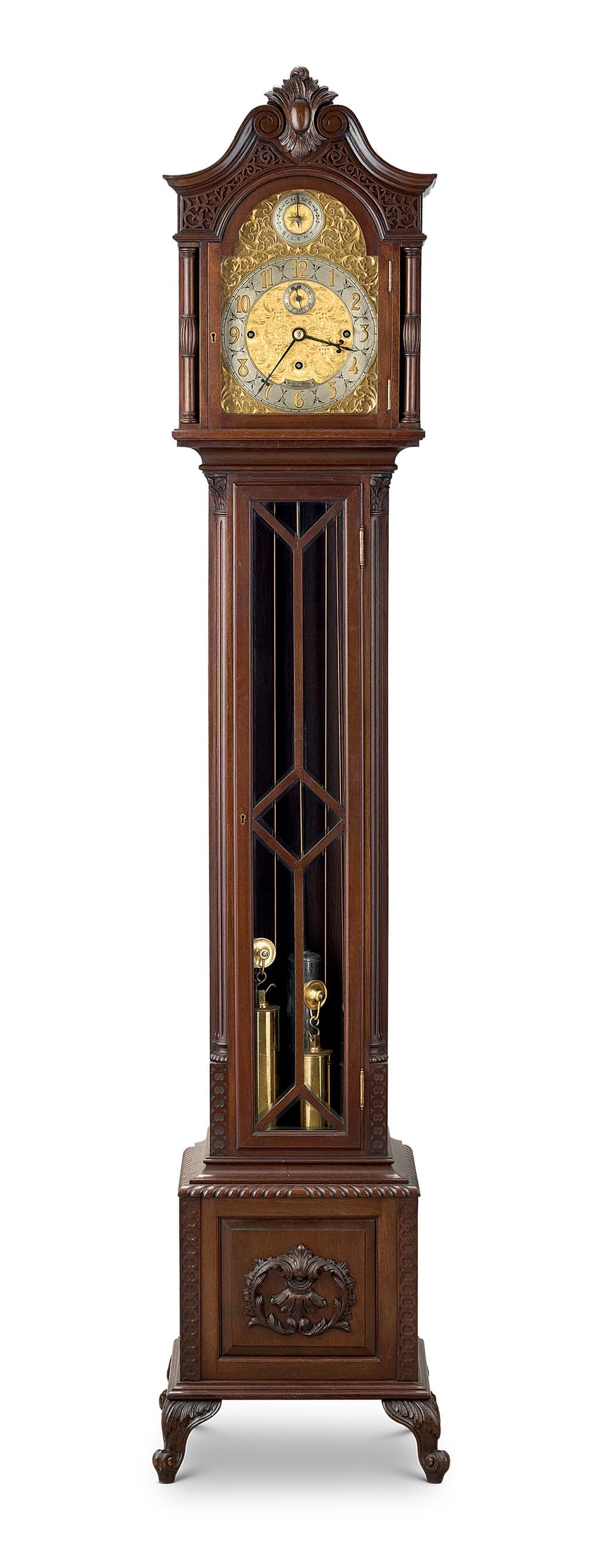 A "Grandmother Clock" is shorter than a grandfather clock, usually measuring between 5 and 6 feet tall. It retains the same general structure, a long pendulum enclosed in a wooden case, but is slimmer and more compact. While it may include chimes and decorative features, it typically has a slightly smaller dial and movement. Grandmother clocks are well suited to medium-sized rooms where a full-size grandfather clock might feel too large.
A "Granddaughter Clock" is the smallest of the three, typically standing between 3 and 5 feet tall. These clocks are more compact and lighter, making them suitable for smaller spaces such as apartments, hallways, or bedrooms. Although they function similarly with a pendulum and weights or sometimes spring-driven mechanisms, they generally have simpler designs and fewer decorative or mechanical features compared to the larger types.
In summary, the key difference between the three types lies primarily in their height and overall scale. While all are longcase clocks with similar fundamental mechanisms, grandfather clocks are the largest and often most elaborate, grandmother clocks are mid-sized and more space-efficient, and granddaughter clocks are the smallest and most compact.
The Anatomy of a Longcase Clock
A closer look at the longcase clock reveals just how considered its design is, with each section of the case serving a specific function while also contributing to the visual whole.
The hood is the most decorative part of the exterior. It frames and protects the dial and movement, and is typically fitted with a glazed door to allow the dial to be read without opening the case. Hoods were designed to be removed entirely for access to the movement, either by sliding upward on early examples or, later, by lifting clear on a fixed column arrangement. The tops of hoods were decorated variously with flat cornices, broken pediments, scrolled pediments, and finials in brass or carved wood.
The trunk is the tall central section that gives the longcase clock its characteristic silhouette. The trunk door is often glazed, at least in its upper portion, so that the pendulum can be seen swinging inside. This is partly functional, as it allows the owner to check that the clock is running without opening the case, and partly decorative, as the rhythmic movement of the pendulum bob became a feature rather than something to be hidden.
The base anchors the clock visually and structurally. It typically rests on bracket feet or a simple plinth moulding and contains the weights at the lowest point of their travel. On the finest examples, the base is panelled and decorated to complement the trunk, while on more modest country clocks it may be quite plain.
Inside the hood, the movement is the heart of the clock. Longcase clock movements are almost always made of brass, with two vertical plates held apart by pillars and containing between them the wheels, pinions, springs, and levers that translate the energy of the falling weights into the regulated counting of time. The dial, mounted on the front plate, is what the world sees: a chapter ring with Roman numerals, subsidiary dials for the date or seconds, and spandrel ornaments in the corners. On later arched dials, the arch above the chapter ring might contain a moonphase disc, a painted scene, or the maker's name on a separate cartouche.
Reading the Clock: How to Date a Longcase
For those who encounter longcase clocks in antique shops or auction rooms, a few visual clues can help narrow down when and where a clock was made.
Square brass dials are generally the earliest, most commonly produced before about 1720, though they continued to be made in some regions well into the 18th century. The corners of these dials are filled with cast brass ornaments called spandrels, whose designs changed in a broadly datable sequence: early cherub-head spandrels give way to more elaborate foliage and figure compositions as the century progresses.
Arched dials, in which the dial plate extends above the chapter ring in a semicircular arch, became fashionable from around 1715 and dominated production through the middle decades of the 18th century. The arch allowed for additional complications and decoration.
Painted dials appeared from around 1770 and quickly became the most popular type for provincial makers and their customers. They offered vivid colour and pictorial decoration at lower cost than the engraved and silvered brass dial, and they remained in production well into the 19th century.
Case styles track closely with the broader history of English furniture. Oak and ebony veneer belong to the Restoration period; marquetry and seaweed inlay to the William and Mary years; lacquer and japanning to the early 18th century; mahogany and restrained classical ornament to the Georgian period; and the heavier, more historicist styles of the Victorian era to the latter half of the 19th century.
The maker's signature, almost always present on English longcase clock dials, is perhaps the most useful single piece of evidence for dating and attribution. Most makers signed with their name and the town in which they worked, and the records of clockmakers' guilds and local directories allow many of these signatures to be dated with reasonable precision.
Famous Longcase Clocks
Famous longcase clocks are often defined by the master horologists who pushed the boundaries of accuracy and artistry, with the works of Thomas Tompion standing at the pinnacle. Known as the "Father of English Clockmaking," Tompion created several of the most renowned specimens in history, including the "Graves Tompion" and the year-going clocks commissioned for the Royal Observatory at Greenwich in 1676. These observatory clocks were revolutionary, featuring thirteen-foot pendulums and achieving a precision of two seconds per day; a feat that helped the first Astronomer Royal, John Flamsteed, map the stars with unprecedented detail. Today, Tompion's surviving longcase clocks are prized as some of the most expensive and culturally significant timepieces in the world, with many residing in the British Royal Collection.
Another legendary figure in the world of longcase clocks is John Harrison, a self-taught carpenter turned clockmaker who forever changed global navigation. Before he invented the marine chronometer to solve the "Longitude Problem," Harrison built a series of remarkable precision longcase clocks in the 1720s. These clocks, constructed primarily of wood, utilized his "grasshopper escapement" and "gridiron pendulum" to maintain accuracy within one second per month, far exceeding the capabilities of his contemporaries. His first longcase clock, completed in 1713 at age 20, is an iconic piece of horological history now housed in the Science Museum in London, representing the humble beginnings of a man who would eventually save thousands of lives at sea.
Beyond these technical marvels, certain longcase clocks are famous for their sheer artistic grandeur and historical provenance. The "Duc d'Orleans Breguet Sympathique" is one such masterpiece, designed by Abraham-Louis Breguet in the early 19th century. This extremely rare "grandfather" style clock features a unique "sympathetic" mechanism where a gold pocket watch rests in a cradle at the top, allowing the main clock to automatically wind and set the watch to the correct time. In the American context, the works of Simon Willard, particularly his tall-case clocks from the late 18th century, are celebrated for their elegant Federal-style cases and are considered some of the most valuable examples of early American craftsmanship.
Why Longcase Clocks Still Matter
It would be easy to dismiss the longcase clock as a historical curiosity, a beautiful relic from an era before quartz movements and atomic time signals rendered mechanical timekeeping effectively obsolete. But that would miss what makes these objects genuinely compelling.
A well-made longcase clock is a feat of engineering achieved without electricity, without synthetic materials, and without the precision manufacturing processes we take for granted today. Every wheel was cut by hand or with simple machine tools; every pivot was polished individually; every piece of brass was cast, filed, and fitted by craftsmen who learned their trade through years of apprenticeship. That such mechanisms could keep time to within seconds per week is, on reflection, extraordinary.
There is also the matter of longevity. A longcase clock made in 1720 and kept in reasonable condition is still ticking today, more than three centuries later. It has outlasted the people who made it, the people who first bought it, and very likely several generations of their descendants. It carries within it a record of human ingenuity and domestic life that no digital device is likely to replicate.
For collectors, the longcase clock offers an unusually rich field. Country clocks by obscure provincial makers can be found for modest sums and are often delightful objects in their own right. At the other end of the market, signed examples by London's greatest 17th and 18th-century makers, names like Thomas Tompion, Joseph Knibb, Daniel Quare, and George Graham, represent some of the finest surviving examples of English craftsmanship from any era, and they command prices to match.
For everyone else, the grandfather clock standing in the hallway remains what it has always been: a steady presence, marking the hours with a voice that carries across a quiet house, a reminder that some ways of measuring time have a beauty that no amount of technological progress has managed to improve upon.
Why Own One Today?
In an era of digital screens, the longcase clock remains a "living" piece of furniture. It requires a relationship; you have to wind it, set it and listen to its heartbeat. For collectors, an antique longcase clock represents a slice of history from the 18th or 19th century, often retaining the signature of the original clockmaker on the dial.
Whether you prefer the massive presence of a Mahogany Grandfather or the delicate charm of a Walnut Grandmother, these clocks remain the ultimate statement piece for any home.