


m. f. husain - the life & legacy of indias picasso
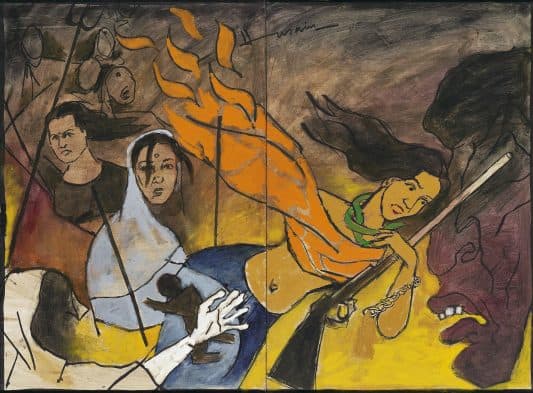
Maqbool Fida Husai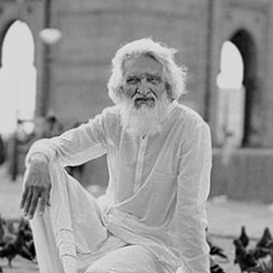 n, fondly known as M. F. Husain, was a celebrated Indian painter often referred to as "India's Picasso" due to his innovative approach to art and his ability to break boundaries in the same way that Pablo Picasso did in the West. Like Pablo Picasso, Husain was known for his bold experimentation with form and style, constantly evolving throughout his career. Husain's work, which often depicted mythological themes, historical narratives, and the human form, gained international acclaim for its unique fusion of Eastern and Western influences. His fearless approach to challenging conventional norms in Indian art earned him this comparison to Picasso, who similarly revolutionized the global art scene.
Early Life & Background
M. F. Husain was born on September 17, 1915, in Pandharpur, Maharashtra, India, to a Muslim family. His father, Fida Husain was a timekeeper in a textile mill and his mother, Zunaib passed away when he was just a child. Husain’s early life was marked by hardship and resilience, shaping his determination to rise above his circumstances.
Husain moved to Indore in his formative years, where he developed a fascination for art and creativity. As a young boy, he taught himself to draw and paint, often using humble materials like chalk and scraps of paper. His journey into the world of art was driven by an innate passion that would eventually make him one of India’s most celebrated artists.
Later Life
In his later years, M. F. Husain faced significant challenges due to controversies surrounding some of his works, particularly his depictions of Hindu deities, which some groups considered disrespectful. The resulting uproar led to legal troubles and eventually forced him to live in self-imposed exile in 2006. Despite this, Husain continued to paint prolifically, creating masterpieces that reflected his unyielding spirit and creative brilliance.
M. F. Husain lived in various countries during his exile, including Qatar and the UK, and was even granted Qatari citizenship in 2010. He passed away on June 9, 2011, in London at the age of 95, leaving behind an extraordinary legacy that continues to inspire artists and admirers worldwide.
Family
M. F. Husain was deeply connected to his family throughout his life. His father, Fida Husain, and mother, Zunaib, played pivotal roles in his early years. He married Fazila, and the couple had six children: Owais Husain, Raisa Husain, Shamshad Husain, Mustafa Husain, Aqueela Husain and Rahool Husain. Despite his global fame, Husain maintained close ties with his family, often drawing inspiration from them for his work.
Education
M. F. Husain did not receive formal education in art. Instead, he was largely self-taught, relying on his determination and natural talent. He later honed his skills at Sir J.J. School of Art in Mumbai, which was instrumental in shaping his artistic vision.
Artistic Journey & Development
M. F. Husain's journey as an artist began with painting cinema hoardings in Mumbai during the 1930s. This job refined his ability to work on large canvases and use bold, striking imagery. In the 1940s, he joined the Progressive Artists’ Group, which revolutionized modern Indian art by fusing Indian themes with Western techniques.
Husain’s work gained recognition for its unique style that broke away from colonial influences, emphasizing Indian narratives. His exhibitions in India and abroad cemented his reputation as a global artist.
Artistic Philosophy
M F Husain believed that art should transcend boundaries and connect with people on a universal level. His philosophy was deeply rooted in celebrating India’s cultural diversity while embracing innovation. For Husain, art was not merely a profession but a spiritual and emotional journey.
Painting Style & Techniques
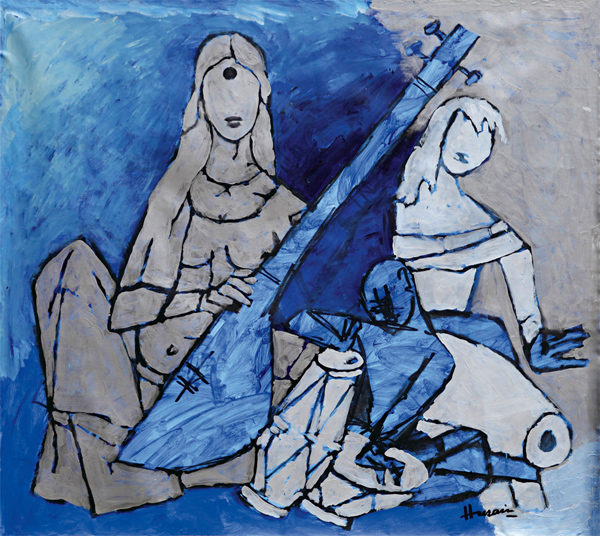 M.F. Husain is renowned for his distinctive painting style that integrates elements of modified cubism with Indian cultural themes. His style is characterized by bold, sweeping lines, fragmented forms, and vibrant colors. By employing a modified cubist approach, Husain deconstructed figures into geometric planes and reassembled them in ways that preserved their essence while evoking movement and emotion. Unlike traditional cubism, which often leans towards abstraction, Husain's work maintained a strong connection to figurative art, blending modernist techniques with culturally rooted symbolism.
M. F. Husain paintings often depicted themes drawn from Indian mythology, history and contemporary life, portraying subjects such as deities, epics, horses, women, and urban scenes. His use of cubist techniques allowed him to present these subjects in a dynamic and multifaceted manner, emphasizing their universality and timelessness. The fragmented forms in his paintings suggest a sense of motion and energy, which resonates with the rhythm of Indian traditions and storytelling. Additionally, his simplified yet powerful figures, marked by expressive brushwork, engage viewers in an emotive dialogue with his art. What set Husain apart was his ability to modernize Indian art while staying deeply rooted in its cultural ethos. His modified cubism was a bridge between the global and the local, reflecting the influence of European modernism while reinterpreting it in an Indian context. By doing so, Husain not only brought a unique perspective to the art world but also contributed to the global recognition of Indian modern art.
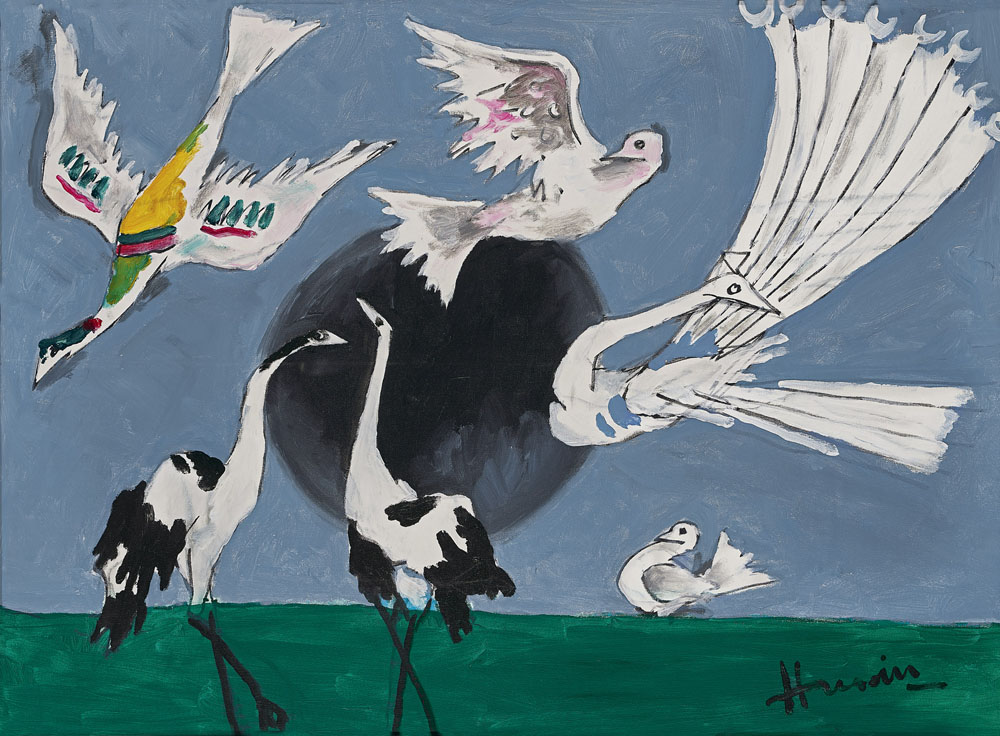 M.F. Husain's painting technique is celebrated for its fluidity, dynamism, and expressive power. He wielded the brush with remarkable confidence, creating bold, sweeping strokes that infused his canvases with a sense of movement and vitality. His approach often featured simplified forms and exaggerated proportions, emphasizing the emotional resonance of his subjects rather than strict realism. Husain's technique showcased a harmony of controlled precision and spontaneous expression, allowing him to bring his ideas to life with a sense of immediacy and energy.
A significant aspect of his technique was his use of color. Husain employed vibrant, unmodulated hues that heightened the visual and emotional impact of his works. His palette often reflected the vividness of Indian culture, drawing on its festivals, landscapes, and traditions. The application of paint in flat, bold planes contributed to the modernist aesthetic of his works, while the careful balance of composition ensured that even his most chaotic depictions retained an underlying harmony. Husain’s ability to combine traditional Indian motifs with modernist techniques was also evident in his use of line. The strong, gestural lines in his paintings defined his figures and created a sense of continuity across his canvases. This use of line, combined with fragmented forms influenced by cubism, gave his work a dynamic structure while allowing the viewer to engage with the narrative elements. Together, these elements made his technique both distinctly modern and deeply rooted in the cultural and emotional fabric of India.
Folk Art Technique
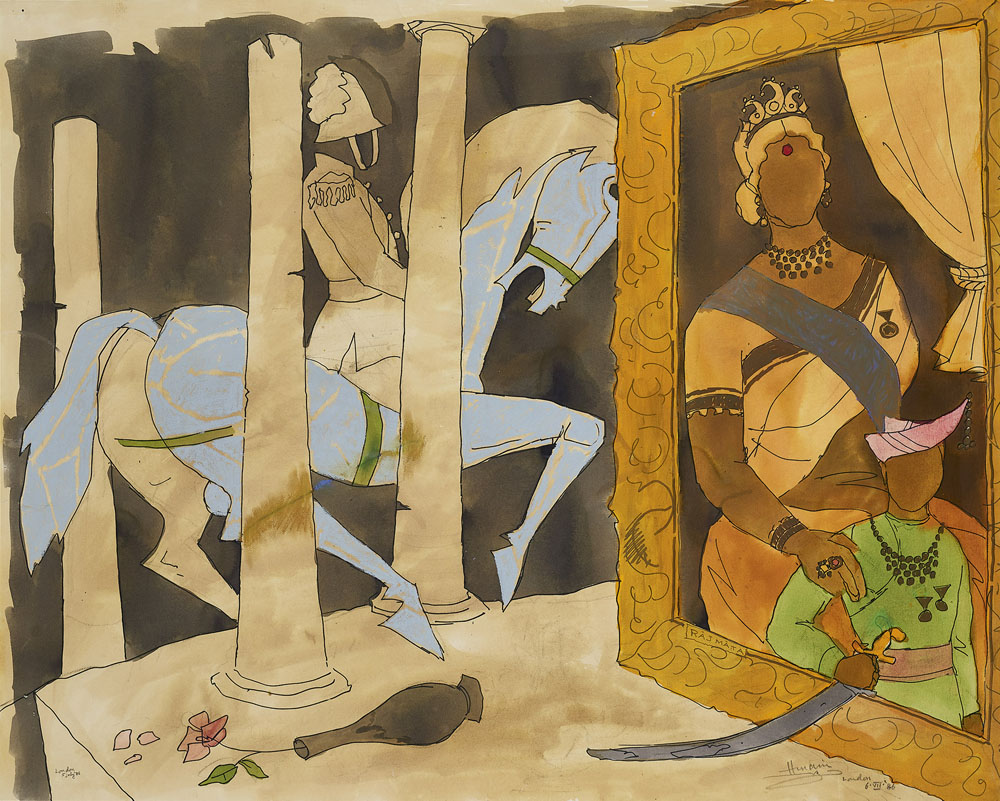 M. F. Husain’s artistic journey was deeply influenced by Indian folk art traditions, which he seamlessly integrated into his modernist style. Drawing inspiration from the vivid colors, bold forms, and storytelling nature of Indian folk and tribal art, Husain created works that resonated with cultural authenticity while embracing contemporary aesthetics. His brushwork often echoed the raw, unrefined strokes seen in traditional murals and Madhubani paintings, lending his canvases an earthy and organic quality. This influence is particularly evident in his use of flattened perspectives and simplified forms, reminiscent of Indian miniature paintings and folk motifs.
M. F. Husain's art celebrated India's diverse visual traditions, drawing upon elements like the geometric patterns of Warli art or the symbolic richness of Pattachitra. His choice of themes, such as rural life, festivals, and mythological narratives, often mirrored the subjects of folk art. However, Husain reimagined these themes in a modern context, using abstraction and cubism to create a unique fusion. His works did not merely imitate folk traditions; instead, they elevated these age-old techniques by embedding them in his experimental and innovative frameworks.
By incorporating folk art techniques into his paintings, Husain bridged the gap between rural and urban, traditional and modern. This approach not only highlighted the enduring relevance of India’s artistic heritage but also brought it to a global audience. His celebration of folk art demonstrated his deep respect for India's cultural roots and his commitment to keeping these traditions alive through his modernist lens.
Portrait Watercolor Painting
M. F. Husain brought a unique sensibility to his portrait watercolor paintings. Unlike his large-scale works in oil and acrylic, his watercolors displayed an intimate, fluid grace, showcasing his ability to capture the essence of his subjects with minimal strokes. Husain’s watercolor portraits often revealed a softer side of his artistic identity, characterized by delicate detailing and an emotional depth that resonated with viewers. His use of translucent layers and vibrant yet subdued hues gave his portraits a distinct luminosity, reflecting both the external features and the inner essence of his subjects.
Husain’s watercolors frequently featured people who inspired him, including cultural icons and everyday individuals. The spontaneity of watercolors allowed him to experiment with form and texture, creating works that were both personal and universal. His portraits often merged abstraction with realism, resulting in pieces that transcended traditional representation. These paintings stood as a testament to his versatility, proving that his creative brilliance extended across mediums, capturing humanity in all its complexity with the lightest of touches.
Famous Paintings
M. F. Husain created a vast repertoire of paintings that resonate with cultural, mythological and personal themes. One of his most celebrated works is "Horses", a recurring motif in his art symbolizing power, energy, and unrestrained freedom. The series features dynamic and fluid representations of horses, often depicted in motion with bold brushstrokes and vibrant colors. These paintings capture the essence of vitality and strength, reflecting Husain's fascination with the animal's grace and power.
Another famous masterpiece by M F Husain is "Mother Teresa", where he depicted the saintly figure without detailing her face, focusing instead on her iconic blue-bordered white sari. This abstraction emphasized the universality of her compassion and service, making her a symbol of selfless love. M F Husain's "Mahabharata Series" reinterprets scenes from the ancient Indian epic, portraying characters like Draupadi, Bhishma, and Arjuna with a contemporary aesthetic. These works blend mythological storytelling with modernist abstraction, offering a visual dialogue between tradition and modernity. These famous works demonstrate Husain’s ability to weave together cultural narratives and modernist techniques, leaving an indelible mark on the global art world.
Characteristics Features Of His Paintings
M. F. Husain’s paintings are celebrated for their vibrant use of color, dynamic lines and bold compositions, making him one of the most recognized figures in modern Indian art. One of the defining characteristics of his work is his fluid and energetic brushstroke, which often conveys a sense of movement and vitality. His compositions, whether of human figures, animals, or abstract forms, are frequently dynamic and full of life, capturing the essence of his subjects in a way that transcends realism. Husain was particularly known for his ability to distill complex narratives and emotions into simplified, powerful visual statements, using exaggerated forms and minimalistic backgrounds to highlight the central themes of his work.
Another significant feature of Husain’s paintings is his deep engagement with Indian mythology, history, and culture, often reflecting these themes through a modernist lens. He famously portrayed epic figures like the gods and goddesses of Hindu mythology, as well as historical figures and events, reinterpreting them in his distinct style. His iconic series on the Mahabharata and Ramayana are excellent examples of this. At the same time, Husain’s work also embraced universal themes like life, death, and human existence, which made his art accessible beyond India’s cultural context. His use of the horse as a recurring motif symbolized strength, energy, and freedom, further emphasizing the universal aspects of his artistic expression.
Lastly, Husain's work stands out for its daring experimentation and willingness to blend abstraction with representation. While his earlier works were more figurative, he later embraced abstraction, playing with shapes and forms in ways that reflected his evolving artistic vision. He often used bright, contrasting colors; reds, yellows, and blues to create intensity and emotional depth. This unique combination of modernist techniques with traditional Indian iconography and symbolism made Husain’s art both innovative and deeply rooted in the cultural fabric of India, allowing him to carve out a distinctive identity in the global art scene.
Art & Cinema
M. F. Husain was a polymath who seamlessly blended the worlds of art and cinema, infusing each with the vibrancy of his creative genius. His foray into filmmaking reflected his deep fascination with storytelling and his desire to explore new mediums. Husain’s most notable cinematic work, Through the Eyes of a Painter (1967), was a groundbreaking experiment in visual poetry. This 16-minute film captured the essence of Rajasthan through a painter's lens, showcasing his signature aesthetic: vibrant colors, fluid compositions, and profound symbolism. The film won the Golden Bear for Best Short Film at the Berlin International Film Festival, establishing Husain as a visionary not just on canvas but also on screen.
Cinema was more than a sideline for Husain; it was an extension of his artistic identity. His love for films manifested in his admiration for Indian actresses, whom he often immortalized in his paintings. Notable muses included Madhuri Dixit, whom he celebrated in works like Gaja Gamini (2000), a film he directed to pay homage to feminine grace and mystique. Later, Tabu inspired his film Meenaxi: A Tale of Three Cities (2004), a richly visual narrative that combined art, music, and poetry. Though his cinematic ventures received mixed commercial responses, they were lauded for their avant-garde approach and their ability to bridge the gap between fine art and popular culture.
For Husain, the dialogue between art and cinema was a way to push boundaries and connect with a wider audience. His films, much like his paintings, were an exploration of identity, culture, and human emotion. By integrating his painterly vision into the cinematic form, he created a unique legacy that continues to inspire both artists and filmmakers.
Madhuri Dixit Painting
M. F. Husain’s series of paintings dedicated to Bollywood actress Madhuri Dixit stands as one of the most iconic intersections of Indian cinema and modern art. Husain, who had long been captivated by the world of cinema, found in Dixit a muse that epitomized grace, beauty, and energy qualities that he sought to capture through his art. His paintings of Madhuri, created in the 1990s, are a celebration of her expressive features and the magnetic aura she radiated on screen. The most famous of these works is Madhuri Dixit in Dance, where Husain portrays the actress in fluid, exaggerated forms, capturing her dynamic movements and the intense passion of her performances. His approach was not only a reflection of her persona but also an exploration of the energy and rhythm of dance as a form of expression.
In these paintings, Husain's signature bold lines and vibrant colors are evident, with the artist emphasizing Madhuri’s physicality through strong, sweeping brushstrokes and dynamic compositions. The use of colors such as reds, blues, and yellows highlights the emotional depth of her performances, with the dance movements almost leaping off the canvas. Husain was drawn to the inherent vitality in Dixit's presence on screen, and he sought to distill that essence into his works, offering a tribute to both her as an individual and as an embodiment of Bollywood's enduring charm. His representations of the actress were not just a portrayal of her external beauty but also an artistic meditation on the power of performance and its emotional impact.
The paintings of Madhuri Dixit became symbolic not only of the actress’s role in the cultural fabric of India but also of Husain’s ability to blend popular culture with the language of modernist art. These works drew significant attention and became part of a broader conversation about the relationship between Indian cinema and visual art. In honoring Dixit, Husain also celebrated the intersection of two of India’s most influential art forms, capturing the magic of Bollywood through the lens of contemporary art.
Famous Quotes
M F Husain’s words, like his art, were insightful. One of his famous quote is “A painter is known by the colors he chooses”.
Accomplishments - Awards Won
M. F. Husain's extraordinary contributions to the world of art earned him numerous prestigious awards and accolades throughout his career. In recognition of his innovative and groundbreaking work, Husain was honored with the Padma Bhushan in 1973, one of India's highest civilian honors. This award celebrated his significant role in shaping modern Indian art and acknowledged his global recognition as a painter of considerable repute. His artistic achievements were further recognized with the Padma Vibhushan, India's second-highest civilian award, in 2010, shortly before his passing. These honors reflect not only his technical brilliance but also his impact on the cultural landscape of India and the international art community.
In addition to these national awards, Husain was celebrated by various international institutions and art bodies. He received the prestigious Lalit Kala Akademi Award in 1955, which marked his early recognition in the Indian art scene. Husain also won numerous awards for his individual exhibitions around the world, including at the Venice Biennale, and was named an honorary member of the Royal Academy of Arts in London. Throughout his career, he was consistently celebrated for his ability to blend traditional Indian art with contemporary influences, pushing the boundaries of artistic expression. His achievements, both on a national and international stage, cement his place as one of the most influential and awarded artists in modern Indian history.
Contributions and Impact on Indian Art
M. F. Husain's contributions to Indian art are significant for both his innovative approach and his ability to merge traditional Indian themes with modernist techniques. Husain was a prominent figure in the progressive art movement, which sought to break away from conventional artistic norms and explore new, dynamic forms of expression. His distinctive style, characterized by vibrant colors, bold lines, and symbolic imagery, drew inspiration from Indian culture, mythology, and history while incorporating elements of European modernism. Husain's works often depicted subjects ranging from historical figures like Mahatma Gandhi to Hindu deities, reflecting a deep engagement with Indian identity, spirituality, and social issues.
Beyond his aesthetic contributions, Husain's impact on Indian art lies in his role as a cultural ambassador who bridged the gap between the traditional and the contemporary. He was one of the first Indian artists to gain international recognition, showcasing his work in prestigious galleries and museums around the world, including in the United States, Europe, and the Middle East. This global exposure helped place Indian art on the international map, inspiring generations of artists to push boundaries and explore diverse styles. However, Husain's art was also controversial, particularly his depictions of religious and cultural symbols, which often provoked debate and even led to legal and political challenges. Despite these controversies, his legacy is cemented as one of the pioneers who transformed Indian modern art and left an indelible mark on the global art scene.
Conclusion
M F Husain stands as one of the most iconic figures in the landscape of modern Indian art. Known for his striking originality and innovative style, Husain’s works encapsulate a deep connection to India’s cultural heritage while embracing the global modernist movement. His vivid canvases, brimming with bold strokes and dynamic forms, depict themes ranging from religious symbolism to the human experience, making his art both accessible and thought-provoking. Husain’s passion for blending the traditional with the contemporary has earned him a special place in the hearts of art enthusiasts, not just in India, but worldwide.
Today, M. F. Husain’s original paintings continue to captivate collectors and art lovers alike, commanding attention in both galleries and private collections. His beautiful paintings, created using diverse mediums such as oil paints, continue to shine on canvas, offering timeless pieces that reflect both his technical skill and his profound understanding of Indian culture. Husain’s prints have also gained widespread acclaim, offering a more accessible way for art enthusiasts to own a piece of his genius. As one of the most sought-after artists in the Indian art market, Husain’s works frequently appear at auctions, with painting prices steadily increasing, reflecting his enduring influence on the art world. Whether through his vibrant canvas paintings or more affordable prints, M. F. Husain’s legacy remains an integral part of India’s artistic heritage.
Did you find this article inspiring? If yes, we recommend another post - 10 Famous Paintings Of Artist M. F. Husain & M. F. Husain 'Gram Yatra' Painting




