manu parekh - holy dip at banaras (2019) | overview
Manu Parekh is one of India’s most respected contemporary artists. His work explores themes of spirituality, human emotion, ritual and the complexities of Indian cultural life. One of his notable works titled Holy Dip of Banaras (2019) captures the spiritual fervor of ritual bathing in the sacred waters of Varanasi's ghats, embodying the artist's lifelong fascination with faith, human devotion, and the city's mystical energy. This article discusses Parekh’s artistic journey, influences, and the significance of Holy Dip within his larger body of work.
A Brief Overview of Manu Parekh
Manu Parekh was born in 1939 in Ahmedabad, Gujarat. He earned a Diploma in Drawing and Painting from the Sir J. J. School of Art in Mumbai in 1962. After graduation, he worked in several creative roles including theatre set design and design positions at the Weavers’ Service Centre in Mumbai and later in Calcutta. These experiences helped shape his artistic worldview. Alongside his professional design work, he continued to paint. His early work focused on the relationship between humans and nature, while later periods took on spiritual and emotional themes.
Varanasi: A Central Theme in His Work
Varanasi, also known as Banaras, has played a major role in Manu Parekh’s artistic practice. His connection to the city began after his father’s death, a personal turning point that led him to explore the spiritual and emotional layers of the holy city. For Manu Parekh, Varanasi represents a place where opposites coexist. Life and death, devotion and decay, ritual and everyday life all meet at the ghats. His paintings of the city are rarely simple landscapes. Instead, they convey the inner tension and profound spiritual charge of the place. Strong colors, bold lines, and abstract geometry help him express the living pulse of the city rather than just its physical form.
Understanding Holy Dip of Banaras (2019)
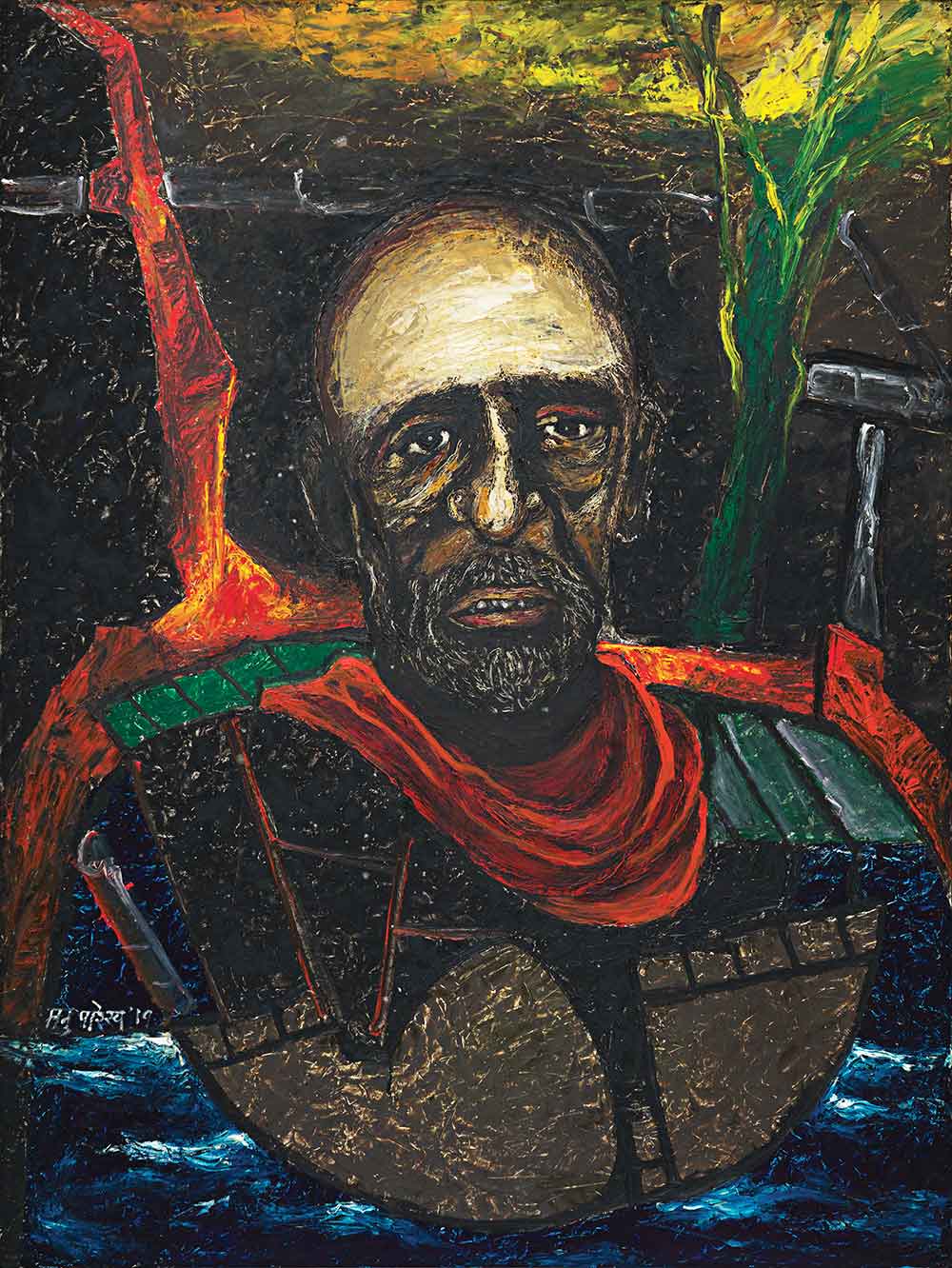 Holy Dip of Banaras is a painting from his later period and continues his exploration of ritual and spiritual experience. The title refers to the act of immersion in sacred water, especially the Ganges River in Varanasi. This ritual is believed to purify the soul and wash away sins.
Although detailed interpretations of the specific visual composition of Holy Dip are limited in public sources, its meaning can be understood through Manu Parekh’s broader artistic context. The act of dipping into holy water represents surrender, renewal, and spiritual transformation. These themes are consistent with his lifelong fascination with ritual and the human search for transcendence.
Symbolism and Interpretation
In Manu Parekh’s artwork, ritual often becomes a form of storytelling. Holy Dip can be viewed through the following ideas:
•> Spiritual cleansing: The ritual of bathing symbolizes purification and renewal.
•> Human vulnerability: Immersion in sacred water can also represent letting go or returning to a source greater than oneself.
•> Cultural memory: The painting reflects a tradition practiced for centuries, tying modern existence to ancient spiritual continuity.
The painting does not merely depict an event. Instead, it expresses an emotional and spiritual reality.
Legacy and Importance of Manu Parekh’s Work
Manu Parekh’s art is significant because it blends modern expression with spiritual inquiry. His paintings are expressive, dramatic, and deeply rooted in place and memory. They address universal themes such as life, death, belief, and the search for meaning. His repeated return to Varanasi demonstrates how certain places can become lifelong sources of reflection and artistic energy.
Conclusion
Holy Dip of Banaras stands as an important example of Manu Parekh’s mature artistic philosophy. It captures the spiritual essence of ritual while acknowledging emotional depth and cultural heritage. The painting invites viewers to consider not only the act of the ritual bath but also the timeless human desire for renewal, reflection, and inner transformation.