


my village, bhil painting by bhuri bai
.jpg&w=3840&q=75)
My Village (2015) - Bhil Art by Bhuri Bai | Overview
Measuring an expansive 79 x 191 inches, the "My Village" mural by Bhuri Bai is not just a painting, it is a topographical map of memory. As the first woman from the Bhil community to transition from traditional pithora wall painting to canvas, Bhuri Bai used this massive scale to recreate the entire universe of her childhood in Jhabua, Madhya Pradesh.
The Artist and Her Journey
Bhuri Bai, born in 1960 in Pitol village in Madhya Pradesh's Jhabua district, emerged from humble beginnings to become one of the most celebrated Bhil artists of contemporary India. Her journey from a tribal village to national and international recognition is remarkable. Originally working as a laborer, she was introduced to painting on paper and canvas in the 1980s when artists from her community were encouraged to translate their traditional wall and floor art onto portable mediums. What began as an experiment became a revolution in Indian folk art, bringing the sophisticated visual language of the Bhil people to galleries and museums worldwide.
About The Painting
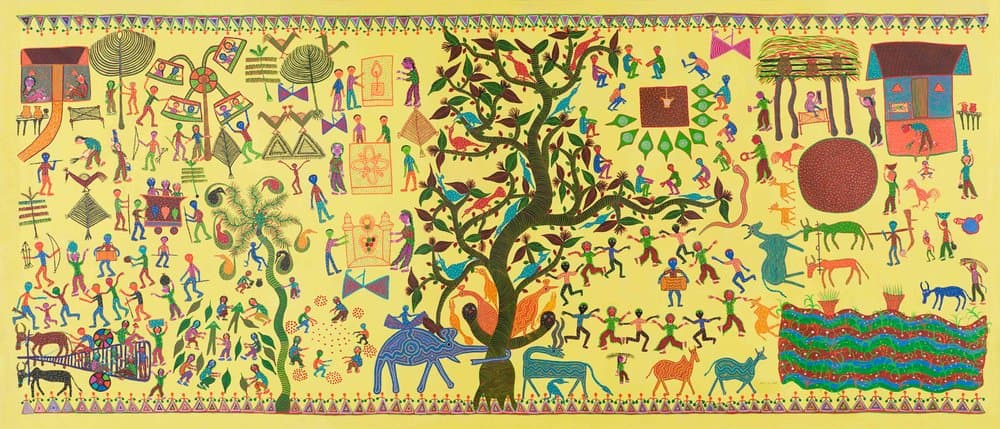 When Bhuri Bai paints "My Village," she channels memories, experiences, and emotions into a composition that feels both intimate and universal. Her village scenes typically feature the rhythms of tribal life: women carrying water pots, men tending to livestock, children playing, trees heavy with fruit, and animals both domestic and wild coexisting in the same visual plane. The flatness of the picture plane, characteristic of folk art traditions worldwide, allows all elements equal importance. There is no hierarchy between the sacred peepal tree and the humble chicken, between the woman grinding grain and the distant hill.
The palette is earthy yet vibrant. Natural ochres, deep browns, brick reds, and cream form the foundation, punctuated by brighter accents that might represent saris, flowers, or birds. Color in Bhil art isn't merely decorative; it carries cultural significance and emotional weight. The deep connection to the land is evident in every hue; these are the colors of soil, bark, leaves, and stone, the colors one sees when living close to the earth.
What makes "My Village" particularly moving is its lack of sentimentality. Bhuri Bai doesn't romanticize or idealize tribal life; instead, she presents it with honest affection. Her village is a place of work hard, unceasing work but also of community, celebration, and belonging. The figures she creates aren't passive subjects but active participants in the ancient cycle of planting and harvesting, celebrating and mourning, living and dying.
Bhuri Bai’s Artistic Journey
Bhuri Bai’s journey as an artist began in her own village, where as a child she watched elders paint Pithora murals despite restrictions that traditionally excluded women from directly painting them. Undeterred, she experimented with painting the mud walls of her home using tools and pigments available immediately revealing an intuitive creative voice.
Her life took a turning point when, while working as a construction laborer in Bhopal, she met the renowned artist Jagdish Swaminathan, then Director of Bharat Bhavan. He encouraged her to experiment with poster paints and paper, allowing her to bring her vibrant visuals into a portable medium for the first time. This leap from walls to canvas marked the beginning of her international recognition and canonization as a contemporary artist.
Bhuri Bai’s Artistic Style
Bhuri Bai's dotted technique, akin to Australian aboriginal art, uses spirals and patterns for elongated surreal figures of flora, fauna, and humans. Early village motifs evolved to include modern elements like airplanes and cellphones, blending nostalgia with contemporary life in her "My Life as an Artist" exhibition. Her autobiographical pieces critique how folk art adapts to markets while questioning tribal artists' autonomy.
Legacy and Influence
Now a teacher, Bhuri Bai trains her family and community, ensuring Bhil art's survival as a women's-led tradition recording births, deaths, and lore. Her global spotlight has inspired artists like Lado Bai, fostering recognition for Adivasi contributions beyond ritual walls. Through vibrant canvases, she immortalizes "My Village"; a dotted world of rituals, nature, and resilience.
Understanding Bhil Art
The Bhils, one of India's largest indigenous communities, have practiced their distinctive art form for generations. Traditionally, this art adorned the walls of homes during festivals and special occasions, created primarily by women using natural pigments. The style is immediately recognizable: figures and forms filled entirely with intricate patterns of dots, dashes, and lines. This technique, which might appear decorative to the untrained eye, actually carries profound meaning each mark connects to the rhythm of daily life, the cycles of nature, and spiritual beliefs.
The dot work in Bhil art is meditative and purposeful. Unlike pointillism in Western art, which blends colors optically, Bhil dots create texture, movement, and symbolic meaning. They might represent seeds being sown, rain falling, stars scattered across the night sky, or simply the patient, repetitive labor of agricultural life. The dense patterning transforms figures into living tapestries, where human, animal, and plant forms seem to vibrate with energy.
Conclusion
Bhuri Bai’s Bhil art is much more than a reflection of “my village” in simple terms. It is an immersive narrative that preserves and celebrates the beauty, complexity, and spirit of Bhil life. Her art bridges past and present, tradition and modernity, and local worlds and global audiences. It stands as a testament to the power of indigenous perspectives in enriching the wider tapestry of world art.




