nandalal bose - modern art artist who painted sati
.jpg&w=3840&q=75)
Artist Nandalal Bose, a pioneering figure in modern Indian art is celebrated for his mastery of visual storytelling. His work not only reflects aesthetic brilliance but also carries deep cultural and philosophical significance. Among his most renowned works is "Sati" a painting that stands as a poignant representation of devotion, sacrifice and the complexities of Indian tradition. This article delves into the meaning, significance, influences, techniques and reception of "Sati", shedding light on why artist Nandalal Bose chose to paint this evocative subject.
What Does 'Sati' Mean
"Sati" refers to the historical Hindu practice where a widow would immolate herself on her husband's funeral pyre. The term derives from Sanskrit, meaning "good woman" or "virtuous wife" and references the goddess Sati who according to Hindu mythology is the first consort of Lord Shiva and later reincarnated as Parvati, self-immolated in response to her father's insult to her husband, Lord Shiva. Nandalal Bose's painting "Sati" draws from this mythological narrative, depicting the self-immolation of the goddess Sati.
The practice, though rare even at its height, became a controversial subject during India's colonial period and reform movements. By the time of Nandalal Bose's artistic career, sati had been legally abolished (banned by the British in 1829) but remained a complex symbol in Indian cultural memory representing both tragic oppression of women and in some interpretations, ultimate devotion.
Why Did Nandalal Bose Paint 'Sati'
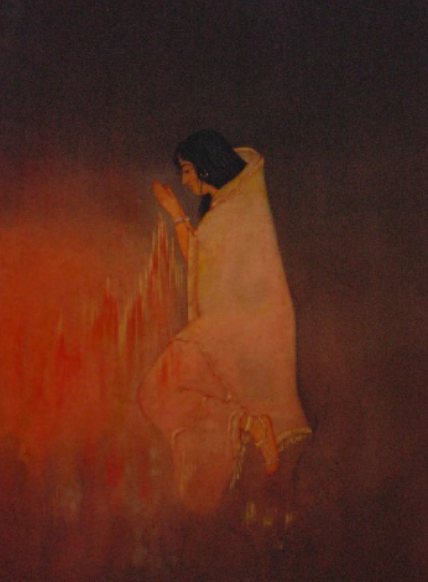 Nandalal Bose painted 'Sati' during a time when India was grappling with colonial rule and a burgeoning movement for independence. This painting was not merely an act of artistic expression but a profound reflection on the spirit of sacrifice, resilience, and moral strength. Bose was deeply influenced by the Indian freedom movement and sought to evoke these ideals through his art.
By painting Sati, Nandalal Bose connected the concept of self-sacrifice to the larger cause of India's struggle for liberation. The painting became an allegory for the nation's fight against oppression, with the figure of Sati symbolizing India herself dedicated, resilient and willing to endure suffering for the greater good. The painting "Sati" can be seen as Bose's attempt to reclaim and celebrate Indian cultural heritage in the face of colonial influences. By portraying the mythological Sati, Bose aimed to evoke a sense of pride and identity among Indians, emphasizing the rich tapestry of their cultural past.
Meaning & Significance Of 'Sati'
The painting 'Sati' is layered with meaning, both personal and national. On one level, it represents the mythical devotion of the goddess Sati, who stood for unyielding love and sacrifice. On another level, it serves as a metaphor for India's colonial struggle, where personal sacrifice was seen as a necessary step toward achieving freedom.
The significance of 'Sati' lies in its ability to evoke a sense of awe, reverence and introspection. It challenges viewers to think about the concepts of duty, devotion, and the cost of freedom. The painting is a reminder of the strength of conviction and the power of selflessness in the face of adversity.
Influences
Nandalal Bose's Sati was shaped by a variety of influences:
• Indian Miniature: Nandalal Bose drew inspiration from the intricate detailing and vibrant colors of traditional Indian art forms.
• Philosophical Teachings: Bose's association with Rabindranath Tagore and his exposure to Indian spiritual texts deeply influenced his artistic vision.
• Social Reform Movements: The early 20th century saw a growing awareness of women's rights and social reform, which likely informed Nandalal Bose's nuanced portrayal of Sati.
Materials & Techniques Used
Nandalal Bose was known for his innovation and adaptability in materials and techniques. For "Sati," he employed:
•> Materials -
• Tempera Paint: Bose frequently used tempera, a medium that involves mixing pigments with a binding agent like egg yolk or gum arabic. It provided vibrant colors and durability.
• Handmade Paper: Bose often worked on handmade paper, which gave his art a unique texture and grounded it in Indian tradition.
•> Techniques -
• Wash Painting: Inspired by Japanese and Chinese techniques, Bose applied translucent layers of color to create depth and subtle gradations.
• Linear Composition: The painting’s composition emphasizes strong, clean lines that highlight the central figure and convey a sense of movement and emotion.
• Symbolic Imagery: Bose often used symbolic elements in his work, such as flames, lotus flowers, or the posture of the subject, to convey deeper meanings.
Reception & Critical Response
When first exhibited, "Sati" generated considerable discussion in Indian art circles. The painting's reception reflected the complex feelings Indians held toward their own cultural practices during a time of national redefinition:
• Artistic Community: Fellow artists largely praised Bose's technical mastery and emotional restraint in handling such a charged subject
• Nationalist Movement: Some independence activists viewed the work as an important reclamation of Indian history from colonial narratives
• Social Reformers: Progressive thinkers appreciated Bose's nuanced treatment that neither glorified nor sensationalized the practice
• Traditional Elements: Some more conservative viewers were uncomfortable with the direct acknowledgment of a banned practice
• International Reception: Western critics noted how Bose transformed what had been an "Oriental curiosity" in colonial accounts into a dignified human narrative.
Art historian R.C. Majumdar noted that "Nandalal Bose achieved what few artists could. He transformed a subject of colonial fascination into a mirror for Indian society to contemplate its own complex heritage".
Legacy Of "Sati"
The painting 'Sati' remains one of Nandalal Bose’s most iconic works, a testament to his ability to combine art with social and political commentary. It serves as a reminder of the enduring power of sacrifice and the importance of staying true to one’s convictions. Through 'Sati,' Bose not only paid homage to Indian mythology but also created a timeless masterpiece that continues to inspire and provoke thought. His work symbolizes the intersection of art, history, and philosophy, making him a true pioneer of modern Indian art.
Significance
Today, Nandalal Bose's "Sati" is recognized as a masterwork that demonstrates how modern Indian art could engage critically with tradition while maintaining cultural authenticity. The painting exemplifies several significant aspects of Bose's contribution to Indian art:
• Cultural Reclamation: Demonstrating how Indian artists could reclaim narratives that had been misrepresented under colonialism
• Modernist Sensibility: Using simplified forms and emotional restraint to create psychological impact
• Technical Innovation: Blending traditional techniques with modern compositional approaches
• Historical Dialogue: Creating art that participates in complex cultural conversations rather than simply decorating or illustrating
• Ethical Dimension: Showing how art can engage with difficult moral questions without becoming didactic.
Conclusion
In essence, Nandalal Bose's Sati is not just a painting but a cultural artifact that invites viewers to engage with the rich tapestry of Indian mythology, history and artistic expression. The painting echoes the silent agony of countless women who surrendered their lives needlessly.