


paritosh sen - profile, history, paintings & art style
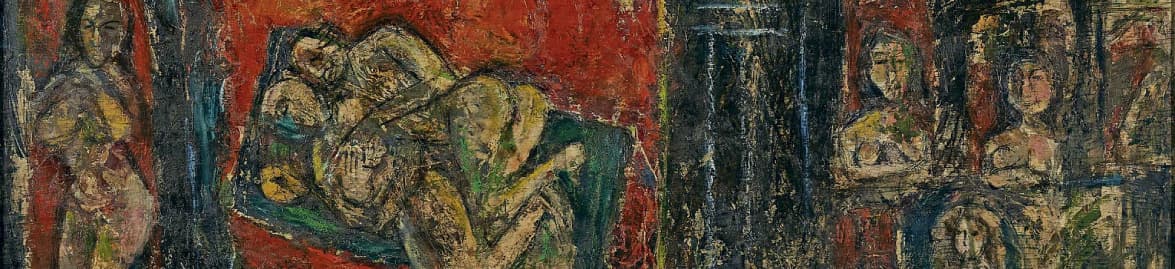
Paritosh Sen (26 September 1918 – 22 October 2008) was a pioneering Indian modernist painter, illustrator, writer, and art critic. A founding member of the Calcutta Group, he played a pivotal role in introducing modernism to Indian art by blending European techniques with Indian themes. Known for his bold use of colour, expressive lines, and socio-political commentary, Sen's works often depicted everyday life with a unique satirical edge.
Sen’s career spanned over six decades, during which he explored various mediums and styles. His art reflected his keen observations of human behaviour, urban life, and societal dynamics. Beyond painting, he was a prolific writer who contributed essays and autobiographical works in both English and Bengali. His contributions to Indian art earned him numerous accolades, including the prestigious L'officier de l'ordre des arts et des lettres from the French government and the Lalit Kala Ratna from India’s Lalit Kala Akademi.
Early Life and Education
Paritosh Sen was born in 1918 in Dhaka (then part of British India, now Bangladesh). He grew up on Jindabahar Lane in Beltoli, Dhaka—a neighbourhood that would later inspire his autobiographical writings. His early exposure to art came through observing the vibrant cultural life around him.
In 1936, Sen moved to Chennai (then Madras) to study at the Government College of Arts and Crafts. He graduated in 1940 with a diploma in Fine Arts. After briefly teaching at Daly College in Indore in 1943, he relocated to Calcutta (now Kolkata), where he became a central figure in the city’s burgeoning art scene.
The Calcutta Group
In 1943, Paritosh Sen co-founded the Calcutta Group alongside artists such as Nirode Mazumdar, Subho Tagore, Gopal Ghose, and Gobardhan Ash. This collective was India’s first modernist artist group and sought to break away from the traditional styles championed by the Bengal School of Art. The group embraced European modernist idioms like cubism and surrealism while addressing contemporary socio-political issues such as poverty, famine, and war.
The Calcutta Group’s inaugural exhibition in 1944 marked a turning point in Indian art history. Its guiding philosophy—“Man is supreme; there is none above him”—reflected its humanistic approach to art. The group’s works resonated with audiences both in India and abroad, laying the foundation for modern Indian art.
Training in Paris
In 1949, Paritosh Sen travelled to Paris on a French government scholarship to study at prestigious institutions such as the École des Beaux-Arts and Académie André Lhote. This period proved transformative for his artistic vision. He immersed himself in European modernism and interacted with influential artists like Pablo Picasso—a meeting that left a lasting impression on him.
During his time in Paris, Sen also worked on designing Bengali typefaces inspired by Rabindranath Tagore’s handwriting. This project earned him recognition from the French government and further cemented his reputation as an innovative artist.
Artistic Style and Themes
Paritosh Sen’s artistic style evolved significantly over his career but consistently reflected his sharp observational skills and deep engagement with societal issues. His works are characterised by bold lines, vibrant colours, and an expressive use of form. Key elements of his style include:
1. Satirical Caricatures
Sen was known for his caricatures that critiqued social norms and political systems. These works often depicted urban life with a touch of irony, exposing hypocrisies while maintaining a sense of humour.
2. Cubist Influences
Inspired by his time in Paris and exposure to Picasso’s works, Sen incorporated cubist elements into his paintings. His use of fragmented forms added dynamism to compositions such as The Bird Seller.
3. Socio-Political Commentary
Many of Sen’s works were shaped by historical events like the Bengal Famine (1943) and World War II. Paintings such as Man Descending Through Space reflect human suffering while questioning societal structures.
4. Female Nudes
Sen’s depictions of female nudes are celebrated for their sensitivity and sensuality. Unlike objectified portrayals common at the time, his works conveyed dignity and emotional depth.
5. Everyday Life
Drawn from his observations of urban environments, Sen’s paintings often featured ordinary people engaged in mundane activities. Works like Boy Floating Paper Boats capture fleeting moments with poetic simplicity.
Notable Works
Some of Paritosh Sen’s most iconic works include:
The Bird Seller: A vibrant cubist-inspired painting reflecting urban life.
Man Descending Through Space: A haunting exploration of human anguish.
Boy Floating Paper Boats: A tender depiction of childhood innocence.
Akbar and Jodhabai: An early work influenced by Mughal miniatures.
Portraits: Including those of Jawaharlal Nehru and Ustad Bade Ghulam Ali Khan.
Exhibitions and Recognition
Paritosh Sen exhibited extensively both nationally and internationally throughout his career:
Major Exhibitions
The Calcutta Group Exhibition (1944)
São Paulo Biennale (1965)
New Delhi Triennale (1968, 1971, 1975)
Havana Biennale (1986)
Galerie 88 Retrospective on his 88th birthday (2007)
Awards
L'officier de l'ordre des arts et des lettres (French Government)
Lalit Kala Ratna (Lalit Kala Akademi)
Rockefeller Fellowship (1970)
Writing Contributions
In addition to painting, Paritosh Sen was an accomplished writer who published essays, travelogues, and autobiographical works in Bengali and English. His notable publications include:
Jindabahar Lane: A series of autobiographical sketches recalling his childhood in Dhaka.
Essays on art criticism for leading journals.
Illustrated stories published by the National Institute of Design (NID), Ahmedabad.
Paritosh Sen’s writings provide valuable insights into his artistic philosophy and personal experiences.
Legacy
Paritosh Sen passed away on 22 October 2008 in Kolkata at the age of 90. His contributions to Indian modernism continue to influence artists today. As a painter, writer, teacher, and critic, he bridged traditional Indian aesthetics with global modernist trends while addressing pressing social issues through his work.
Sen’s ability to blend satire with empathy made him a unique voice in Indian art history—a legacy that remains relevant as contemporary artists grapple with similar challenges of identity, culture, and modernity.
Conclusion
Paritosh Sen was more than just an artist; he was a chronicler of human experiences who used colour, line, and form to tell stories that resonate universally. From founding the Calcutta Group to meeting Picasso in Paris, his journey reflects a relentless pursuit of innovation while staying grounded in Indian realities.
Through his paintings and writings alike, Sen offered profound reflections on society while celebrating its contradictions—a reminder that great art is not just about beauty but also about truth.




