


prabhakar barwe: the artist’s search for universal abstraction
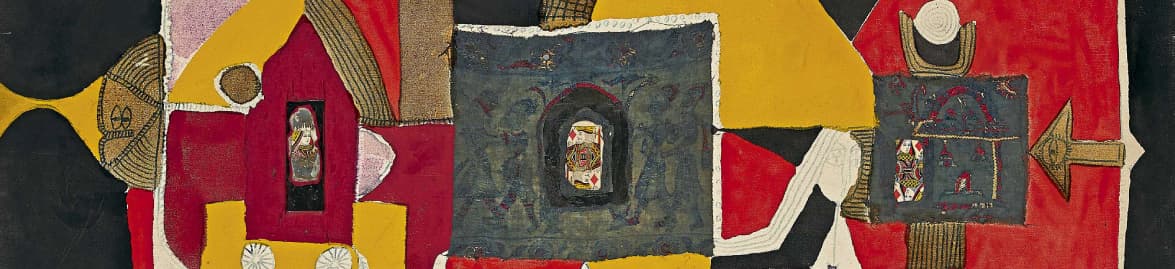
Prabhakar Barwe, a prominent figure in Indian modern art, is renowned for his dedicated exploration of abstract art that transcends cultural and geographical confines. Departing from both colonial academic conventions and traditional Indian miniature styles, Barwe fashioned a distinctive aesthetic blending global modernist principles with deep metaphysical contemplation. His artistic journey embodies a quest to distill universal human experiences into pure forms of color, space and symbolism.
Early Life and Inspirations
Prabhakar Barwe, born in Nagaon, Maharashtra, belonged to a family with a rich artistic heritage, including his granduncle, the sculptor Vinayak Pandurang Karmarkar. While studying at Mumbai’s Sir J.J. School of Art from 1954 to 1959, he rebelled against the institution's focus on realistic figurative art. A pivotal moment came when he encountered the watercolors of Paul Klee, which showcased floating motifs and transparent surfaces, inspiring Barwe's shift towards abstraction. Influenced by Klee's work rooted in fundamental form principles, Barwe came to believe that art could tap into a "shared subconscious" transcending national boundaries.
 Exploration of Symbolism and Textile Design
Barwe's time at the Weavers’ Service Centre in Varanasi from 1961 to 1965 was transformative. Collaborating with artists like K.G. Subramanyan, he delved into Tantric philosophy while designing textiles. Although not a practitioner of Tantra, he reinterpreted its geometric symbolism—such as mandalas, yantras, and primal shapes—as universal vessels for human experiences. This period marked the genesis of his "Neo-Tantra" approach, where ritualistic forms became channels for existential contemplation.
Development of a Unique Artistic Vocabulary
Barwe's artistic style evolved through four distinct phases, each refining his abstract language:
- Late 1960s: Geometric archetypes imbued with Tantric symbolism, depicted in opaque watercolors.
- 1970s: Phallic forms and cosmic icons rendered in glossy enamel to capture the luminosity of watercolors, creating a sense of tactility.
- 1980s: Isolation of everyday objects like safety pins, lemons, and combs against expansive empty backgrounds to transform them into meditative symbols.
- 1990s: Metaphysical landscapes featuring staircases, clocks, and boxes suspended in ethereal gradients, exploring emptiness as a space for imaginative contemplation during his confinement due to asthma.
Manipulation of Space and Objects
Central to Barwe's universalist approach was his manipulation of spatial relationships. By isolating objects against void-like backgrounds, he destabilized their literal meanings, creating what he termed an "irrational arrangement." Influenced by Zen minimalism, this technique allowed mundane items to resonate as archetypes, transcending their everyday significance. His subdued color palettes and glossy finishes enhanced the meditative quality of his works, setting him apart from his contemporaries driven by narrative elements.
Global Recognition and Influence
Barwe's artistic contributions received international acclaim, including the Yomiuri Shimbun Award in 1969, Lalit Kala Akademi National Award in 1976, and exhibitions at prestigious venues like New York’s Grey Art Gallery, Washington’s Hirshhorn Museum, and the Tokyo Biennale. His treatise "Kora Canvas" emphasized the power of unpainted space in art, highlighting the convergence of artist and viewer in the creative process.
Legacy and Continuing Impact
Despite his premature passing in 1995, Prabhakar Barwe legacy endures through retrospectives and exhibitions reaffirming his significance in the art world. His ability to transform confinement into creative liberation was showcased in exhibitions like "Inside the Empty Box." By bridging Tantric metaphysics, Pop Art object fetishism, and surrealist poetics, Barwe demonstrated abstract art's capacity to articulate shared human consciousness transcending cultural boundaries.
In conclusion, Barwe's enduring legacy underscores art's ability to forge connections through profound emptiness. By transcending the boundaries between the concrete and abstract, he revealed the extraordinary within the ordinary, inviting viewers into a perpetual dialogue where meaning unfolds continuously. In his artistic universe, form was not merely visual but palpable, fostering a dialogue where meaning evolves endlessly.




