rasik raval’s folk motifs: connecting warli, bhimbetka & modern painting
.jpg&w=3840&q=75)
Rasik Durgashanker Raval (1928–1980) stands as a seminal figure in Indian modernism who forged a distinct visual language by weaving the ancient and indigenous into the fabric of twentieth-century art. Born in Gujarat and trained at the Sir J. J. School of Art in Mumbai, Raval grappled with the need to articulate a modern expression that remained connected to India’s cultural roots. His artistic journey was marked by sustained experimentation with folk and tribal visual idioms as a source of freshness, authenticity, and cultural continuity in modern painting.
Ancient Echoes: Bhimbetka and the Roots of Indian Visual Culture
Long before formal art institutions existed in India, early humans painted their experiences directly onto rock surfaces. The Bhimbetka rock shelters in present-day Madhya Pradesh offer some of the earliest examples of human artistic expression in South Asia, with painted motifs dating back to at least 10,000 BCE. These prehistoric paintings depict dancing figures, hunting scenes, animals, and communal rituals, rendered in linear and rhythmic forms that convey movement, vitality, and collective life.
Despite the vast distance in time, the geometric simplicity, rhythmic dynamism, and communal spirit visible in Bhimbetka paintings resonate strongly with later folk traditions such as Warli painting. These early visual practices establish a foundational grammar of Indian art, one that privileges symbolism, repetition, and an intimate relationship with nature and community life.
Warli Painting: Tribal Simplicity and Symbolic Expression
The Warli painting tradition of Maharashtra is one of India’s most enduring and recognizable tribal art forms. Characterized by simplified human and animal figures painted in white on earthen or ochre backgrounds, Warli art reflects daily life, agricultural cycles, rituals, and festivals. Artists rely on basic geometric shapes such as circles, triangles, and lines to depict complex social structures and cosmic beliefs.
The visual parallels between Warli paintings and Bhimbetka rock art are striking. Both employ reduced forms, rhythmic repetition, and narrative scenes rooted in shared human activity. Rather than individual expression, these traditions emphasize collective experience, reinforcing a worldview in which art functions as a social and cultural act rather than a purely aesthetic one.
 Rasik Raval’s Artistic Synthesis
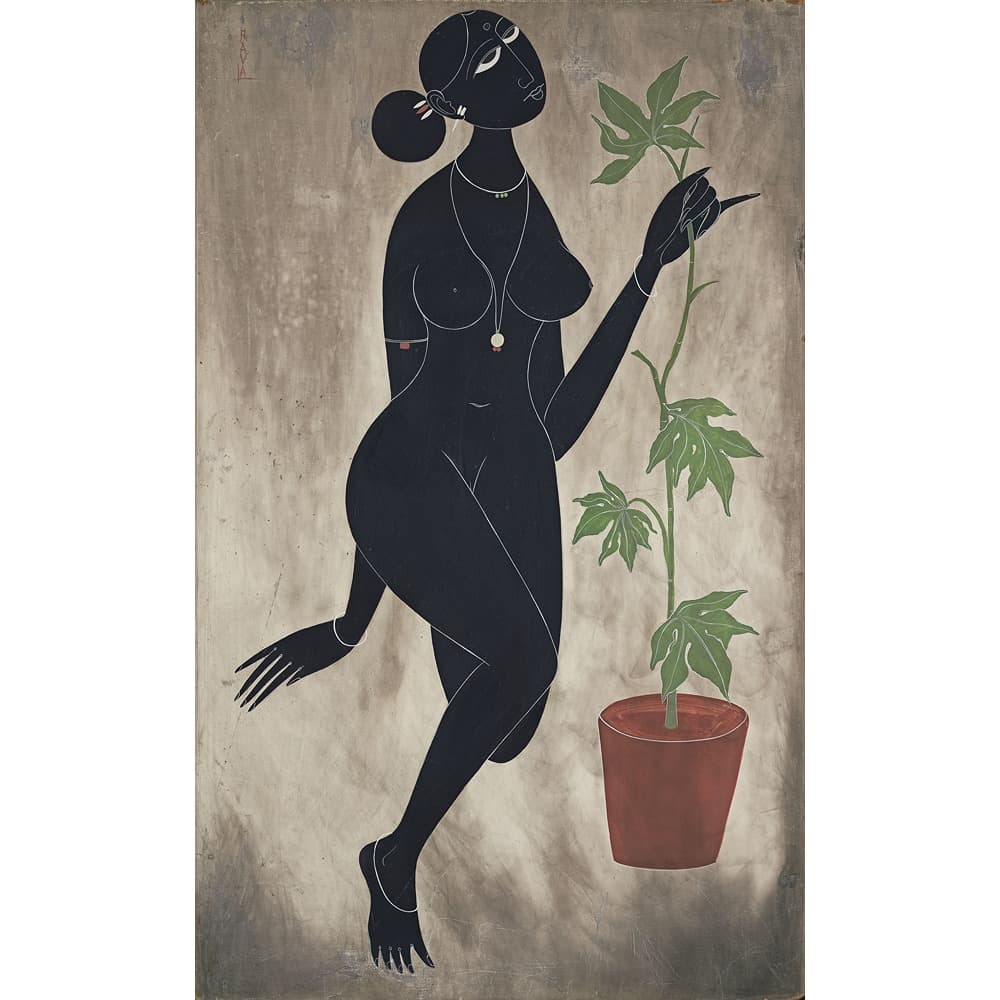
Rasik Raval’s contribution to modern Indian art lies in his ability to absorb the essence of folk and prehistoric traditions without replicating them directly. He engaged deeply with tribal life and visual culture, drawing inspiration from dancers, village women, birds, animals, and everyday rural scenes. These motifs echo both Warli imagery and the primal vitality of Bhimbetka paintings.
However, Raval reimagined these influences through a modernist lens. His figures are elongated and lyrical, often rendered in flat planes of vibrant color with flowing, calligraphic lines. Forms are simplified yet expressive, maintaining symbolic clarity while achieving compositional sophistication. Rather than functioning as ethnographic documentation, his paintings operate as poetic reinterpretations of indigenous visual memory.
The Poetics of Form: Meaning in Raval’s Paintings
Raval’s work exists at the intersection of memory, myth, and modernity. By integrating folk motifs reminiscent of Warli painting and the elemental forms of prehistoric cave art, he articulated a vision of Indian identity that was forward-looking rather than nostalgic. His paintings acknowledge ancient visual traditions while engaging confidently with global modernist aesthetics.
Several recurring elements define this synthesis. Collective movement and communal rituals appear frequently, recalling the dance scenes of both Warli art and Bhimbetka caves. Minimalist forms carry symbolic weight, allowing universal themes to emerge through economy of line and color. Rhythmic repetition structures his compositions, creating visual harmony while echoing traditional narrative modes.
Legacy and Cultural Significance
Rasik Raval received significant recognition during his lifetime, including awards from the Bombay Art Society, Lalit Kala Akademi, and the Academy of Fine Arts, Calcutta. His works are held in major institutional and private collections and continue to be studied for their refined balance between indigenous tradition and modern artistic practice.
More importantly, Raval’s art offers a compelling model of culturally grounded modernism. His engagement with folk and prehistoric sources demonstrates how ancient visual knowledge systems can be transformed into contemporary artistic language without losing their integrity or symbolic power.
Conclusion
Rasik Raval’s artistic vision establishes a meaningful dialogue across time. By drawing upon the folk simplicity of Warli painting and the primal energy of Bhimbetka rock art, he created a modern pictorial language rooted in deep cultural memory. His work affirms that modern Indian painting need not sever ties with indigenous traditions. Instead, it can evolve through them, achieving continuity, relevance, and expressive depth within a contemporary framework.