reba hore’s artistic journey: from economics graduate to renowned painter
.jpg&w=3840&q=75)
Reba Hore (1926 – 2008) was an Indian painter, sculptor and print-maker whose work spanned water-colours, mixed media, oil, pastels and terracotta. Her art is rooted in daily life, emotional reflection, and the human condition, often with a spontaneous, expressionistic touch. Though she was married to the well-known artist Somnath Hore, her own voice and practice have gradually been rediscovered and appreciated.
Early Life
Reba Hore was born in 1926 in Bengal (West Bengal, India). She initially completed a graduation in Economics before shifting to pursue art. She became politically active at a young age and joined the Indian Communist movement, reflecting her early awareness of social issues. The experiences of her time, including witnessing the Bengal Famine of 1943 and the broader social upheavals, left an imprint on her later work.
Later Life & Death
In the 1960s and beyond, Reba Hore lived and worked in places that shaped her creative trajectory: Kolkata, New Delhi and notably Santiniketan. Her time in Santiniketan (from the late 1960s) proved significant, as it opened up new encounters, materials and ideas. Later in life, she dealt with health issues, for instance an allergy that forced a change in medium, and personal loss, including the death of her husband in 2006. She passed away in 2008.
Family
Reba Hore was married to Somnath Hore (1921-2006), the prominent sculptor and print-maker. They had a daughter, Chandana Hore, who is also an artist. Throughout her life, Reba balanced her own art-practice with familial roles, domestic responsibilities and the influence of being married to a major artist-figure. Oft-commented that her visibility was overshadowed by her spouse, the reconsideration of her work has become part of the discourse of women artists in India.
Education
Reba Hore completed her undergraduate degree in Economics, and then studied art at the Government College of Art & Craft, Kolkata. Her formal art education gave her the skills and means to engage with modernist idioms, but her practice remained deeply personal and rooted in lived experience rather than purely formal concerns.
Painting Styl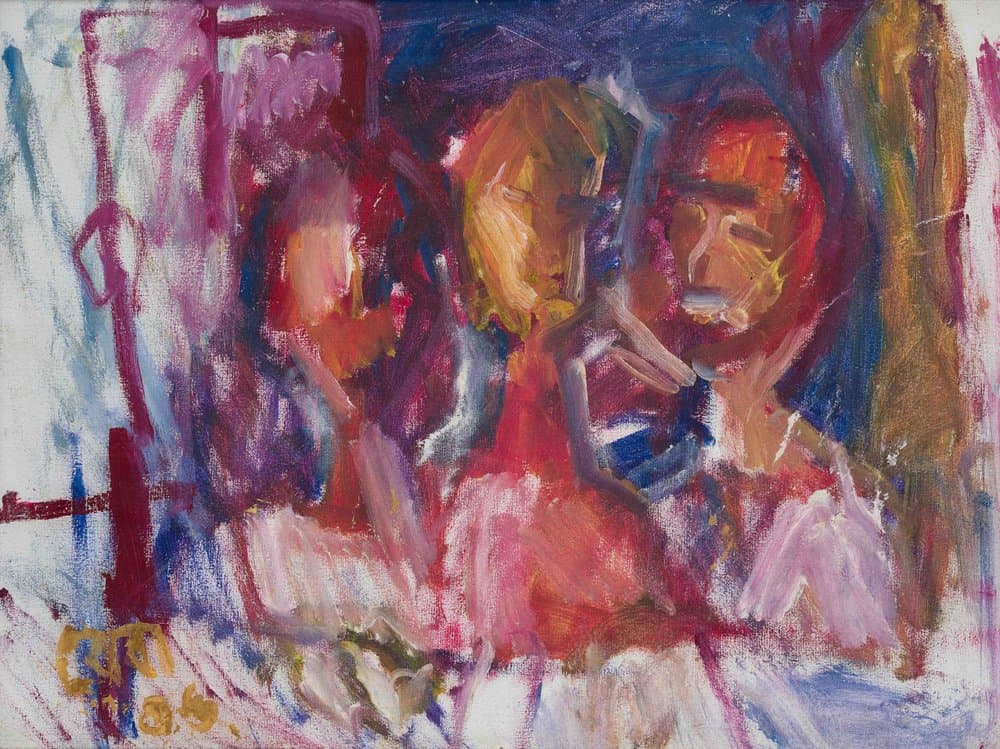 e
e
Reba Hore's art style is marked by spontaneity, emotional directness and a strong descriptive line. She worked across multiple media: oils, pastels, mixed media, terracotta sculpture. In her earlier years she painted domestic scenes, women at work, animals, daily life; in later years she shifted to more abstracted, expressionist, and sometimes surreal forms. Her process included improvisation and intuition: as she once said, “My paintings have a lot of spontaneity about them. There is a concept … but it only arises as a motive, a goal, an aim.”
Famous Paintings
Reba Hore's famous paintings include:
• Diary of the Broken Leg – a sequence of works (drawings, pastels, poems) created during a long convalescence in 2004.
• Works exhibited in I Grow More and More (2021, Mumbai) which covered works from the 1950s to the 1990s, including terracotta sculptures.
• Several untitled oil on canvas pieces of the 1960s-70s that depict domestic space, women with utensils, animals, executed with bold brush strokes and colour.
Characteristic Features of Her Paintings
• S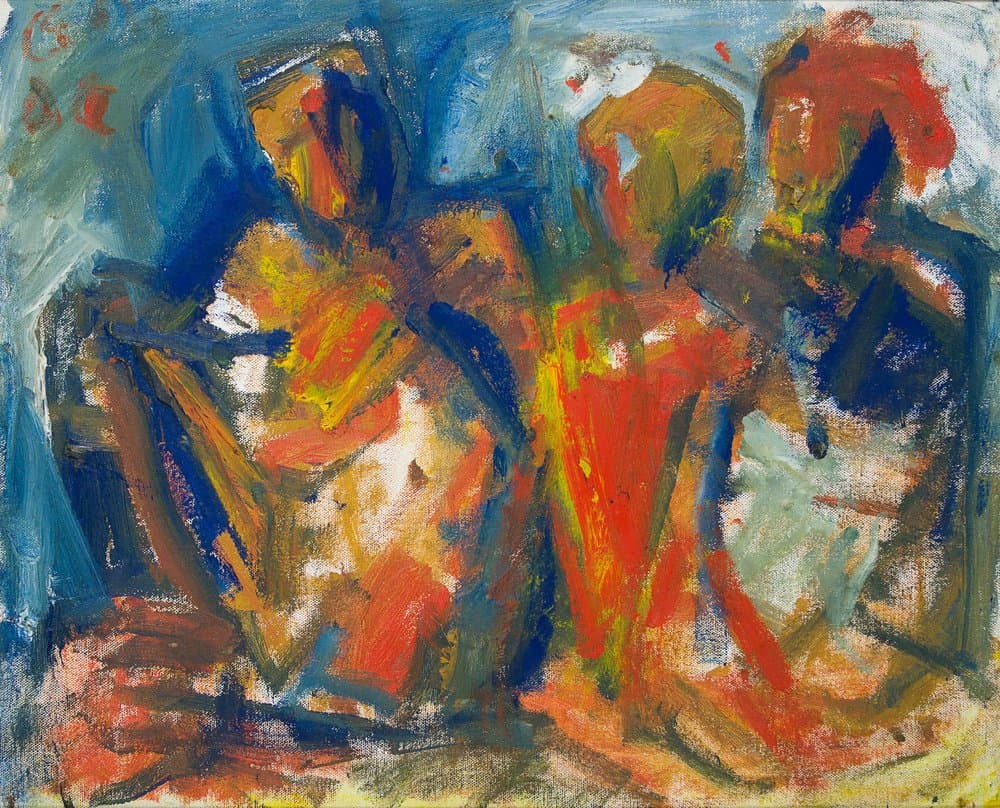 trong line and expressive mark-making: Her drawings and pastels often feature bold, sometimes jagged lines that convey emotional force.
• Rooting in lived experience: Many works depict domestic labour, animals, everyday scenes, but these are rendered with emotional depth, not mere genre scenes.
• Transition from figuration to abstraction: In later years her art moved from representation to more abstracted forms, textures, and materials.
• Use of multiple media and material experiment: Terracotta sculptures, encaustic (wax) works, mixed media pieces mark her willingness to explore.
• Emotional intensity and introspection: Works like the Diary of the Broken Leg show how physical pain, ageing, illness translate into visual and poetic forms.
Contribution in Indian Art
Reba Hore contributed to Indian art in several important ways:
• She provides a distinctive voice of a woman artist working in the modern/post-modern transition in India, often overshadowed by male peers but now being rediscovered.
• Her work engages with social issues (famine, labour, domesticity) through personal expression rather than overt political messaging, thereby offering a bridge between the social conscious modernism of Bengal and more introspective contemporary art.
• By experimenting with materials and modes (drawing, terracotta, encaustic, mixed media), she helped expand what Indian art of her generation could include.
• Her example contributes to the reconsideration of women’s artistic labour in India , both the creative and the domestic , and the integration of the two.
Enduring Legacy & Impact
Though she was long under-recognised, since the 2010s there has been a growing revival of interest in her work. Her rediscovery helps correct art-historical omissions regarding women artists in India, particularly those who balanced domestic responsibilities with serious art-practice. Her legacy also lies in the way she transformed personal experience, pain, ageing, everyday life, into art, thereby contributing to a more inclusive and humanist understanding of Indian modernism. Today her works are exhibited, collected, and studied more widely, and she is increasingly referenced in discussions of Indian women’s art.
Exhibitions
• The Broken Foot Journal and Other Stories, Experimenter, Kolkata (2021) – retrospective bringing together oil paintings, drawings and terrace works.
• I Grow More and More – Reba Hore, Akara Art, Mumbai (2021) – solo show of her works from the 1950s–1990s including terracotta sculptures.
• Do You Know How To Start a Fire?, Experimenter – Kolkata (Sept–Nov 2024) – solo exhibition revisiting her oeuvre.
Awards
Records of major awards specific to Reba Hore are less prominent in public sources than those of some of her contemporaries. However, she is increasingly given recognition in institutional and gallery-contexts for her contribution. (Sources do not list a widely recognised national award for her at the time of writing.)
Conclusion
Reba Hore stands as a quietly powerful figure in Indian art , someone whose art emerged from the everyday, from the body, from experience, and yet whose voice is deeply felt. She challenges the idea that compelling art must always be monumental or loudly declared; in her hands, the domestic, the personal, the intimate become sources of artistic vitality. As her work receives renewed attention, it enriches our understanding of Indian modernism and the many artists who contributed to it but were given less visibility.
Lesser-Known Facts
• During a period of convalescence in 2004 after breaking her leg for the third time, she created the Diary of the Broken Leg, composed of drawings, poems and reflections, turning pain into art.
• Owing to an allergy to oil paints later in life, she shifted her material practice to wax (encaustic), pastels and mixed media.
• Though married to a celebrated male artist, she maintained a distinct voice: she is described as “a moving river” compared to her husband’s fiery nature.
• Much of her work remained unseen or under-valued during her lifetime; only in recent years has a reassessment of her practice taken place in major exhibitions.
• Her inclusion of terracotta sculpture alongside painting and drawing broadens the way we might think of her, beyond the label “painter” to a multi-media artist.