


rekha rodwittiya: the feminist voice in indian contemporary art
.jpg&w=3840&q=75)
Rekha Rodwittiya (born 31 October 1958) is a celebrated Indian contemporary artist, educator, curator and feminist voice. Her work is deeply rooted in figurative narrative, with allegorical, surreal and magical-realist elements combined with thematic concern for gender, identity, daily life and resistance. Based in Vadodara (Baroda), she is associated with the Baroda School of art and has over four decades of practice.
Early Life
Rekha Rodwittiya was born in Bengaluru, Karnataka, India on 31 October 1958. Her family moved to Baroda (now Vadodara) in 1967, where she was mainly brought up. She comes from a liberal-minded urban middle-class background, which allowed her considerable freedom of thought and creative pursuit from a young age. As a child she was clear about her inclination towards art, she has recalled that at age five she “knew she would be a painter.”
Later Life
After completing her education (see below), Rekha Rodwittiya settled in Baroda and established her practice there. She founded and runs the studio-space The Collective Studio, Baroda (with her husband) to mentor younger artists and provide an alternative art-education environment. Over the years she has exhibited widely in India and abroad, taken up residencies, and built her voice as an educator and feminist-artist-curator. Her work continues to evolve, exploring new media, autobiographical traces and socio-political narratives.
Family
Rekha Rodwittiya’s parents are Ardishar and Komala Palamkote. Her family moved to Baroda when she was young. She is married to artist Surendran Nair and together they run The Collective Studio in Baroda.
Education
• From 1976 to 1981, she did her BFA (Painting) at the Faculty of Fine Arts, M.S. University of Baroda, Baroda (now Vadodara).
• In 1982, she was awarded the prestigious Inlaks scholarship to study MA Painting at the Royal College of Art in London, which she completed in 1984.
• During her Baroda schooling she also studied photography under Prof. Jyoti Bhatt and was influenced by teachers including Nasreen Mohamedi.
Painting Style
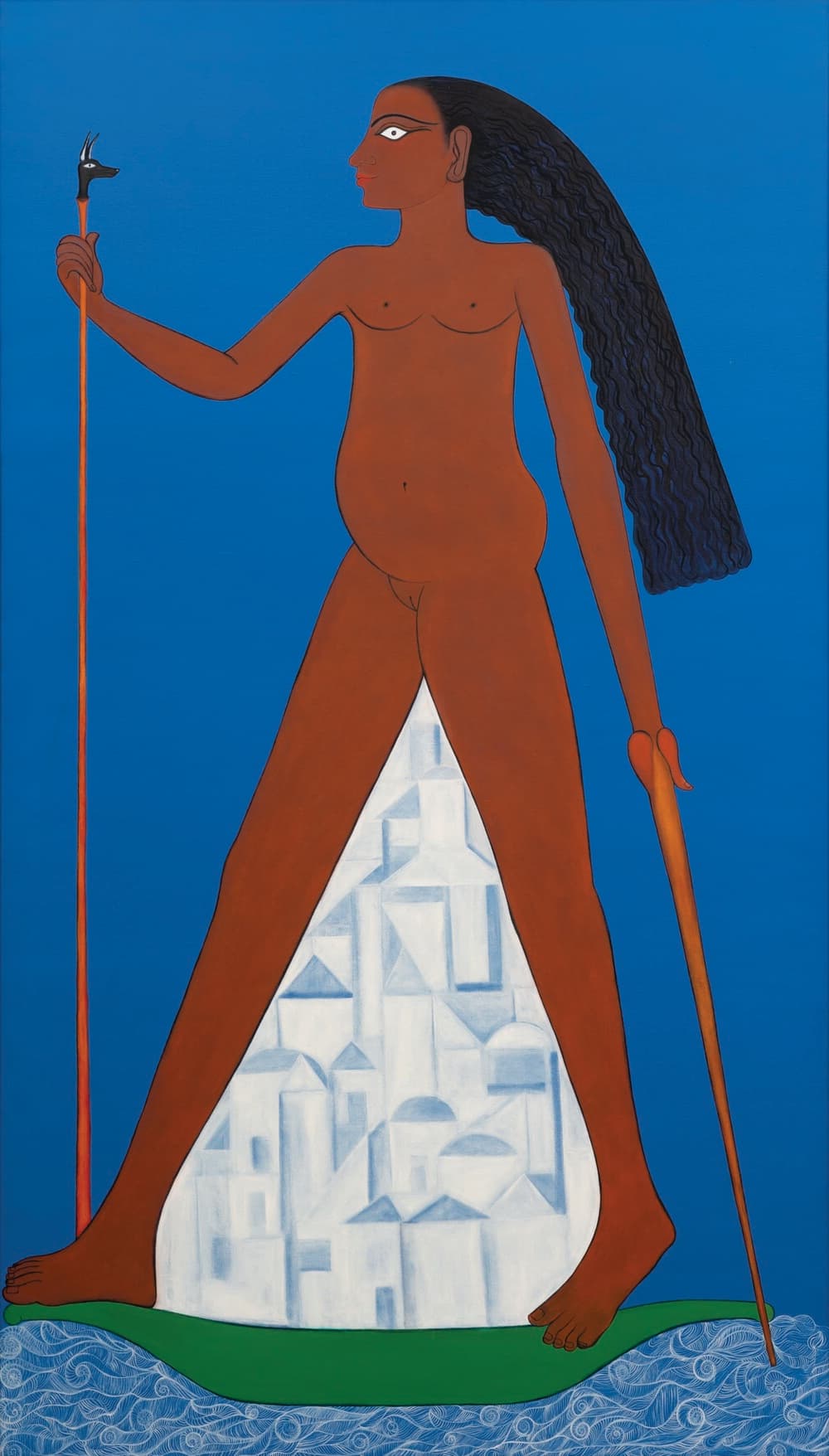 Rekha Rodwittiya’s style combines figurative representation with allegory, myth, symbolism and magical realism. She draws from the narrative tradition of the Baroda School, yet situates her work firmly within feminist, socio-political and autobiographical registers. Her canvases often feature a strong female protagonist, rendered in bold colours, often frontal gaze, occupying central space, against backgrounds full of domestic objects, animals, tools, symbolic motifs. She uses oil, acrylic, mixed media, prints and watercolour across various periods.
Famous Paintings
Rekha Rodwittiya's famous paintings include:
• The Quilt Makers (1996-97): Acrylic & oil on canvas, depicting two sisters quilt-making; vivid red and blue palette; commanding gaze of the women.
• Untitled (The Fire Eater) (1995): Oil on canvas, compact size, evocative of inner transformation.
• Telling Stories (1995): Oil on canvas, exploring narratives of women and voice.
• The Visitation (1986): Mixed media on paper, now in the National Gallery of Modern Art, New Delhi collection (Accession NGMA-12536).
Characteristic Features of Her Paintings
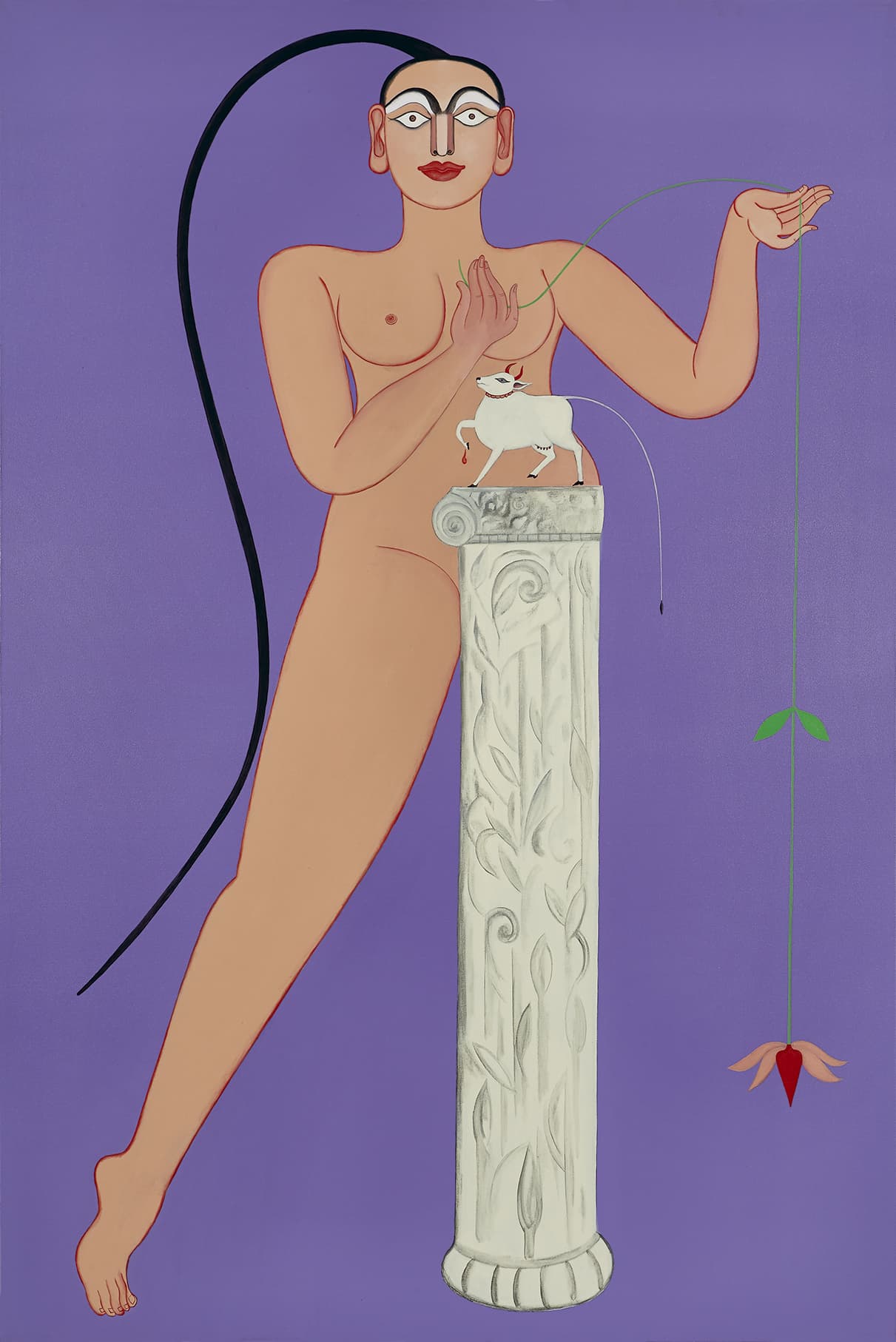 • Female central figure: The woman is not object, but subject frontal or boldly placed, often looking back at viewer.
• Domestic and mundane objects: Sewing machines, scissors, keys, birds, fish, threads everyday items become symbolic of female labour, memory, agency.
• Bold, flat colour fields + narrative detail: Figures stand out against saturated backgrounds; patterns and motifs often drawn from folk, myth, or craft.
• Surreal / magical realist ambience: The image may read as everyday scenario yet layered with metaphor; space may distort or flatten; meaning remains open.
• Feminist gaze: She actively challenges voyeuristic view of women; her works demand engagement rather than passive consumption.
Contribution in Indian Art
Rekha Rodwittiya carries forward the legacy of the Baroda School while innovating through her unique feminist vision and figurative language. She played a crucial role in creating supportive spaces for emerging artists and has significantly contributed to the discourse on gender and identity in Indian art. Her paintings continue to be celebrated internationally for their emotional intensity and socio-political engagement.
Exhibitions
Rekha Rodwittiya has held numerous solo and group exhibitions nationally and internationally. Some highlights:
• Solo exhibitions: Urja Art Gallery, Baroda (1982); Art Heritage, New Delhi (1985); Cymroza Art Gallery, Mumbai (1985, 1990); Gallery Sassi, Stockholm (1988); Apparao Galleries at Gallery 678, New York (1997).
• Recent major show: Rekha@Sixty: Transient Worlds of Belonging at Sakshi Gallery, Mumbai (2018) marking six decades of her work.
• She has also taken part in major residencies: Geneva, Stockholm, New York, London among others.
Awards
• 1981 Inlaks Scholarship for MA Painting, Royal College of Art, London
• 1982 Unilever Painting Award, Royal College of Art
• 1990 Rockefeller Foundation Asian Cultural Council Fellowship to work in New York
• Her academic and fellowship awards attest to her international stature and artistic excellence.
Conclusion
Rekha Rodwittiya stands as a pioneering figure in contemporary Indian art, whose work transcends traditional boundaries with a lucid feminist voice and artistic mastery. Her evocative figurative paintings not only narrate personal journeys but also speak to wider social injustices, making her an enduring influence in Indian and global art scenes.
Lesser-Known Facts
• During her student days, Rekha was financially independent through selling her photography, a skill she learned from her mentor Jyoti Bhatt.
• She briefly experimented with film and video during her studies in London before fully dedicating herself to painting.
• Rekha Rodwittiya's use of the color red relates deeply to South Asian ritualistic symbolism representing violence, passion, fertility, and feminine strength.




